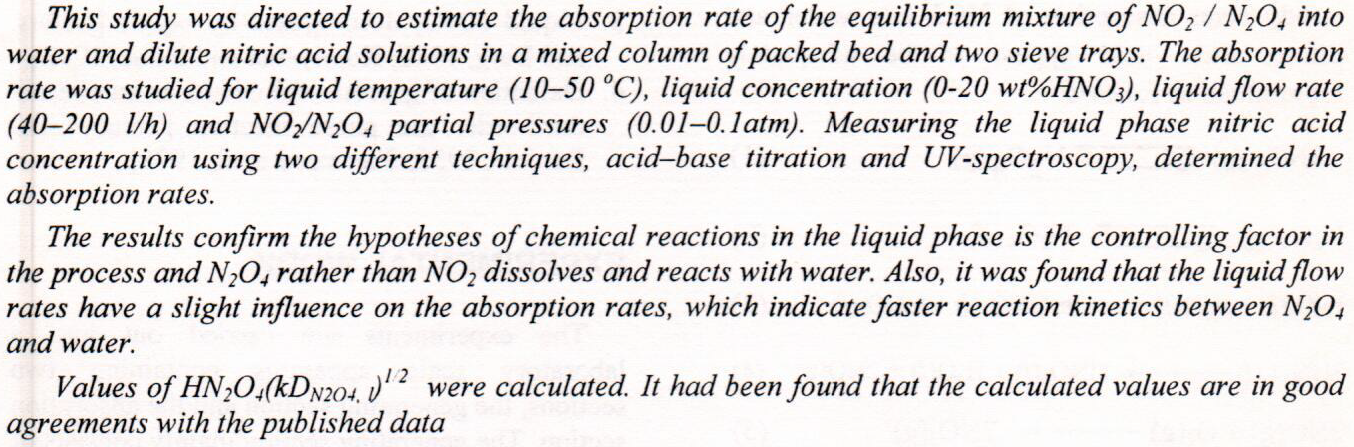
Absorption of NO2 into Water and Nitric Acid Solutions in a Fixed Column

Background: One of the drawbacks of vital teeth bleaching is color stability. The aim of the present study was to evaluate the effects of tea and tomato sauce on the color stability of bleached enamel in association with the application of MI Paste Plus (CPP-ACPF). Materials and Methods: Sixty enamel samples were bleached with 10% carbamide peroxide for two weeks then divided into three groups (A, B and C) of 20 samples each. After bleaching, the samples of each group were subdivided into two subgroups (n=10). While subgroups A1, B1 and C1 were kept in distilled water, A2, B2, and C2 were treated with MI Paste Plus. Then, the samples were immersed in different solutions as follow: A1 and A2 in distilled water (control); B1 and B2 in black
... Show More
This study was conducted to study the cytogenetic effect of both alcoholic and water extracts of propolis on mice. Three different samples of propolis were collected from three different regions of Iraq (Najaf, Arbil and Baghdad) to be used in this study. The cytotoxic effect of two different doses of each extracted sample was measured by employing cytogenetic analysis which included (mitotic index (MI), chromosomal aberrations (CAs), micronucleus index (MN) and sperm abnormalities). Results showed that significant increase in MI and significant reduction in MN, CAs and sperm abnormalities percentage were seen after treatment with both alcoholic and water extract of the three samples when compared with negative control, and alcoholic extrac
... Show MoreTo achieve safe security to transfer data from the sender to receiver, cryptography is one way that is used for such purposes. However, to increase the level of data security, DNA as a new term was introduced to cryptography. The DNA can be easily used to store and transfer the data, and it becomes an effective procedure for such aims and used to implement the computation. A new cryptography system is proposed, consisting of two phases: the encryption phase and the decryption phase. The encryption phase includes six steps, starting by converting plaintext to their equivalent ASCII values and converting them to binary values. After that, the binary values are converted to DNA characters and then converted to their equivalent complementary DN
... Show More (3)
(3)
 (1)
(1)

Gas lift is one of the oldest methods used to produce hydrocarbon fluids from wells experiencing declining production. It works by aerating the mixture inside production tubing and forcing it to the surface. One of the reasons for declining production in oil wells is an increase in water cut or a drop in reservoir pressure, which requires one of the artificial lift methods to restore production. (A) oil field suffers from an increase in water cut, which has affected well productivity. The wells under study have a water cut of up to 66%, resulting in very low production rates. In this research, Pipesim software was used to build a physical and fluid model, then design an optimal gas lift system that achieves the highest possible prod
... Show More
The probability is considered one of the grammatical cases in all languages of the world. Expressions of probability in Spanish language are expressed by various structures, expressions and some verb tenses. By this study explains the grammatical cases, the verbal periphrases, the impersonal expressions, the future tenses (simple and perfect) and the conditional mode of probability in Spanish language .We have explains these cases in detail with examples that have extracted from various spanish grammar books .The specific objective of this study is to know the resources and constructions of probability in Spanish language and their translation in Arabic language.
One of the most common procedures in oral surgery is the removal of impacted mandibular third molars, often followed by pain, swelling, alveolitis, and trismus. Purpose. To compare the outcomes of the intrasocket application of 1% hyaluronic acid oral gel (HA) and advanced platelet-rich fibrin (A-PRF) on the expected postoperative complications, pain, swelling, and trismus follow the surgical extraction of the impacted mandibular third molar. Material and Methods. A randomized controlled trial was conducted at the Oral and Maxillofacial Surgery Unit, Dental Teaching Hospital. Healthy patients who required surgical removal of the impacted mandibular third molar were divided randomly into three groups. The extraction site of the group
... Show More
(10)
(6)
