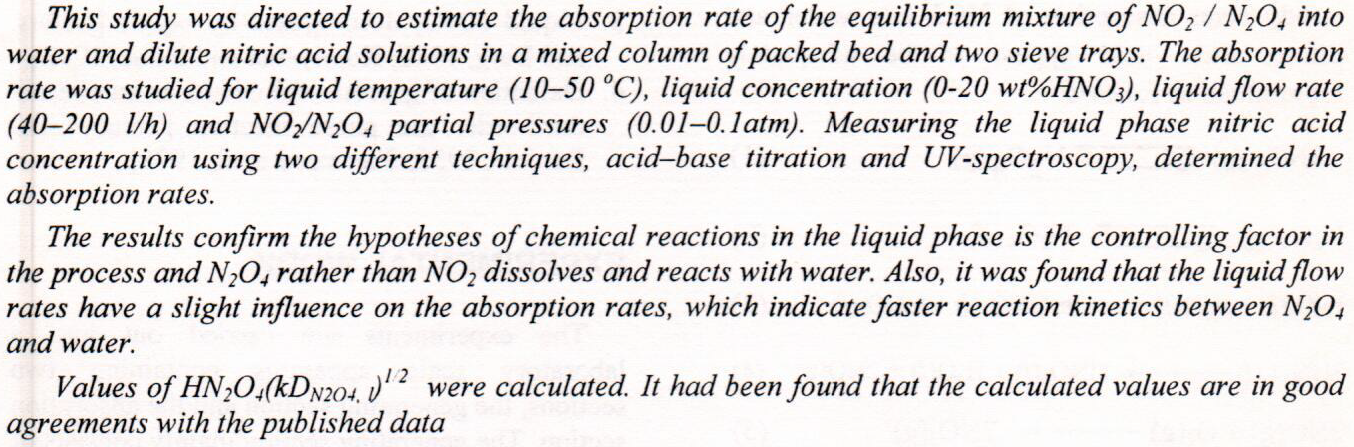
Absorption of NO2 into Water and Nitric Acid Solutions in a Fixed Column

Poly (viny1 alcohol) (PVA) of 72000 g mol -1 molar mass was cross linked through cold cast esterification with different mol % of MA and EDTA (10 % , 20 % and 30 % ), and two different mol % mixture of MA l EDTA (20 %/5% and 20%/10% .
ENGLISH
 (1)
(1)

In the present study, an attempt has been to develop a new water quality index (WQI) method that depends on the Iraqi specifications for drinking water (IQS 417, 2009) to assess the validity of the Euphrates River for drinking by classifying the quality of the river water at different stations along its entire reach inside the Iraqi lands. The proposed classifications by this method are: Excellent, Good, Acceptable, Poor, and Very poor. Eight water quality parameters have been selected to represent the quality of the river water these are: Ion Hydrogen Concentration (pH), Calcium (Ca), Magnesium (Mg), Sodium (Na), Chloride (Cl), Sulphate (SO_4), Nitrate (NO_3), and Total Dissolved Solids (TDS). The variation of the water quality parameters
... Show MoreIn the present study, an attempt has been to develop a new water quality index (WQI) method that depends on the Iraqi specifications for drinking water (IQS 417, 2009) to assess the validity of the Euphrates River for drinking by classifying the quality of the river water at different stations along its entire reach inside the Iraqi lands. The proposed classifications by this method are: Excellent, Good, Acceptable, Poor, and Very poor. Eight water quality parameters have been selected to represent the quality of the river water these are: Ion Hydrogen Concentration (pH), Calcium (Ca), Magnesium (Mg), Sodium (Na), Chloride (Cl), Sulphate (SO_4), Nitrate (NO_3), and Total Dissolved Solids (TDS). The variation of the water quality p
... Show More
(24)
Fusidic acid (FA) is a well-known pharmaceutical antibiotic used to treat dermal infections. This experiment aimed for developing a standardized HPLC protocol to determine the accurate concentration of fusidic acid in both non-ionic and cationic nano-emulsion based gels. For this purpose, a simple, precise, accurate approach was developed. A column with reversed-phase C18 (250 mm x 4.6 mm ID x 5 m) was utilized for the separation process. The main constituents of the HPLC mobile phase were composed of water: acetonitrile (1: 4); adjusted at pH 3.3. The flow rate was 1.0 mL/minute. The optimized wavelength was selected at 235 nm. This approach achieved strong linearity for alcoholic solutions of FA when loaded at a serial concentrati
... Show More (5)
(3)
(5)
(3)

This paper presents a computer simulation model of a thermally activated roof (TAR) to cool a room using cool water from a wet cooling tower. Modeling was achieved using a simplified 1-D resistance-capacitance thermal network (RC model) for an infinite slab. Heat transfer from the cooling pipe network was treated as 2-D heat flow. Only a limited number of nodes were required to obtain reliable results. The use of 6th order RC-thermal model produced a set of ordinary differential equations that were solved using MATLAB - R2012a. The computer program was written to cover all possible initial conditions, material properties, TAR system geometry and hourly solar radiation. The cool water supply was considered time
... Show MoreCombining different treatment strategies successively or simultaneously has become recommended to achieve high purification standards for the treated discharged water. The current work focused on combining electrocoagulation, ion-exchange, and ultrasonication treatment approaches for the simultaneous removal of copper, nickel, and zinc ions from water. The removal of the three studied ions was significantly enhanced by increasing the power density (4–10 mA/cm2) and NaCl salt concentration (0.5–1.5 g/L) at a natural solution pH. The simultaneous removal of these metal ions at 4 mA/cm2 and 1 g NaCl/L was highly improved by introducing 1 g/L of mordenite zeolite as an ion-exchanger. A remarkable removal of heavy metals was reported
... Show More
(2)
(2)
Combining different treatment strategies successively or simultaneously has become recommended to achieve high purification standards for the treated discharged water. The current work focused on combining electrocoagulation, ion-exchange, and ultrasonication treatment approaches for the simultaneous removal of copper, nickel, and zinc ions from water. The removal of the three studied ions was significantly enhanced by increasing the power density (4–10 mA/cm2) and NaCl salt concentration (0.5–1.5 g/L) at a natural solution pH. The simultaneous removal of these metal ions at 4 mA/cm2 and 1 g NaCl/L was highly improved by introducing 1 g/L of mordenite zeolite as an ion-exchanger. A remarkable removal of heavy metals was reported
... Show More
(2)
(2)
Water samples were collected from output of water for Al-Wahda plant where located in al-karrada area in Baghdad city to study water contamination with bacteria, fungi and Algae. The study lasted one year started on August, 2016 to July,2017.Results were acquired according to two tests performed, the first is biological test included total coliform,E.coli, pseudomonas aeruginosa, total fungi, Diatom and non Diatom Algae and the second is physiochemical test included temperature, turbidity and residual chlorine. The results of bacteria were within the permitted specification in the Iraqi standards no. 14/2270 for the year 2015 except August was exceeded the permitted standard for total coliform, it was 1.1< cell/100 ml.Total Fungi, Dia
... Show More