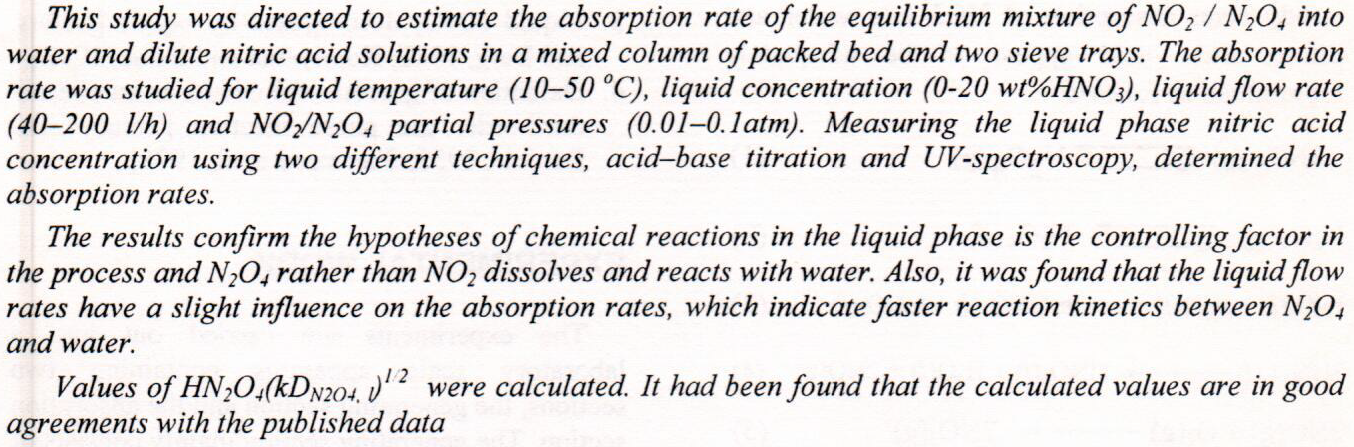
Absorption of NO2 into Water and Nitric Acid Solutions in a Fixed Column

High-performance liquid chromatographic methods are used for the determination of water-soluble vitamins with UV-Vis. Detector. A reversed-phase high-performance liquid chromatographic has been developed for determination of water-soluble vitamins. Identification of compounds was achieved by comparing their retention times and UV spectra with those of standards solution. Separation was performed on a C18 column, using an isocratic 30% (v/v) acetonitril in dionozed water as mobile phase at pH 3.5 and flow rate 1.0m/min. The method provides low detection and quantification limits, good linearity in a large concentration interval and good precision. The detection limits ranged from 0.01 to 0.025µg/ml. The accuracy of the method was
... Show More (4)
(4)

 (26)
(8)
(26)
(8)


A variety of oxides were examined as additives to a V2O5/Al2O3 catalyst in order to enhance the catalytic performance for the vapor phase oxidation of toluene to benzoic acid. It was found that the modification with MoO3 greatly promoted the little reaction leading to improve catalyst performance in terms of toluene conversion and benzoic acid selectivity. The effect of catalyst surface area, catalyst promoters, reaction temperature, O2/toluene, steam/toluene, space velocity, and catalyst composition to catalyst performance were examined in order to increase the benzoic acid selectivity and yield.
(1)
(1)
Modified asphalt is considered one of the alternatives to address the problems of deficiencies in traditional asphalt concrete, as modified asphalt addresses many of the issues that appear on the pavement layers in asphalt concrete, resulting from heavy traffic and vehicles loaded with loads that exceed the design loads and the large fluctuations in the daily and seasonal temperatures of asphalt concrete. The current study examined the role of polyphosphoric acid (PPA) as a modified material for virgin asphalt when it was added in different proportions (1%, 2%, 3%, 4%) of the asphalt weight. The experimental program includes the volumetric characteristics associated with the Marshall test, the physical properties, and th
... Show More
The current work discusses the removal of brilliant dyes. These dyes were Brilliant Cresyl Blue (BCB) and Brilliant Green (BG) by the use of poly acrylic acid hydrogel beads (PAA). We examined the adsorption isotherms and found that the factors preferring it are temperature and salt, shaking effects, wet PAA, (BCB) and (BG) follows Freundlich equation more than other equations. Based on the results, there is a positive correlation between adsorption of dyes (BCB and BG) and temperature (Endothermic process). We calculated the thermodynamic functions (ΔG, ΔS, and ΔH). The ion strength effects on the adsorptions at (20 °C) increased adsorption if the salt concentrations is high. We treated the kinetics outcomes based on Lagergren Equation
... Show More
(1)
The ceiling of the midbrain has a couple of optic lobes which are prominent and used as an optic center that reflex what it receives from eye retina fibers. The histology of optic tectum has been studied in Iraqi water snake natrix tesselata tesselata . It was found that the number of optic tectum were seven main strata organized from the outside to the inside as follows : the stratum zonula (SZ), the stratum opticum (SO), the stratum fibrosum et griseum superficialis (SFGS), the stratum griseum central (SGC), the stratum album central (SAC), the stratum griseum periventricular (SGP), and the stratum album periventricular (SAP). the three last strata consider deep layers on the optic tectum It was noticed that the thinnest strata was the fi
... Show More
(4)
(1)

