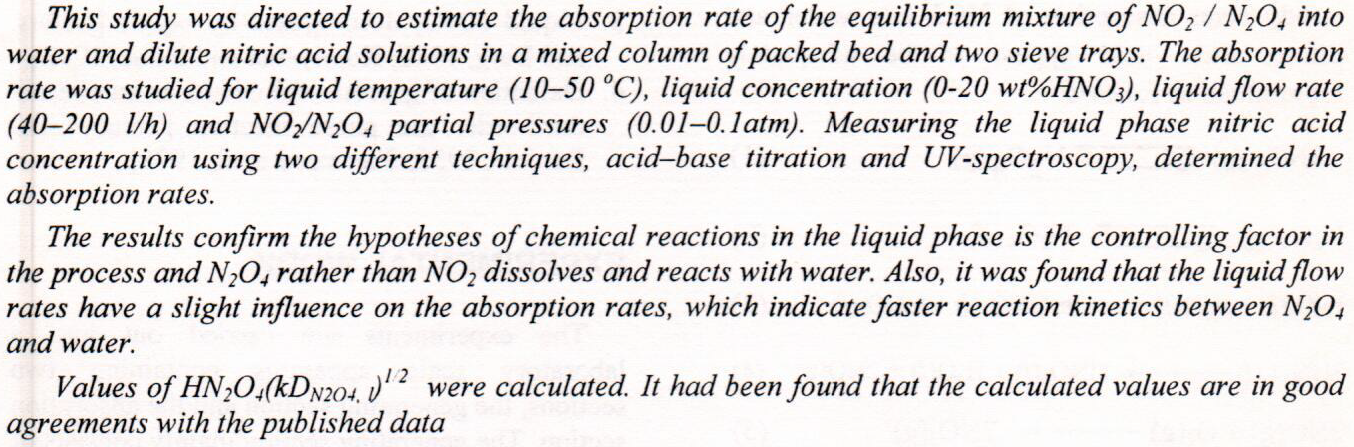
Absorption of NO2 into Water and Nitric Acid Solutions in a Fixed Column

In the present work, asphaltenes and resins separated from emulsion samples collected from two Iraqi oil wells, Nafut Kana (Nk) and Basrah were used to study the emulsion stability. The effect of oil resins to asphaltene (R/A) ratio, pH of the aqueous phase, addition of paraffinic solvent (n-heptane), aromatic solvent (toluene), and blend of both (heptol) in various proportions on the stability of emulsions had been investigated. The conditions of experiments were specified as an agitation speed of 1000 rpm for 30 minutes, heating at 50 °C, and water content of 30%. The results showed that as the R/A ratio increases, the emulsion will be unstable and the amount of water separated from emulsion increases. It was noticed that the em
... Show More (10)
(10)
 (9)
(9)



Abstract
This work involves studying corrosion resistance of AA 6061T6 butt welded joints using Two different welding processes, tungsten inert gas (TIG) and a solid state welding process known as friction stir welding, TIG welding process carried out by using Rolled sheet of thickness6mm to obtain a weld joint with dimension of (100, 50, 5) mm using ER4043 DE (Al Si5) as filler metal and argon as shielding gas, while Friction stir welding process carried out using CNC milling machine with a tool of rotational speed 1000 rpm and welding speed of 50mm/min to obtain the same butt joint dimensions. Also one of weld joint in the same dimensions subjected to synergistic weld
... Show More
(5)
(3)
(1)
(1)
The Iraqi marshes are considered the most extensive wetland ecosystem in the Middle East and are located in the middle and lower basin of the Tigris and Euphrates Rivers which create a wetlands network and comprise some shallow freshwater lakes that seasonally swamped floodplains. Al-Hawizeh marsh is a major marsh located east of Tigris River south of Iraq. This study aims to assess water quality through water quality index (WQI) and predict Total Dissolved Solids (TDS) concentrations in Al-Hawizeh marsh based on artificial neural network (ANN). Results showed that the WQI was more than 300 for years 2013 and 2014 (Water is unsuitable for drinking) and decreased within the range 200-300 in years 2015 and 2016 (Very poor water). The
... Show More
(1)
Water samples from a variety of sources in Kelantan, Malaysia (lakes, ponds, rivers, ditches, fish farms, and sewage) were screened for the presence of bacteriophages infecting
(11)
(8)
The Iraqi marshes are considered the most extensive wetland ecosystem in the Middle East and are located in the middle and lower basin of the Tigris and Euphrates Rivers which create a wetlands network and comprise some shallow freshwater lakes that seasonally swamped floodplains. Al-Hawizeh marsh is a major marsh located east of Tigris River south of Iraq. This study aims to assess water quality through water quality index (WQI) and predict Total Dissolved Solids (TDS) concentrations in Al-Hawizeh marsh based on artificial neural network (ANN). Results showed that the WQI was more than 300 for years 2013 and 2014 (Water is unsuitable for drinking) and decreased within the range 200-300 in years 2015 and 2016 (Very poor water). The develope
... Show More