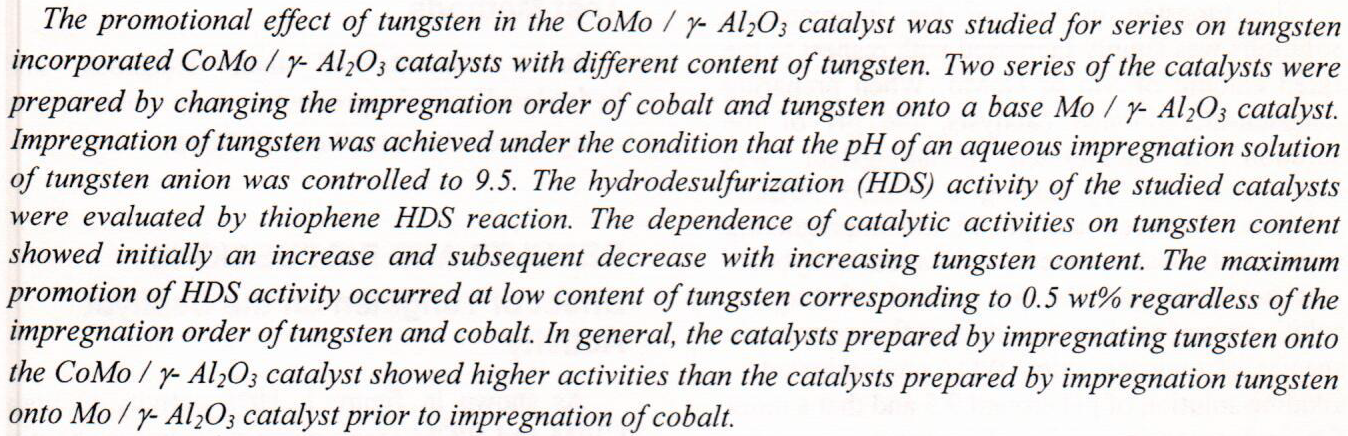
Tungsten Incorporated CoMo/γ-Al2O3 Hydrodesulfurization Catalyst

This study is concerned with the effect of adding two kinds of ceramic materials on the mechanical properties of (Al-7%Si- 0.3%Mg) alloy, which are zirconia with particle size (20μm > P.S ≥ 0.1μm) and alumina with particle size (20μm > P.S ≥ 0.1μm) and adding them to the alloy with weight ratios (0.2, 0.4, 0.6, 0.8 and 1%). Stirring casting method has been used to make composite material by using vortex technique which is used to pull the particles to inside the melted metals and distributed them homogenously.
After that solution treatment was done to the samples at (520ºC) and artificial ageing at (170ºC) in different times, it has been noticed that the values of hardness is increased with the aging time of the o
... Show MoreThis paper aims to study the chemical degradation of Brilliant Green in water via photo-Fenton (H2O2/Fe2+/UV) and Fenton (H2O2/Fe2+) reaction. Fe- B nano particles are applied as incrustation in the inner wall surface of reactor. The data form X- Ray diffraction (XRD) analysis that Fe- B nanocomposite catalyst consist mainly of SiO2 (quartz) and Fe2O3 (hematite) crystallites. B.G dye degradation is estimated to discover the catalytic action of Fe- B synthesized surface in the presence of UVC light and hydrogen peroxide. B.G dye solution with 10 ppm primary concentration is reduced by 99.9% under the later parameter 2ml H2O2, pH= 7, temperature =25°C within 10 min. It is clear that pH of the solution affects the photo- catalytic degradation
... Show More
 (1)
(1)
 (1)
(1)

When writing a text, such as a newspaper article, various types of discourse markers are frequently used to group sentences into paragraphs and parts in order to establish a discourse with certain functions, such as coordination, orientation, emphasizing the concepts presented, etc. It should also be noted that this type of mark exists in both written and spoken language. Therefore, it is convenient to dedicate a chapter to these linguistic elements to clarify their use and their classification, which is mainly based on Jose Portolés (2001), as well as the main features, specifically their features (prosodic, morphological, semantic and pragmatic).
Resumen
... Show More
This paper aims at providing the teaching staff members with the necessary skills so as to become capable of tackling various situations, and treating daily problems that face students learning Spanish as a Second Language. This is made as an attempt to make teachers of foreign languages in general acquainted with modern trends of teaching with less complicated methods, specifically in teaching e earlier stages of foreign languages.
Abstracto:
En el presente trabajo pretendemos dotar al docente no nativo de Lenguas extranjeras, con algunos de los métodos necesari
... Show More
Background: The PMMA polymer denture base materials are low in thermal and strength properties. The aim of the study was to investigate the change in glass transition temperature, E-Moudulus and coefficient of thermal expansion of acrylic denture base material by addition of Al2O3, TiO2 and SiO2nano-fillers in 5% by weight. Materials and methods: The type of polymerization is free radical bulk polymerization. one hundred twenty (120) specimens were prepared , the specimens were divided into four groups according to the material had been added (one control and three for Al2O3, TiO2 and SiO2nanocomposite) each group was subdivided in to three groups according to the test had been done on it, the degree of transition (Tg) was measured by The d
... Show MoreAs a result of industrial development, many types of waste are generated, some of which are discharged into water, causing water pollution and having a negative impact on life. The electro-Fenton process (EF) has verified high efficiency in treating pollutants with low cost, ease of handling and operation, and this technology is one of the more efficient advanced oxidation technologies. The main objective of this present work is to explore the efficiency of a three-dimensional Electro-Fenton system (3DEF) in removing eosin, methylene blue, and methylene violet from simulated wastewater using graphite as anode, nickel foam as the cathode, and alum sludge as the third particle and as the source of catalyst. The study investigated the effect o
... Show More
Background: Polymethyl methacrylate (PMMA) is the most commonly used material in denture fabrication. The material is far from ideal in fulfilling the mechanical requirements, like low impact and transverse strength, poor thermal conductivity. The purpose of this study was to evaluate the effect of addition a composite of surface treated Nano Aluminum oxide (Al2O3) filler and plasma treated polypropylene fiber (PP) on some properties of denture base material. Materials and methods: One hundred fifty prepared specimens were divided into 5 groups according to the tests, each group consisted of 30 specimens and these were subdivided into 3 groups (unreinforced heat cured acrylic resin as control group),reinforced acrylic resin with( 0.5%wt Nan
... Show MoreStructure type and disorder have become important questions in catalyst design, with the most active catalysts often noted to be “disordered” or “amorphous” in nature. To quantify the effects of disorder and structure type systematically, a test set of manganese(III,IV) oxides was developed and their reactivity as oxidants and catalysts tested against three substrates: methylene blue, hydrogen peroxide, and water. We find that disorder destabilizes the materialsthermodynamically, making them stronger chemical oxidantsbut not necessarily better catalysts. For the disproportionation of H2O2 and the oxidative decomposition of methylene blue, MnOx-mediated direct oxidation competes with catalytically mediated oxidation, making the most
... Show More
(25)
(27)

The use of foam electrodes as a cathode has proven its efficiency in wastewater treatment. In this study, methyl orange (MO) was treated by Electro-Fenton technology (EFT) using a copper foam (Cf) as a cathode. EFT was an advanced strategy for MO degradation, which accomplished excellent degradation efficiency (%ReMO) exceeded 98% over 35 min treatment period at prime conditions using 0.124 mM of iron salts (FeSO4.7H2O), 0.3 LPM of air flow, 0.2 mA/cm2 of current density (CD), and initial pH of 3.0. The outcomes showed that the air flow rate had the main impact on the %ReMO. Furthermore, the contribution of anodic oxidation (AO) to dye removal was investigated to distinguish its role relative to the EFT mechanism, revealing that the MO degr
... Show More
(1)