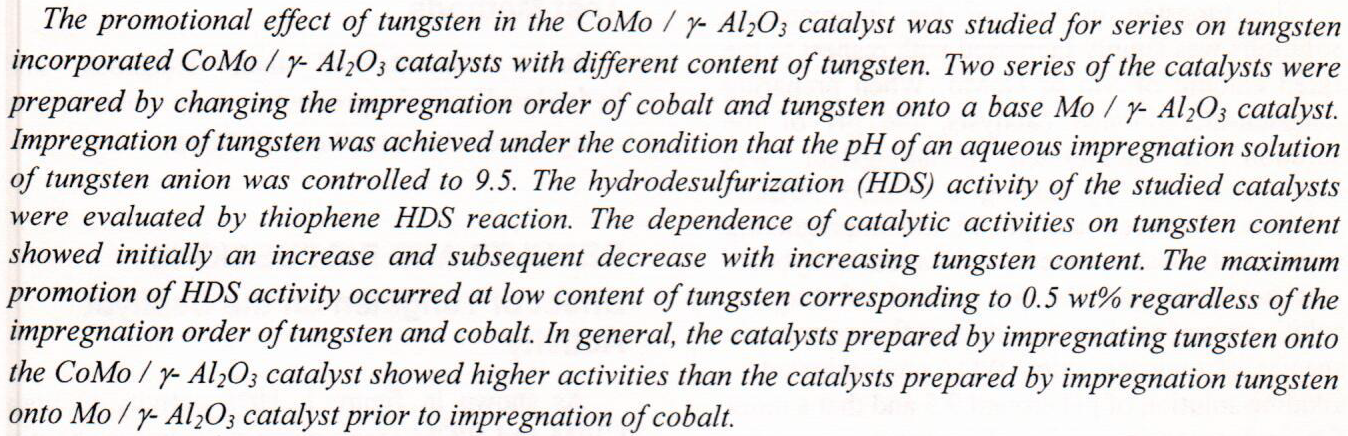
Tungsten Incorporated CoMo/γ-Al2O3 Hydrodesulfurization Catalyst

The dual nature of asphalt binder necessitates improvements to mitigate rutting and fatigue since it performs as an elastic material under the regime of rapid loading or cold temperatures and as a viscous fluid at elevated temperatures. The present investigation assesses the effectiveness of Nano Alumina (NA), Nano Silica (NS), and Nano Titanium Dioxide (NT) at weight percentages of 0, 2, 4, 6, and 8% in asphalt cement to enhance both asphalt binder and mixture performance. Binder evaluations include tests for consistency, thermal susceptibility, aging, and workability, while mixture assessments focus on Marshall properties, moisture susceptibility, resilient modulus, permanent deformation, and fatigue characteristics. NS notably im
... Show More (21)
(21)
 (20)
(20)



Abstract Physical requirements are an important priority for the development of football gymnastics coaches because the nature of performance is interconnected and interconnected in terms of the player's duties in the match. In the gameplay situations, the player must perform the skill with strength and speed coupled with accuracy and the reactions of the colleague and competitor alike, which represents the normal reality of the football gymnasium Skilled exercises are one of the most suitable technical side exercises as they are built according to the components of the skill requirements of the game and the nature of its performance, which appear on the gro
... Show More
(8)
(8)
(6)
(3)
(9)
Biodiesel is an environmentally friendly fuel and a good substitution for the fossil fuel. However, the purity of this fuel is a major concern that challenges researchers. In this study, a calcium oxide based catalyst has been prepared from local waste eggshells by the calcination method and tested in production biodiesel. The eggshells were powdered and calcined at different temperatures (700, 750, 800, 850 and 900 °C) and periods of time (1, 2, 3, 4 and 5 hr.). The effect of calcination temperature and calcination time on the structure and activity of the solid catalyst were examined by X-ray Diffraction (XRD), Scanning Electron Microscopy (SEM), and Brunaure-Emmett-Teller (BET). The optimum catalyst performance was obtained at 900 °C
... Show More
(12)
Catalytic reduction is considered an effective approach for the reduction of toxic organic pollutants from the environment, but finding an active catalyst is still a big challenge. Herein, Ag decorated CeO2 catalyst was synthesized through polyol reduction method and applied for catalytic reduction (conversion) of 4-nitrophenol (4-NP) to 4-aminophenol (4-AP). The Ag decorated CeO2 catalyst displayed an outstanding reduction activity with 99% conversion of 4-NP in 5 min with a 0.61 min−1 reaction rate (k). A number of structural characterization techniques were executed to investigate the influence of Ag on CeO2 and its effect on the catalytic conversion of 4-NP. The outstanding catalytic performances of the Ag-CeO2 catalyst can be assigne
... Show More
(20)
(19)
This work deals with kinetics and chemical equilibrium studies of esterification reaction of ethanol with acetic acid. The esterification reaction was catalyzed by an acidic ion exchange resin (Amberlyst- 15) using a batch stirred tank reactor. The pseudo-homogenous and Eley-Rideal models were successfully fitted with experimental data. At first, Eley-Rideal model was examined for heterogeneous esterification of acetic acid and ethanol. The pseudo-homogenous model was investigated with a power-law model. The apparent reaction order was determined to be (0.88) for Ethanol and (0.92) for acetic acid with a correlation coefficient (R2) of 0.981 and 0.988, respectively. The reaction order was determined to be 4.1087x10⁻³ L0.8/(mol0.8.min) with
... Show More
(10)
(4)
Background: Even the wide use of dental implants, still there is a proportion of implants are failed due to infection. Much considerable attention has been paid to modify the implant surface. Coating of dental implant with a biocomposite material of suitable properties can improve osseointegration. And this is the main concern of this study. The aim of present study was to evaluate the use of a biocomposite coating of dental implant with (ceramic nano Al2O3 and metalic AgNo3) on the bond strength at bone – implant interface and tissue reaction. Materials and methods: A total number of forty-eight screws, CpTi dental implant used in this study. Half of these screws were coated with a biocomposite material of nano (Al2O3and AgNo3), thi
... Show More
(6)
In this study, Al2O3 thin films were prepared by dc reactive sputtering technique using different gas mixtures of argon and oxygen gases (90:10, 70:30, 50:50, 30:70, and 10:90). These films were characterized to introduce their surface morphology and elemental composition as functions of the oxygen content in the gas mixture. The gas mixing ratio plays a crucial role in controlling the nanoscale morphology of the prepared thin films. The [Al]/[O] ratio varies non-linearly with the Ar:O2 mixing ratio. Increasing the oxygen content leads to a progressive decrease in surface roughness, resulting in smoother and more uniform films with finer granular features. These results presented herein are useful to optimize the sputtering process to ac
... Show More