Tungsten Incorporated CoMo/γ-Al2O3 Hydrodesulfurization Catalyst
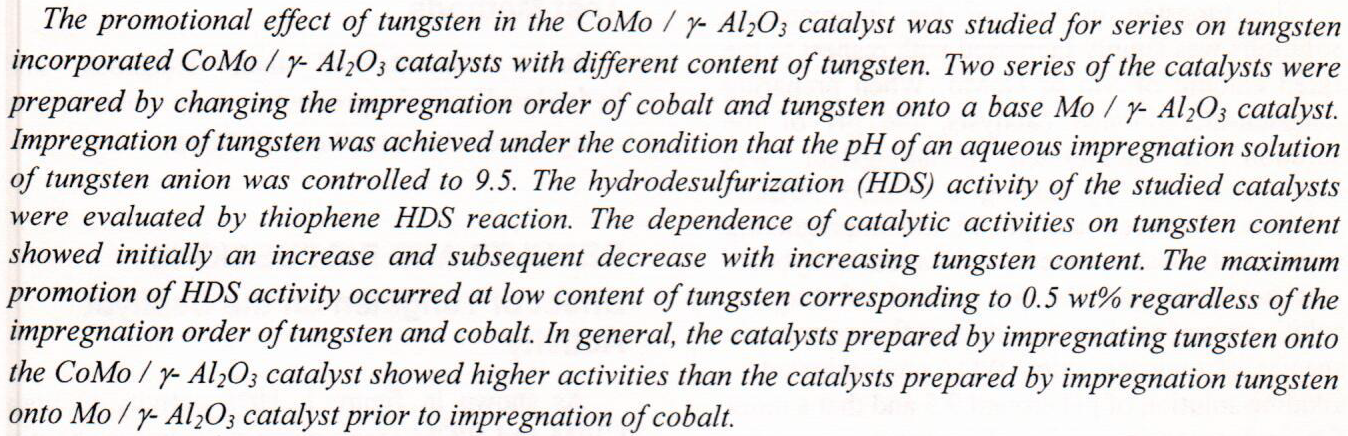

 (17)
(17)
 (12)
(12)



Iraqi bentonite is used as main material for preparing ceramic samples with the additions of alumina and magnesia. X-ray diffractions analyses were carried out for the raw material at room temperature. The sequence of mineral phase's transformations of the bentonite for temperatures 1000 ,1100 ,1200 and 1250 ºC reflects that it finally transformed in to mullite 39.18% and cristobalite 62.82%. Samples of different weight constituent were prepared. The effect of its constitutional change reveals through its heat treatments at 1000,1100,1200,1250and 1300ºC .The samples of additions less than 15% of alumina and magnesia could not stand up to 1300ºC while the samples of addition more than 15% are stable .That is shown by analy
... Show More
Two different composite materials were prepared by stir casting method of AA 6061 alloy as a matrix reinforced with two addition different ceramic materials Al2O3 and B4C of grain size 20 µm by 2.5, 5, 7.5 and10% in weight. The composite material with aluminum alloy as a matrix possesses a unique mechanical properties such as: high specific strength and hardness, low density, and high resistance to corrosion and friction wear. This composite is widely used in automotive parts space and marine applications.
Pin-on-disc technique was used to calculate the wear rate for each addition of Al2O3 and B4C particles. Rockwell hardness test and
... Show More
In this work, 332 Al alloy was prepared and reinforced with (0.5% and 1%) nano-Al2O3 particles. The prepared unreinforced and reinforced 332 Al alloy with nano-Al2O3 were solution heat treated (T6) at 510 ̊C and aged at 225 ̊C with different times (1, 3, and 5 h). Hardness test was performed on all the prepared alloys. All prepared alloys were dry slided under different applied loads (5, 10, 15, and 20 N) against steel counterface surface using pin on disk apparatus. The results showed that refinement effect was observed after addition of nano-Al2O3 particles and a change in silicon morphology after performing the solution heat treatment. The results also showed that har
... Show More
(4)
Global technological advancements drive daily energy consumption, generating additional carbon-induced climate challenges. Modifying process parameters, optimizing design, and employing high-performance working fluids are among the techniques offered by researchers for improving the thermal efficiency of heating and cooling systems. This study investigates the heat transfer enhancement of hybrid “Al2O3-Cu/water” nanofluids flowing in a two-dimensional channel with semicircle ribs. The novelty of this research is in employing semicircle ribs combined with hybrid nanofluids in turbulent flow regimes. A computer modeling approach using a finite volume approach with k-ω shear stress transport turbulence model was used in these simu
... Show More
(14)
(20)
γ-Al2O3–NPs were synthesized by a green synthesis process based on Boswellia carterii resin extract and aluminum sulphate in an alkaline medium. Boswellia carterii resin extract is a significant reducing and stabilizing agent for synthesizing γ-Al2O3–NPs.Several techniques, including Fourier–transform infrared (FT-IR), UV–visible spectroscopy, x-ray diffraction, electron microscopy (XRD), energy dispersive x-ray (EDX), scanning electron microscopy (SEM), Transmission electron microscopy (TEM), and atomic force microscopy (AFM), were utilized to investigate the final product. XRD and SEM confirmed a plate-like crystalline structure with an average size of 17.5 nm. FT-IR analysis identified aluminum oxide stretching vibrations (655,
... Show More
Esterification considers the most important reaction in biodiesel production. In this study, oleic acid was used as a suggested feedstock in order to study and simulate production of biodiesel. The batch esterification reaction of oleic acid was carried out at various operating conditions; temperature from 40 to 70 °C, ethanol to oleic acid molar ratio from 3/1 and 6/1 and a reaction time up to 180 min.
The catalyst used was prepared NaY zeolite, which is added to the reaction mixture as 2, 5 and 10 wt.% of oleic acid.
The results show that the optimum conditions, gives 0.81 conversion of oleic acid, were 6/1 molar ratio of ethanol/oleic acid, 5 wt.% NaY relative to initial oleic acid, 70°C and 60 minutes. The activation energy o
The hydroconversion of Iraqi light straight run naphtha was studied on zeolite catalyst. 0.3wt.%Pt/HMOR catalyst was prepared locally and used in the present work. The hydroconversion performed on a continuous fixed-bed laboratory reaction unit. Experiments were performed in the temperature range of 200 to 350°C, pressure range of 3 to 15 bars, LHSV range of 0.5-2.5h-1, and the hydrogen to naphtha ratio of 300.
The results show that the hydroconversion of Iraqi light straight naphtha increases with increase in reaction temperature and decreases with increase in LHSV.
High octane number isomers were formed at low temperature of 240°C. The selectivity of hydroisomerization improved by increasing reaction pressu
... Show MoreIn this study NiO - CoO bimetallic catalysts are prepared with two Ni/Co ratios (70:30 and 80: 20) using the precipitation method of nitrate salts. The effects of Ni /Co ratio and preparation methods on the catalyst are analyzed by using different characterization techniques, i.e. atomic absorption (AA) , XRD, surface area and pore volume measurements according to the BET method . The results indicate that the best catalyst is the one containing the percentage of Ni :Co ( 70 : 30 ). Experiments indicate that the optimal conditions to prepare catalyst are stirring for three hours at a temperature of 60oC of the preparation , pH= (8-9) , calcination temperature at 400oC for two hours
... Show More