Electrochemical behavior of Anodized AA7075 Aluminum Alloy in 0.1M NaCl Solution as Investigated by Potentiostatic Polarization Ttechnique
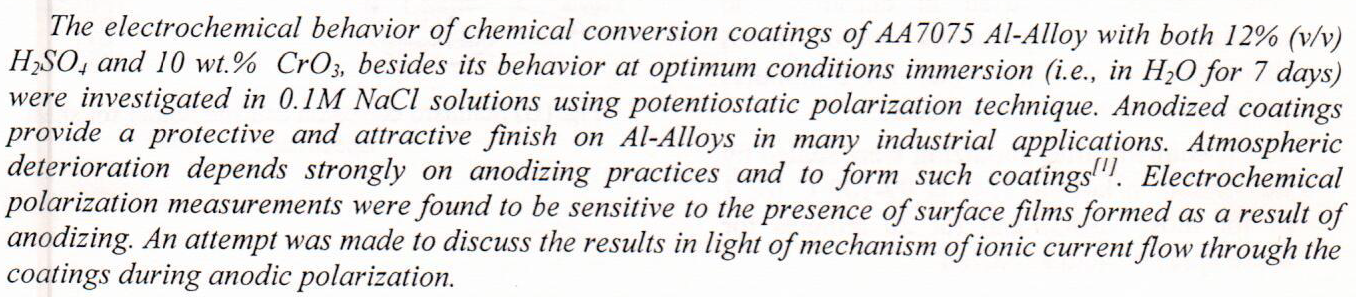

 (37)
(37)
 (24)
(24)



In this study, NaOH dissolution method was applied to dissolve cellulose fibers which extracted from date palm fronds (type Al-Zahdi) taken from Iraqi gardens. In this process, (NaOH)-solution is brought into contact with the cellulose fibers at low temperature. Experiments were conducted with different concentrations of NaOH (4%, 6%, 8% and12%) weight percent at two cooling bath temperatures (-15 oC) and (-20oC). Maximum cellulose dissolution was 23 wt% which obtained at 8 wt% concentration of NaOH and at cooling bath temperature of -20oC. In order to enhance the cellulose fibers dissolution, the sample was pretreated with Fenton's reagent which consists of hydrogen peroxide (H2O2), oxalic acid (C2H2O4) and ferrous sulfate (FeSO4). This
... Show More
(4)
There Are Many Communities Suffering Of Unemployment Due To Has Great Social And Economic Impact, As Well As The Psychological Effects Devastating And Serious And That May Threaten States With Collapse And Leading Human Displacement And Loss And Crime, And Often Derive Unemployed People To Practice Bad Habits Such As Gambling, Alcohol And Drug Abuse To Escape From Their Reality To Their Concerns And Problems.
It Should Be Noted, That The Largest Percentage Of Unemployment In Developing Societies Represented By The Educated Class Of University Graduates, And This Is Something Painful.
The Unemployed Know That (Each Capable Of Working And Who Want To Look For And Accept Prevailing Bricks) Is Th
... Show MoreIn this study, NaOH dissolution method was applied to dissolve cellulose fibers which extracted from date palm fronds (type Al-Zahdi) taken from Iraqi gardens. In this process, (NaOH)-solution is brought into contact with the cellulose fibers at low temperature. Experiments were conducted with different concentrations of NaOH (4%, 6%, 8% and12%) weight percent at two cooling bath temperatures (-15 oC) and (-20oC). Maximum cellulose dissolution was 23 wt% which obtained at 8 wt% concentration of NaOH and at cooling bath temperature of -20oC. In order to enhance the cellulose fibers dissolution, the sample was pretreated with Fenton's reagent which consists of
... Show More
(4)
In this study, NaOH dissolution method was applied to dissolve cellulose fibers which extracted from date palm fronds (type Al-Zahdi) taken from Iraqi gardens. In this process, (NaOH)-solution is brought into contact with the cellulose fibers at low temperature. Experiments were conducted with different concentrations of NaOH (4%, 6%, 8% and12%) weight percent at two cooling bath temperatures (-15 oC) and (-20oC). Maximum cellulose dissolution was 23 wt% which obtained at 8 wt% concentration of NaOH and at cooling bath temperature of -20oC. In order to enhance the cellulose fibers dissolution, the sample was pretreated with Fenton's reagent which consists of
... Show MoreTwo modes of electrochemical harvesting for microalgae were investigated in the current work. A sacrificial anode (aluminum) was used to study the electrocoagulation-flotation process, and a nonsacrificial anode (graphite) was used to investigate the electroflotation process. The study inspected the effect of chloride ions concentration and the interelectrode distance on the performance of the electrochemical harvesting processes. The results demonstrated that both electrodes achieved maximum harvesting efficiency with a 2 g/L NaCl concentration. Interestingly, by increasing the NaCl concentration to 5 g/L, the harvesting efficiency reduced dramatically to its lowest value. Generally, the energy consumption decreased with increasing
... Show More
(7)
(6)
The cost of microalgae harvesting constitutes a heavy burden on the commercialization of biofuel production. The present study addressed this problem through economic and parametric comparison of electrochemical harvesting using a sacrificial electrode (aluminum) and a nonsacrificial electrode (graphite). The harvesting efficiency, power consumption, and operation cost were collected as objective variables as a function of applied current and initial pH of the solution. The results indicated that high harvesting efficiency obtained by using aluminum anode is achieved in short electrolysis time. That harvesting efficiency can be enhanced by increasing the applied current or the electrolysis time for both electrode materials, where 98
... Show More
(13)
(9)
The driving idea for the present work was to combine the effect of polyvinyl alcohol (PVA) as corrosion inhibitor with the distance between the anodic and cathodic elements of the galvanic cell, beside their area ratio, in scope of synergistic suppression of galvanic corrosion on Cu/Fe model couple, using weight loss method. The performance affecting galvanic corrosion process has been tested for three major factors affect the process:
1. Four PVA inhibitor concentrations were selected to be (0, 1000, 4000 and 7000 ppm) in simulated cooling water.
2. Two cathode: anode area ratios as 1:1 and 2.4:1.
3. Two distances apart cathode – anode as 3 and 7 cm.
Maximum corrosion inhibition achieved was 86% which indicates that increa
This work was conducted to study the treatment of industrial waste water, and more particularly those in the General Company of Electrical Industries.This waste water, has zinc ion with maximum concentration in solution of 90 ppm.
The reuse of such effluent can be made possible via appropriate treatments, such as chemical coagulation, Na2S is used as coagulant.
The parameters that influenced the waste water treatment are: temperature, pH, dose of coagulant and settling time.
It was found that the best condition for zinc removal, within the range of operation used ,were a temperature of 20C a pH value of 13 , a coagulant dose of 15 g Na2S /400ml solution and a settling time of 7 days. Under these conditions the zinc concentrat