Electrochemical behavior of Anodized AA7075 Aluminum Alloy in 0.1M NaCl Solution as Investigated by Potentiostatic Polarization Ttechnique
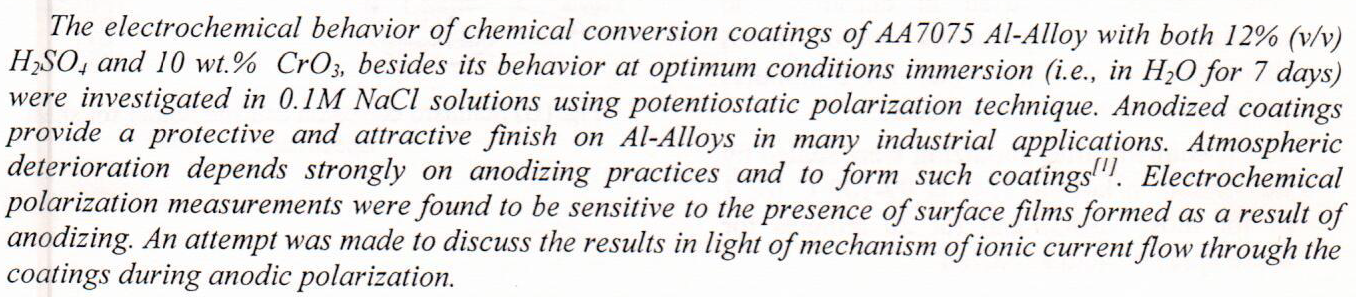

The influence and hazard of fire flame are one of the most important parameters that affecting the durability and strength of structural members. This research studied the influence of fire flame on the behavior of reinforced concrete beams affected by repeated load. Nine self- compacted reinforced concrete beams were castellated, all have the same geometric layout (0.15x0.15x1.00) m, reinforcement details and compressive strength (50 Mpa). To estimate the effect of fire flame disaster, four temperatures were adopted (200, 300, 400 and 500) oC and two method of cooling were used (graduated and sudden). In the first cooling method, graduated, the tested beams were leaved to cool in air while in the second method, sudden, water splash was use
... Show MoreThe influence and hazard of fire flame are one of the most important parameters that affecting the durability and strength of structural members. This research studied the influence of fire flame on the behavior of reinforced concrete beams affected by repeated load. Nine self- compacted reinforced concrete beams were castellated, all have the same geometric layout (0.15x0.15x1.00) m, reinforcement details and compressive strength (50 Mpa).
To estimate the effect of fire flame disaster, four temperatures were adopted (200, 300, 400 and 500) oC and two method of cooling were used (graduated and sudden). In the first cooling method, graduated, the tested beams were leaved to cool in air while in the seco
... Show MoreElastic magnetic M1 electron scattering form factor has been calculated for the ground state J,T=1/2-,1/2 of 13C. The single-particle model is used with harmonic oscillator wave function. The core-polarization effects are calculated in the first-order perturbation theory including excitations up to 5ħω, using the modified surface delta interaction (MSDI) as a residual interaction. No parameters are introduced in this work. The data are reasonably explained up to q~2.5fm-1 .
Fe, Co and Sb nanopowders were fruitfully prepared by electrical wire explosion method in Double distilled and de-ionized water (DDDW) media. The formation of iron, cobalt and antimony (FeCoSb) alloy nanopowder was monitored by X-ray diffraction. The x-ray diffraction pattern indicates that there are iron, cobalt and antimony peaks. Optical properties of this alloy nanoparticles were characterized by UV-Visible absorption spectra. The absorption peak position is shifted to the lower wavelengths when the current increases. That means the mean size of the nanoparticles controlled by changing the magnitude of the current. The surface morphological analysis is carried out by employing Scanning Electron Microscope (SEM). Particles with varies
... Show More (1)
(1)

Understanding, promoting, and teaching media literacy is an important societal challenge. STEM educators are increasingly looking to incorporate 21st century skills such as media literacy into core subject education. In this paper we investigate how undergraduate Computer Science (CS) students can learn media literacy as a by-product of collaborative video tutorial production. The paper presents a study of 34 third-year CS undergraduates who, as part of their learning, were each asked to produce three video tutorials on Raspberry Pi programming, using a collaborative video production tool for mobile phones (Bootlegger). We provide results of both quantitative and qualitative analysis of the production process and resulting video tutorials,
... Show More (22)
(17)
(22)
(17)


A procedure, depending on the derivatization and determination of aniline was depicted andvalidated in this study. 8-hydroxyquinoline (8-HQ) was used as the derivatizing agent for thedetermination of aniline. An optimization study was performed for the derivatization reaction, i.e.,the diazonium coupling reaction, the optimum parameters were as follows: 22 mM of hydrochloricacid, 54mM of sodium hydroxide, and 1.8mM of sodium nitrate. The optimization study of themethod of cloud point extraction (CPE) revealed that the extraction solvent was 0.5 ml of Triton X-100, the optimum temperature was 90 °C, and the incubation time was 25 min. The linearity,correlation coefficients, molar absorptivities, and limits of detection were improved using t
... Show MoreQuadrupole Q moments and effective charges are calculated for 9C, 11C, 17C and 19C exotic nuclei using shell model calculations. Excitations out of major shell space are taken into account through a microscopic theory which are called core-polarization effects. The simple harmonic oscillator potential is used to generate the single particle matrix elements of 9,11,17,19C. The present calculations with core-polarization effects reproduced the experimental and theoretical data very well.
This work introduces a newly synthesized triazole derivative, 5-([(2-furanyl)methyl]-thiomethyl)-4-(naphtha-2-yl)-3-hydroxyl-4H-1,2,4-triazole (FTNT), as an effective corrosion inhibitor for carbon steel A106 G/B in 0.1 M HCl solution. The structure of the novel derivative was confirmed by FTIR, 1 H NMR, and 13 C NMR spectra. Potentiodynamic polarization measurements reveal that FTNT markedly suppresses corrosion, with inhibition efficiency reaching 81.6% at 600 ppm. Thermodynamic analysis indicates spontaneous, physisorption/chemisorption-augmented adsorption of FTNT on the steel surface, best described by the Freundlich isotherm. Atomic force microscopy (AFM) surface examination demonstrated that a protective FTNT coating precipitated on
... Show MoreBackground: Enterococcus faecalis (E. faecalis) is a prototypical resistant bacterium in root canal infections and a leading cause of endodontic treatment failure. German chamomile (Matricaria chamomilla) flower extract has been used as a traditional medicine to treat infections. The aim of this study was to investigate the antimicrobial efficacy of chamomile extract on the removal of E. faecalis root canal biofilm. Materials and Methods: Chamomile flower extract was prepared and subjected to detailed chemical analysis. For the in vitro biofilm model, human mandibular premolars (n=48) with 18-20mm working length were used. Root canal preparation was performed using the ProTaper® Next system. Each sample was split longitudinally and reassem
... Show More
This study investigates the ionic conduction dependence on the size of alkaline cations in gel polymer electrolytes based on double iodide can enhance by incorporating a salt having a bulky cation.
... Show More
(2)