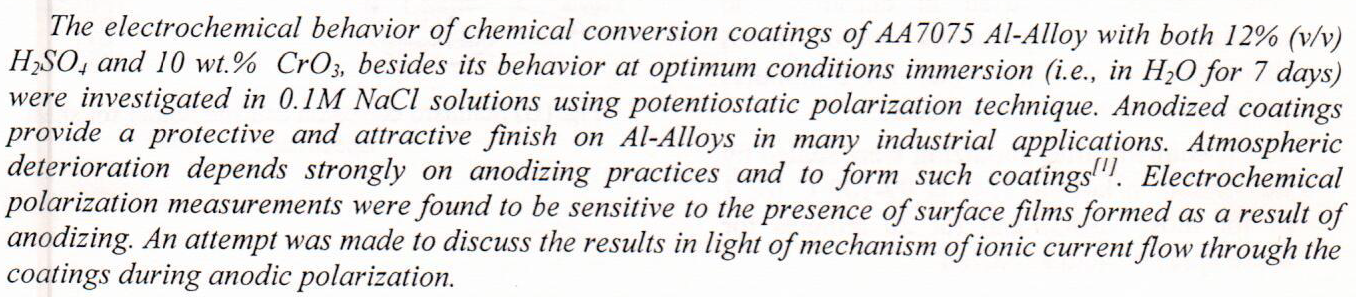
Electrochemical behavior of Anodized AA7075 Aluminum Alloy in 0.1M NaCl Solution as Investigated by Potentiostatic Polarization Ttechnique

KE Sharquie, AA Noaimi, S Al-Hashimy, IGF Al-Tereihi, The Iraqi Postgraduate Medical Journal, 2013 - Cited by 5
تعتبر المعادلات التفاضلية الموجية من اهم المواضيع التي تمثل على سبيل المثال الحركة الموجية للاهتزازات الأرضية . ومن هنا فان ايجاد حلول تقريبيه لمثل هذه المعادلات بدقة وسرعه عالية وبشكل اسرع من الحلول التحليلية والمعقدة , اصبح ممكنا من خلال استخدام الذكاء الاصطناعي واساليب التعلم الالي. في هذا البحث هناك ثلاثة أهداف الأول هو تحويل مشكلة القيمة الأولية للمعادلة الموجية إلى شكلها القانوني وإيجاد حلها ا
... Show More

KE Sharquie, AA Noaimi, MS Al-Zoubaidi, Journal of Cosmetics, Dermatological Sciences and Applications, 2015 - Cited by 8
The inverse kinematics of redundant manipulators has infinite solutions by using conventional methods, so that, this work presents applicability of intelligent tool (artificial neural network ANN) for finding one desired solution from these solutions. The inverse analysis and trajectory planning of a three link redundant planar robot have been studied in this work using a proposed dual neural networks model (DNNM), which shows a predictable time decreasing in the training session. The effect of the number of the training sets on the DNNM output and the number of NN layers have been studied. Several trajectories have been implemented using point to point trajectory planning algorithm with DNNM and the result shows good accuracy of the end
... Show More (2)
(2)
 (2)
(2)
The present work aims to study the possibility of utilization a forward osmosis desalination process as an alternative method to extract water from brine solution rejected from reverse osmosis process.
Experiments conducted in a laboratory–scale forward osmosis (FO) unit in cross flow flat sheet membrane cell yielded water flux ranging from (0.0315 to 0.56 L/m2 .min) when using CTA membrane,and ranging from (0.419 to 2.785 L/m2 .min) for PA membrane under 0.4 bar. Two possible membrane orientations were tested. Sodium chloride with high concentrations was used as draw solution solute. The effect of membrane orientation on internal concentration polarization (ICP) was studied. Two regimes of ICP; dilutive and concentrative were desc
(5)
Inelastic transverse and longitudinal form factors of same parity have
been studied for B 10 nucleus in the frame work of the shell model for
many particles, by using He 4 as an inert core and the remaining
particles were distributed in 3 / 2 1 / 2 1p ,1p which form the model
space. The calculations of the present work based on the harmonic
oscillator potential with fixed size parameter (b). Here we use the
first order correction for the perturbation theory and the interaction
from Cohen-Kurath (CK). Adding the core-polarization effects to
form factors calculations gave a good agreement with the
experimental data. Calculations have been performed for the
transverse excited states of: (1 ,0 )at ( E 0.178M
Under cyclic loading, aluminum alloys exhibit less fatigue life than steel alloys of similar strength and this is considered as Achilles's heel of such alloys. A nanosecond fiber laser was used to apply high speed laser shock peening process on thin aluminum plates in order to enhance the fatigue life by introducing compressive residual stresses. The effect of three working parameters namely the pulse repetition rate (PRR), spot size (ω) and scanning speed (v) on limiting the fatigue failure was investigated. The optimum results, represented by the longer fatigue life, were at PRR of 22.5 kHz, ω of 0.04 mm and at both v's of 200 and 500 mm/sec. The research yielded significant results represented by a maximum percentage increase in the fa
... Show More
(4)
(2)

The kinetics of nickel removal from aqueous solutions using a bio-electrochemical reactor with a packed bed rotating cylinder cathode was investigated. The effects of applied voltage, initial nickel concentration, the rotation speed of the cathode, and pH on the reaction rate constant (k) were studied. The results showed that the cathodic deposition occurred under mass transfer control for all values of the applied voltage used in this research. Accordingly, the relationship between concentration and time can be represented by a first-order equation. The rate constant was found to be dependent on the applied voltage, initial nickel concentration, pH, and rotation speed. It was increased as the applied voltage increased and decreased as t
... Show More
(1)
(36)
(25)