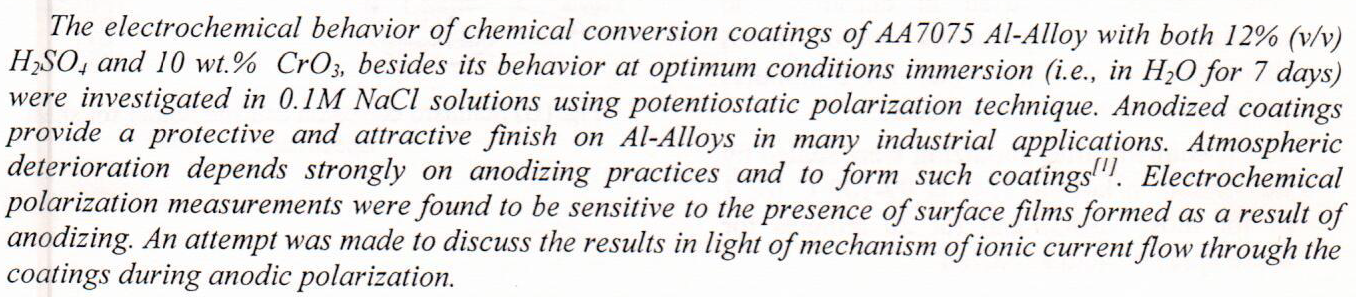
Electrochemical behavior of Anodized AA7075 Aluminum Alloy in 0.1M NaCl Solution as Investigated by Potentiostatic Polarization Ttechnique

 (12)
(12)
 (6)
(6)


يعد تحليل العلاقات الكمية بين البنية والممتلكات/النشاط (QSPR/QSAR) أمرًا بالغ الأهمية لفهم خصائص المركبات المرتبطة بالمخدرات، خاصة في علاج مرض الزهايمر. في هذه الدراسة، هدفنا هو استخدام أساليب مبتكرة بما في ذلك استخدام المؤشرات الطوبولوجية -درجة و- درجة ، المستمدة من نظرية الرسم البياني، لتقييم الخصائص والخصائص الفيزيائية والكيميائية لخمسة أدوية لمرض الزهايمر: تاكرين، دونيبيزيل، ريفيستيجمين، جالانتامي
... Show More
(4)
(2)
Abstract: The increased interest in developing new photonic devices that can support high data rates, high sensitivity and fast processing capabilities for all optical communications, motivates a pre stage pulse compressor research. The pre-stage research was based on cascading single mode fiber and polarization maintaining fiber to get pulse compression with compression factor of 1.105. The demand for obtaining more précised photonic devices; this work experimentally studied the behavior of Polarization maintaining fiber PMF that is sandwiched between two cascaded singe mode fiber SMF and fiber Bragg gratings FBG. Therefore; the introduced interferometer performed hybrid interference of both Mach-Zehnder
... Show MoreIn this work, the spectra for plasma glow produced by pulse
Nd:YAG laser (λ=532 and 1064nm) on Ag:Al alloy with same molar
ratio samples in distilled water were analyzed by studying the atomic
lines compared with aluminum and silver strong standard lines. The
effect of laser energies of the range 300 to 800 mJ on spectral lines,
produced by laser ablation, were investigated using optical
spectroscopy. The electron temperature was found to be increased
from 1.698 to 1.899 eV, while the electron density decreased from
2.247×10¹⁵ to 5.08×1014 cm-3 with increasing laser energy from 300
to 800 mJ with wavelength of 1064 nm. The values of electron
temperature using second harmonic frequency are greater than of<
(2)
Oil well drilling fluid rheology, lubricity, swelling, and fluid loss control are all critical factors to take into account before beginning the hole's construction. Drilling fluids can be made smoother, more cost-effective, and more efficient by investigating and evaluating the effects of various nanoparticles including aluminum oxide (Al2O3) and iron oxide (Fe2O3) on their performance. A drilling fluid's performance can be assessed by comparing its baseline characteristics to those of nanoparticle (NPs) enhanced fluids. It was found that the drilling mud contained NPs in concentrations of 0,0.25, 0. 5, 0.75 and 1 g. According to the results, when drilling fluid was used without NPs, the coeff
... Show More
(3)
(1)
(2)

Polarization manipulation elements operating at visible wavelengths represent a critical component of quantum communication sub-systems, equivalent to their telecom wavelength counterparts. The method proposed involves rotating the optic axis of the polarized input light by an angle of 45 degree, thereby converting the fundamental transverse electric (TE0) mode to the fundamental transverse magnetic (TM0) mode. This paper outlines an integrated gallium phosphide-waveguide polarization rotator, which relies on the rotation of a horizontal slot by 45 degree at a wavelength of 700 nm. This will ultimately lead to the conception of a mode hybridization phenomenon in the waveguide. The simulation results demonstrate a polarization co
... Show More
(1)
(2)
The corrosion behavior of low carbon steel in washing water of crude oil solution has been studied potentiostatically at five temperatures in the range ( 303 –343 )K, at pH ( 4 ) and at pH (4,6,7,9,11 ) at (343K)..The corrosion potential shifted to more negative values with increasing temperature and the corrosion current density increased with increasing temperature, the corrosion current density (icorr) decreased with increasing pH in the rang ( 4 – 7 ) and it increased with increasing pH in the rang ( 9 – 11 ) at ( 343 K ), while the corrosion potential generally variation with increasing pH in the rang (4-11)at(343K. From the general results for this study can be seen that thermodynamic and kinetic function were
... Show More
(1)
(6)
Different cooking conditions were examined for aluminum content in food cooked while wrapped with aluminum foil. The influence of each anticipated factor (the acidity of the cooking medium, type of acids normally used in cuisines namely acetic and tartaric acids, various cooking temperatures, influence of the presence of sodium chloride salt, the effect of cooking oil, and the length of time of cooking) was studied thoroughly as a function of aluminum degraded out of the aluminum foils to the medium. The experimental samples were digested with nitric acid upon fulfillment of examining each factor separately before quantifying aluminum with the sensitive technique of atomic absorption spectroscopy. The outcomes of the study have shown that t
... Show More
(1)