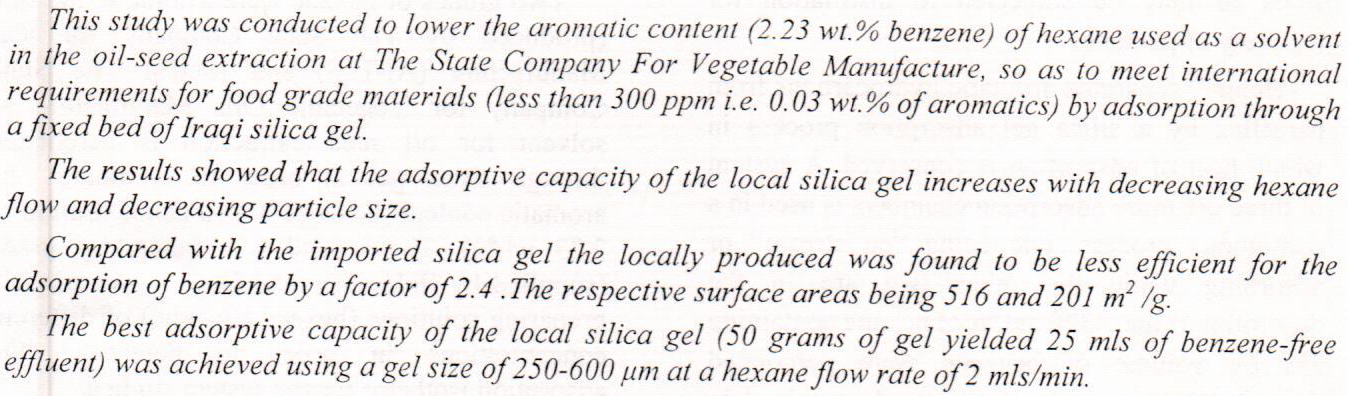
Reduction of Aromatic Content from Hexane by Silica Gel

This study designed to prepare ultrafine apixaban (APX) o/w nanoemulsion (NE) based gel with droplet size below 50 nm as a good method for transdermal APX delivery without using permeation enhancer, alternatively, the formulation components itself act as permeation enhancer. APX, a potent oral anticoagulant drug that selectively and directly inhibit coagulation factor Xa, was selected as a good candidate for transdermal delivery as it displays poor water solubility (0.028 mg/mL) and low bioavailability (50%). APX-NE gel was prepared using triacetin, triton-x-100 and carbitol as oil phase, surfactant and cosurfactant respectively, while Carbopol 940 used as a gelling agent. Ex vivo permeation of APX-NE gel through human stratum c
... Show More (17)
(17)
 (11)
(11)


Nefopam (N.F.) HCl is a non-narcotic centrally-acting, non-opioid benzoxazocine analgesic to relieve acute and chronic pain. It exhibits low bioavailability (about 36%) due to its first-pass degradation in the liver.
Intranasal administration has been used as a new route for targeting active brain sites and enhancing the bioavailability of N.F. HCl bypassing hepatic metabolism.
In situ gel of N.F. HCl was prepared by the cold method using different concentrations of Poloxamer 407, Poloxamer 188, HPMC K4M, Carbapol 934, and Hyaluronic acid polymers.
The results show that identification tests are superimposed with references, solubility study shows that N.F. HCl is suitable to be administered intranasally; Compatibi
... Show More
(15)
(11)
A simple and rapid high performance liquid chromatographic with fluorescence detection method for the determination of the aflatoxin B1, B2, G1 and G2 in peanuts, rice and chilli was developed. The sample was extracted using acetonitrile:water (90:10, v/v%) and then purified by using ISOLUTE multimode solid phase extraction. After the pre-column derivatisation, the analytes were separated within 3.7 min using Chromolith performance RP-18e (100–4.6 mm) monolithic column. To assess the possible effects of endogenous components in the food items, matrix-matched calibration was used for the quantification and validation. The recoveries of aflatoxins that were spiked into food samples were 86.38–104.5% and RSDs were <4.4%. The method was
... Show More
(95)
(85)

Background: Frovatriptan succinate (FVT) is an effective medication used to treat migraines; however, available oral formulations suffer from low permeability; accordingly, several formulations of FVT were prepared. Objective: Prepare, optimize, and evaluate FVT-BE formulation to develop enhanced intranasal binary nano-ethosome gel. Methods: Binary ethosomes were prepared using different concentrations of phospholipid PLH90, ethanol, propylene glycol, and cholesterol by thin film hydration and characterized by particle size, zeta potential, and entrapment efficiency. Furthermore, in-vitro, in-vivo, ex-vivo, pharmacokinetics, and histopathological studies were done. Results: Regarding FVT-loaded BE, formula (F9) demonstrated the best paramet
... Show More
(30)
(26)
The study aims to analyze computer textbooks content for preparatory stage according to the logical thinking. The researcher followed the descriptive analytical research approach (content analysis), and adopted an explicit idea during the analysis process. One of the content analysis tools which was designed based on mental processes employed during logical thinking has utilized to figure out the study results. The findings revealed that logical thinking skills formed (52%) in fourth preparatory textbook and (47%) in fifth preparatory textbook.
The objective of this research is to analyze the content of science textbook at the elementary level, according to the dimensions of sustainable development for the academic year (2015-2016). To achieve this goal has been to build a list with dimensions of sustainable development to be included in science textbooks in primary school, after seeing the collection of literature and research and studies, as has been reached to the list of the dimensions of the three sustainable development and social, economic and environmental in the initial image consisted of (63) the issue of sub-divided the three-dimensional, the menu and offered a group of arbitrators and specialists in curriculum and teaching methods, and thus the menu consiste
... Show MoreThe current study aims to identify the needs in the stories of the Brothers Grimm. The research sample consisted of (3) stories, namely: 1- The story of the Thorn Rose (Sleeping Beauty) 2- The story of Snow White 3- The story of Little Red Riding Hood. The number of pages analyzed reached (15.5) pages, and to achieve the research objectives, Murray's classification of needs was adopted, which contains (36) basic needs that are further divided into (129) sub-needs. The idea was adopted as a unit of analysis and repetition as a unit of enumeration, Reliability was extracted in two ways: 1- Agreement between the researcher and himself over time, where the agreement coefficient reached 97%. The second was agreement between the researcher and tw
... Show MoreToday, problems of spatial data integration have been further complicated by the rapid development in communication technologies and the increasing amount of available data sources on the World Wide Web. Thus, web-based geospatial data sources can be managed by different communities and the data themselves can vary in respect to quality, coverage, and purpose. Integrating such multiple geospatial datasets remains a challenge for geospatial data consumers. This paper concentrates on the integration of geometric and classification schemes for official data, such as Ordnance Survey (OS) national mapping data, with volunteered geographic information (VGI) data, such as the data derived from the OpenStreetMap (OSM) project. Useful descriptions o
... Show MoreThe Main think that be kept by the speech communication as a concept traditionally being expressed on the subject or a certain idea of a goal came on as needed functional addressed to recipients of benefits or likely to benefit from those rhetorical message through a speech importance and priority of the effect of not less than the effect of that letter, in science content role ends once you absorb it mentally, either in the art of design Valamadmon intellectual embodied through its interaction with the overall shape of the finished design, and often content is associated in the mind of the receiver through a letter communicative linked to the sense or the goal that meant the designer, and try to identify and explain. And meaning i
... Show More