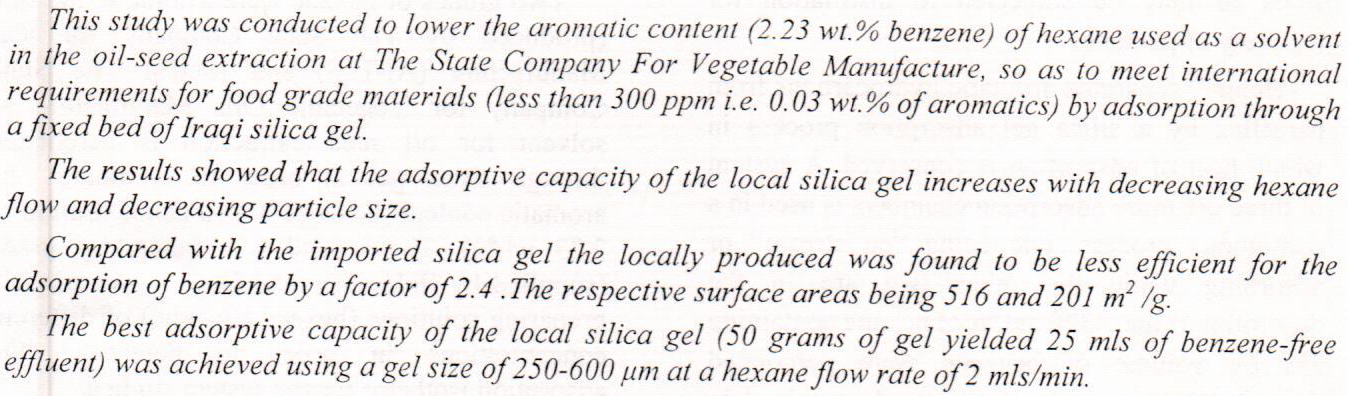
Reduction of Aromatic Content from Hexane by Silica Gel

Mutans streptococci (MS) are a group of oral bacteria considered as the main cariogenic organisms. MS consists of several species of genus Streptococcus which are sharing similar phenotypes and genotypes. The aim of this study is to determine the genetic diversity of the core species of clinical strains of Streptococcus mutans, Streptococcus sobrinus and Streptococcus downei by using repitative extragenic palindromic (REP) primer. The DNA of the clinical strains of S. mutans (n=10), S. sobrinus (n=05) and S. downei (n=04) have been employed in the present study, which have been previously isolated from caries active subjects. The DNA of the clinical and reference strains was
... Show More (3)
(3)
 (4)
(4)


 (45)
(48)
(8)
(8)
(8)
(6)
(45)
(48)
(8)
(8)
(8)
(6)
This work studies the performance of zeolite permeable reactive barrier in removing cadmium from a contaminated shallow aquifer. Batch tests have been performed to characterize the equilibrium sorption properties of the zeolite in cadmium-containing aqueous solutions. A 1D numerical finite difference model has been developed to describe pollutant transport within groundwater taking pollutant sorption on the permeable reactive barrier (PRB), which is performed by Langmuir equation, into account. Numerical results show that the PRB starts to saturate after a period of time (~120 h) due to reduction of the retardation factor, indicating a decrease in the percentage of zeolite functionality. However, a reasonable agreement between model predict
... Show More
(38)
(24)
In this work, the possibility of utilizing osmosis phenomenon to produce energy as a type of the renewable energy using Thin Film Composite Ultra Low Pressure membrane TFC-ULP was studied. Where by forward osmosis water passes through the membrane toward the concentrated brine solution, this will lead to raise the head of the high brine solution. This developed static head may be used to produce energy. The aim of the present work is to study the static head developed and the flux on the high brine water solution side when using forward and reverse osmosis membranes for an initial concentration range from 35-300 g/l for each type of membrane used at room temperature and pressure conditions, and finally calculating the maximum possible po
... Show MoreIn the present work, the pollutants of the municipal wastewater are reduced using Chlorella vulgaris microalgae. The pollutants that were treated are: Total organic carbon (TOC), Chemical oxygen demand (COD), Nitrate (NO3), and Phosphate (PO4). Firstly, the treatment was achieved at atmospheric conditions (Temperature = 25oC), pH 7 with time (1 – 48 h). To study the effect of other microorganisms on the reduction of pollutants, sterilized wastewater and unsterilized wastewater were used for two types of packing (cylindrical plastic and cubic polystyrene) as well as algae's broth (without packing), where the microalgae are grown on the packing then transported to the wastewater for treatment. Th
... Show More
(5)
This study aims to predict the organic pollution produced from the presence of some polycyclic aromatic hydrocarbons (PAHs) and determination it's concentrations (µg/L , ppb) in Tigris river water by a collection twenty-seven water samples from a selected three stations with nine sampling sites and three depths of water (5 cm , 2 m and 4 m) each site for 4.6 km distance of a geographic studied area which is located between the ( Al-Senak and AL-Sarrafiah bridges ) at Baghdad city – Iraq on May, 2012. The geographic location was determined with a Global Positioning System (GPS) and Geographic Information System (GIS) software program. The concentrations of fourteen components (PAHs) were performed using the reverse phase
... Show More
(1)
(11)
(8)
