The Optimal Corrosion Inhibition of Aluminum in 0.1M NaCl Solution
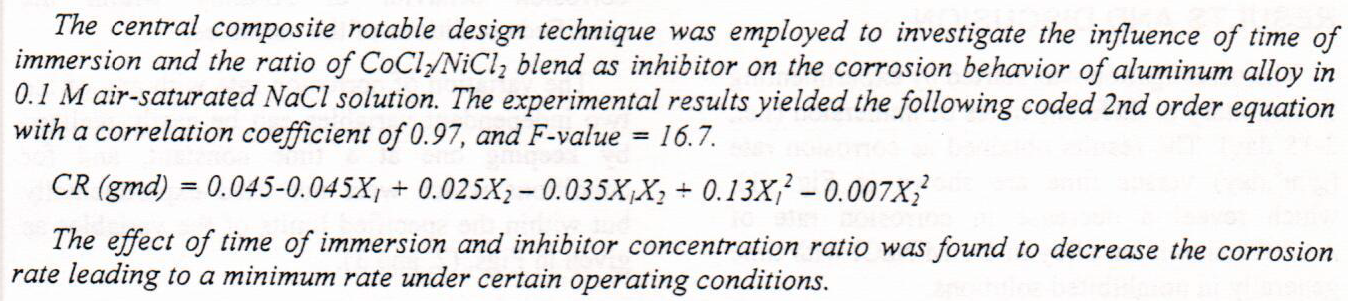

 (9)
(9)
 (9)
(9)



The present work elucidates the utilization of activated carbon (AC) and activated carbon loaded with silver nanoparticles (AgNPs-AC) to remove tetracycline (TC) from synthetically polluted water. The activated carbon was prepared from tea residue and loaded with silver nanoparticles. Scanning electron microscopy (SEM), X-ray diffraction (XRD), Fourier transform infrared spectroscopy (FTIR), and Brunauer-Emmett-Teller (BET) were used to characterize the activated carbon (AC) and silver nanoparticles-loaded activated carbon (AgNPs-AC). The impact of various parameters on the adsorption effectiveness of TC was examined. These variables were the initial adsorbate concentration (Co), solution acidity (pH), adsorption time (t), and dosag
... Show More
(2)
(1)
Sorption is a key factor in removal of organic and inorganic contaminants from their aqueous solutions. In this study, we investigated the removal of Xylenol Orange tetrasodium salt (XOTS) from its aqueous solution by Bauxite (BXT) and cationic surfactant hexadecyltrimethyl ammonium bromide modified Bauxite (BXT-HDTMA) in batch experiments. The BXT and BXT-HDTMA were characterized using FTIR, and SEM techniques. Adsorption studies were performed at various parameters i.e. temperature, contact time, adsorbent weight, and pH. The modified BXT showed better maximum removal efficiency (98.6% at pH = 9.03) compared to natural Bauxite (75% at pH 2.27), suggesting that BXT-HDTMA is an excellent adsorbent for the removal of XOTS from water. The equ
... Show More
(16)
(14)
(16)
(14)
(55)
(48)
This research introduces a developed analytical method to determine the nominal and maximum tensile stress and investigate the stress concentration factor. The required tooth fillets parametric equations and gears dimensions have been reformulated to take into account the asymmetric fillets radiuses, asymmetric pressure angle, and profile shifting non-standard modifications. An analytical technique has been developed for the determination of tooth weakest section location for standard, asymmetric fillet radiuses, asymmetric pressure angle and profile shifted involute helical and spur gears. Moreover, an analytical equation to evaluate gear tooth-loading angle at any radial distance on the involute profile of spur and hel
... Show More
(2)
The 17 α-ethinylestradiol (EE2) adsorption from aqueous solution was examined using a novel adsorbent made from rice husk powder coated with CuO nanoparticles (CRH). Advanced analyses of FTIR, XRD, SEM, and EDSwere used to identify the classification parameters of a CRH-like surface morphology, configuration, and functional groups. The rice husk was coated with CuO nanoparticles, allowing it to create large surface area materials with significantly improved textural qualities with regard to functional use and adsorption performance, according to a detailed characterization of the synthesized materials. The adsorption process was applied successfully with elimination effectiveness of 100% which can be kept up to 61.3%. The parameters of ads
... Show More
(16)
(14)
Two homopolymeric and three copolymeric additives for base oil were synthesized using octyl acrylate (OA) and tert-butyl acrylamide (TBA) monomers. The two additives named P1 and P2 are the homopolymers of TBA and OA, respectively, whereas copolymeric additives named Co1, Co2, and Co3 were synthesized by varying the ratios of TBA:OA as 1:3, 3:1 and 1:1, respectively. The prepared polymers were characterized by Fourier Transform Infrared (FTIR). Based on the solubility of synthesized polymers in base oil and reactivity ratios of TBA/OA copolymer (0.222, 0.434) calculated by Fineman-Ross method, P2, Co1, Co2 and Co3 were selected to evaluate their performance as pour point depressant (PPD), viscosity improver (VII), and anticorrosion addit
... Show More
(2)
The Electro-Fenton oxidation process is one of the essential advanced electrochemical oxidation processes used to treat Phenol and its derivatives in wastewater. The Electro-Fenton oxidation process was carried out at an ambient temperature at different current density (2, 4, 6, 8 mA/cm2) for up to 6 h. Sodium Sulfate at a concentration of 0.05M was used as a supporting electrolyte, and 0.4 mM of Ferrous ion concentration (Fe2+) was used as a catalyst. The electrolyte cell consists of graphite modified by an electrodepositing layer of PbO2 on its surface as anode and carbon fiber modified with Graphene as a cathode. The results indicated that Phenol concentration decreases with an increase in current dens
... Show More
(15)