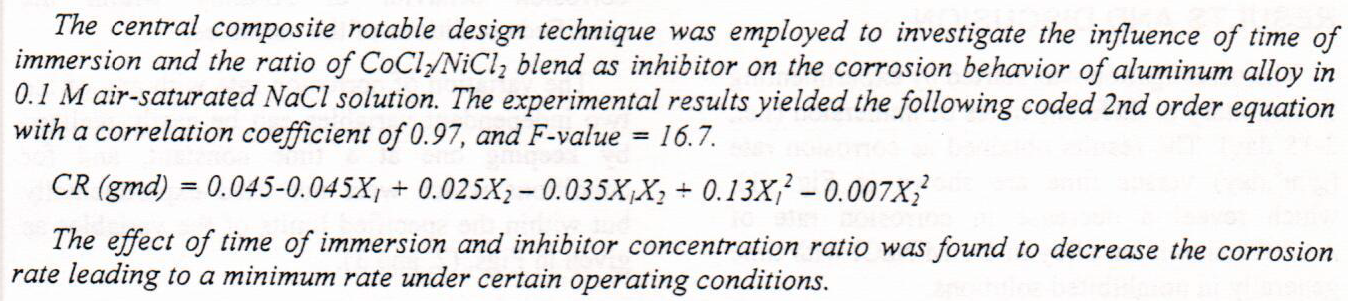
The Optimal Corrosion Inhibition of Aluminum in 0.1M NaCl Solution

The current study investigated the stability and the extraction efficiency of emulsion liquid membrane (ELM) for Abamectin pesticide removal from aqueous solution. The stability was investigated in terms of droplet emulsion size distribution and emulsion breakage percent. The proposed ELM included a mixture of corn oil and kerosene (1:1) as a diluent, Span 80 (sorbitan monooleate) as a surfactant and hydrochloric acid (HCl) as a stripping agent without utilizing a carrier agent. Parameters such as homogenizer speed, surfactant concentration, emulsification time and internal to organic volume ratio (I/O) were evaluated. Results show that the lower droplet size of 0.9 µm and higher stable emulsion in terms of breakage percent of 1.12 % were
... Show More (5)
(5)

 (5)
(5)

The current study investigated the stability and the extraction efficiency of emulsion liquid membrane (ELM) for Abamectin pesticide removal from aqueous solution. The stability was investigated in terms of droplet emulsion size distribution and emulsion breakage percent. The proposed ELM included a mixture of corn oil and kerosene (1:1) as a diluent, Span 80 (sorbitan monooleate) as a surfactant and hydrochloric acid (HCl) as a stripping agent without utilizing a carrier agent. Parameters such as homogenizer speed, surfactant concentration, emulsification time and internal to organic volume ratio (I/O) were evaluated. Results show that the lower droplet size of 0.9 µm and higher stable emulsion in terms of breakage percent of 1.12 % we
... Show More
(5)
(4)
(1)
Natural Bauxite (BXT) mineral clay was modified with a cationic surfactant (hexadecy ltrimethy lammonium bromide (BXT-HDTMA)) and characterized with different techniques: FTIR spectroscopy, X-ray powder diffraction (XRD) and scanning electron microscopy (SEM). The modified and natural bauxite (BXT) were used as adsorbents for the adsorption of 4- Chlorophenol (4-CP) from aqueous solutions. The adsorption study was carried out at different conditions and parameters: contact time, pH value, adsorbent dosage and ionic strength. The adsorption kinetic (described by a pseudo-first order and a pseudo-second order), equilibrium experimental data (analyzed by Langmuir, Freundlich and Temkin isotherm models) and thermodynamic parameters (change in s
... Show MoreThe paper presents a highly accurate power flow solution, reducing the possibility of ending at local minima, by using Real-Coded Genetic Algorithm (RCGA) with system reduction and restoration. The proposed method (RCGA) is modified to reduce the total computing time by reducing the system in size to that of the generator buses, which, for any realistic system, will be smaller in number, and the load buses are eliminated. Then solving the power flow problem for the generator buses only by real-coded GA to calculate the voltage phase angles, whereas the voltage magnitudes are specified resulted in reduced computation time for the solution. Then the system is restored by calculating the voltages of the load buses in terms
... Show MoreActivated carbon derived from Ficus Binjamina agro-waste synthesized by pyro carbonic acid microwave method and treated with silicon oxide (SiO2) was used to enhance the adsorption capability of the malachite green (MG) dye. Three factors of concentration of dye, time of mixing, and the amount of activated carbon with four levels were used to investigate their effect on the MG removal efficiency. The results show that 0.4 g/L dosage, 80 mg/L dye concentration, and 40 min adsorption duration were found as an optimum conditions for 99.13% removal efficiency. The results also reveal that Freundlich isotherm and the pseudo-second-order kinetic models were the best models to describe the equilibrium adsorption data.
(7)
(3)
This study aimed to study the inhibition activity of purified bacteriocin produced from the local isolation Lactococcuslactis ssp. lactis against pathogenic bacteria species isolated from clinical samples in some hospitals Baghdad city. Screening of L. lactis ssp. Lactis and isolated from the intestines fish and raw milk was performed in well diffusion method. The results showed that L. lactis ssp. lactis (Lc4) was the most efficient isolate in producing the bacteriocin as well observed inhibitory activity the increased that companied with the concentration, the concentration of the twice filtrate was better in obtaining higher inhibition diameters compared to the one-fold concentration. The concentrate
... Show More
(20)
(16)
 (20)
(16)
(20)
(16)