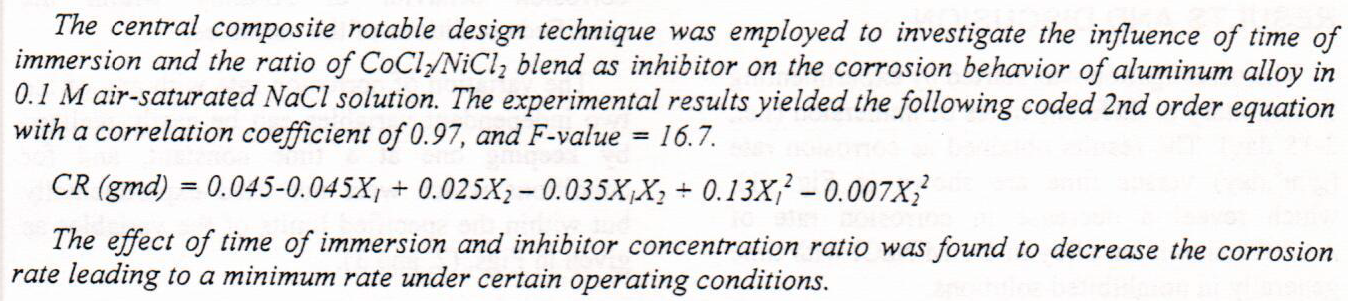
The Optimal Corrosion Inhibition of Aluminum in 0.1M NaCl Solution

The use of biopolymer material Chitosan impregnated granular activated carbon CHGAC as adsorbent in the removal of lead ions pb.2+ from aqueous solution was studied using batch adsorption mode. The prepared CHGAC was characterized by Scanning Electronic Microscopy (SEM) and atomic-absorption pectrophotometer. The adsorption of lead ions onto Chitosan-impregnated granular activated carbon was examined as a function of adsorbent weight, pH and
contact time in Batch system. Langmuir and Freundlich models were employed to analyze the resulting experimental data demonstrated that better fitted by Langmuir isotherm model than Freundlich model, with good correlation coefficient. The maximum adsorption capacity calculated f


A demonstration of the inverse kinematics is a very complex problem for redundant robot manipulator. This paper presents the solution of inverse kinematics for one of redundant robots manipulator (three link robot) by combing of two intelligent algorithms GA (Genetic Algorithm) and NN (Neural Network). The inputs are position and orientation of three link robot. These inputs are entering to Back Propagation Neural Network (BPNN). The weights of BPNN are optimized using continuous GA. The (Mean Square Error) MSE is also computed between the estimated and desired outputs of joint angles. In this paper, the fitness function in GA is proposed. The sinwave and circular for three link robot end effecter and desired trajectories are simulated b
... Show More (8)
(8)
This research presents the possibility of using banana peel (arising from agricultural production waste) as biosorbent for removal of copper from simulated aqueous solution. Batch sorption experiments were performed as a function of pH, sorbent dose, and contact time. The optimal pH value of Copper (II) removal by banana peel was 6. The amount of sorbed metal ions was calculated as 52.632 mg/g. Sorption kinetic data were tested using pseudo-first order, and pseudo-second order models. Kinetic studies showed that the sorption followed a pseudo second order reaction due to the high correlation coefficient and the agreement between the experimental and calculated values of qe. Thermodynamic parameters such as enthalpy change (ΔH
... Show More
(2)
We present a reliable algorithm for solving, homogeneous or inhomogeneous, nonlinear ordinary delay differential equations with initial conditions. The form of the solution is calculated as a series with easily computable components. Four examples are considered for the numerical illustrations of this method. The results reveal that the semi analytic iterative method (SAIM) is very effective, simple and very close to the exact solution demonstrate reliability and efficiency of this method for such problems.
(2)
(2)
The combined system of electrocoagulation (EC) and electro-oxidation (EO) is one of the most promising methods in dye removal. In this work, a solution of 200 mg/l of Congo red was used to examine the removal of anionic dye using an EC-EO system with three stainless steel electrodes as the auxiliary electrodes and an aluminum electrode as anode for the EC process, Cu-Mn-Ni Nanocomposite as anode for the EO process. This composite oxide was simultaneously synthesized by anodic and cathodic deposition of Cu (NO3)2, MnCl2, and Ni (NO3)2 salts with 0.075 M as concentrations of each salt with a fixed molar ratio (1:1:1) at a constant current density of 25 mA/cm2. The characteristics structure and surface morphology of the depo
... Show More
(1)
The development of a new, cheap, efficient, and ecofriendly adsorbents has become an important demand for the treatment of waste water, so nano silica is considered a good choice. A sample of nanosilica (NS) was prepared from sodium silicate as precursor and the nonionic surfactant Tween 20 as a template. The prepared sample was characterized using various characterization techniques such as FT-IR, AFM, SEM and EDX analysis. The spectrum of FTIR confirms the presence of silica in the sample, while SEM analysis of sample shows nanostructures with pore ranging (2-100nm).The adsorptive properties of this sample were studied by removing Congo red dye (CR) from aqueous solution. Batch experimental methods were carried o
... Show More (14)
(5)
(14)
(5)

The purpose of this research is to investigate the impact of corrosive environment (corrosive ferric chloride of 1, 2, 5, 6% wt. at room temperature), immersion period of (48, 72, 96, 120, 144 hours), and surface roughness on pitting corrosion characteristics and use the data to build an artificial neural network and test its ability to predict the depth and intensity of pitting corrosion in a variety of conditions. Pit density and depth were calculated using a pitting corrosion test on carbon steel (C-4130). Pitting corrosion experimental tests were used to develop artificial neural network (ANN) models for predicting pitting corrosion characteristics. It was found that artificial neural network models were shown to be
... Show More
(1)
DAIRMD Professor Hayder R. Al-Hamamy, **Professor Adil A. Noaimi, **Dr. Ihsan A. Al-Turfy, IOSR Journal of Dental and Medical Sciences (IOSR-JDMS), 2015