The Optimal Corrosion Inhibition of Aluminum in 0.1M NaCl Solution
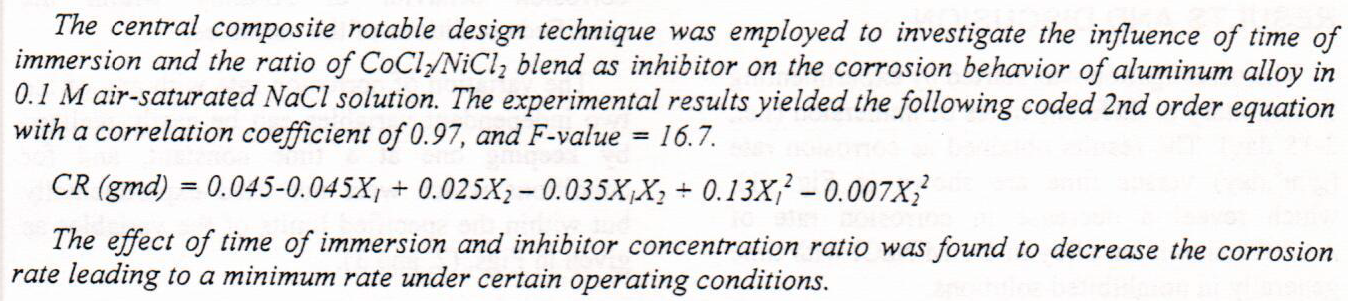

A detailed study of adsorption from solution of amitriptyline-HCl, chlorpromazine-HCl and
chlordiazepoxide-HCl on bentonite clay surface has been performed at variable conditions of
temperature, pH and ionic strength. It is aimed in this work to explore the capability of this clay in
treatment of poisoning by the mentioned drugs if taken in quantities higher than the usual doses.
Quantities of drugs adsorbed have been determined by UV spectrophotometric technique. The
sequence of adsorption in neutral media at 37.5 CÙ’ followed the order:
Amitriptyline-HCl > chlorpromazine-HCl > chlordiazepoxide-HCl.
The results were discussed in the light of Langmuir and Freundich adsorption isotherms. The usual
basic th

 (16)
(16)
 (15)
(15)


This study was aimed to investigate the response surface methodology (RSM) to evaluate the effects of various experimental conditions on the removal of levofloxacin (LVX) from the aqueous solution by means of electrocoagulation (EC) technique with stainless steel electrodes. The EC process was achieved successfully with the efficiency of LVX removal of 90%. The results obtained from the regression analysis, showed that the data of experiential are better fitted to the polynomial model of second-order with the predicted correlation coefficient (pred. R2) of 0.723, adjusted correlation coefficient (Adj. R2) of 0.907 and correlation coefficient values (R2) of 0.952. This shows that the predicted models and experimental values are in go
... Show More
(17)
KE Sharquie, AA Noaimi, AG Al-Ghazzi, Journal of Dermatology & Dermatologic Surgery, 2015 - Cited by 19
In this paper, we present new algorithm for the solution of the nonlinear high order multi-point boundary value problem with suitable multi boundary conditions. The algorithm is based on the semi-analytic technique and the solutions are calculated in the form of a rapid convergent series. It is observed that the method gives more realistic series solution that converges very rapidly in physical problems. Illustrative examples are provided to demonstrate the efficiency and simplicity of the proposed method in solving this type of multi- point boundary value problems.
The main parameters and methods influencing the removal of Gentian Violet (GV) dye from aqueous media were investigated using a stachy plant in this study. The surface of the stachy plant was determined using FTIR spectra. Adsorption is influenced by the adsorbent's characteristic groups. The research took into account the usual conditions for GV dye adsorption by the stachy plant, such as the impact of contact time. Mass dosage , after 0.3 g the amount of adsorbed dye declines. Study pH and ionic strength, the results obtained showed that at pH 3 the largest adsorption of (GV) was seen, while at pH 9, the lowest adsorption was observed at 298 K, the adsorption kinetics and equilibrium constants were achieved, and the equilibr
... Show More
(1)
The university course timetable problem (UCTP) is typically a combinatorial optimization problem. Manually achieving a useful timetable requires many days of effort, and the results are still unsatisfactory. unsatisfactory. Various states of art methods (heuristic, meta-heuristic) are used to satisfactorily solve UCTP. However, these approaches typically represent the instance-specific solutions. The hyper-heuristic framework adequately addresses this complex problem. This research proposed Particle Swarm Optimizer-based Hyper Heuristic (HH PSO) to solve UCTP efficiently. PSO is used as a higher-level method that selects low-level heuristics (LLH) sequence which further generates an optimal solution. The proposed a
... Show More
(15)
(4)
The adsorption behavior of congo red dye from its aqueous solutions was investigated onto natural and modified bauxite clays. Both bauxite and modified bauxite are primarily characterized by using, FTIR, SEM, AFM, and XRD. Several variables are studied as a function of adsorption including contact time, adsorbent weight, pH, ionic strength, particle size and temperature under batch adsorption technique. The absorbance of the solution before and after adsorption was measured spectrophotometrically. The equilibrium data fit with Langmuir model of adsorption and the linear regression coefficient R2 is found to be 0.9832 and 0.9630 for natural and modified bauxite respectively at 37.5°C which elucidate the best fitting isotherm model. The gene
... Show More
(7)
(2)