The Optimal Corrosion Inhibition of Aluminum in 0.1M NaCl Solution
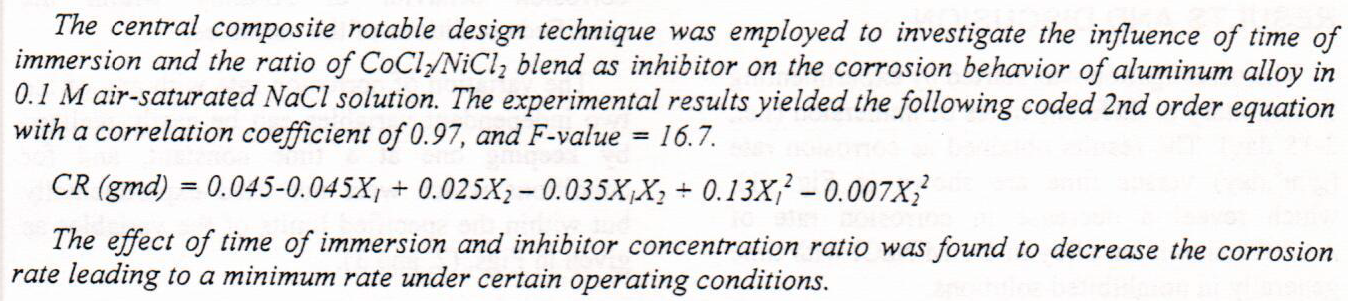

Corrosion inhibiting admixtures are unique among other methods to protect reinforced concrete from corrosion damage. In this study, the effect of furfural on the fresh and hardened properties of concrete mixes of 35 and 45 MPa compressive strengths as well as the corrosion inhibition of furfural was evaluated. Furfural was added at different dosages (1, 2 and 3% by weight of cement) with and without superplasticizer (HRWR). Different electrochemical measurements were performed (Half-cell potential, Tafel plot and linear polarization resistance). Electrochemical measurements confirmed that furfural dramatically reduces the rate of corrosion; the inhibition efficiencies were 62.7 and 63.8 % due to 3% furfural addition to 35 and 45MPa-concr
... Show More (1)
(1)

Psoriasis is a chronic autoimmune inflammatory skin condition characterized by uncontrolled keratinocyte proliferation and potential systemic manifestations. Its pathogenesis involves activation of both innate and adaptive immune responses, leading to an imbalance in inflammatory cytokines. Interleukin (IL)-12 and IL-23 are key cytokines in the pathophysiology of psoriasis and sustain chronic skin inflammation. Biologic therapies, such as ustekinumab (UST), have been developed to induce long-term remission in moderate-to-severe psoriasis. The objective of this study was to identify differences in serum levels of inflammatory biomarkers [erythrocyte sedimentation rate, high-sensitivity C-reactive protein (hs-CRP), IL-12, IL-17, IL-22, and IL
... Show More
In this study we focused on the determination of influence the novel synthesized thiosemicarbazide derivative "2-(2-hydroxy-3-methoxybenzylidene) hydrazinecarbothioamide" (HMHC) influenced the corrosion inhibition of mild steel (MS) in a 1.0 M hydrochloric acid acidic solution.This is in an effort to preserve the metal material by maintaining it from corrosion.The synthesized inhibitor was characterized using elemental analysis, and NMR-spectroscopy. Then the corrosion inhibition capability of (HMHC) was studied on mild steel in an acidic medium by weight loss technique within variables [temperature, inhibitor concentration, and time]. The immersion periods were [1:00, 3:00, 5:00, 10:00, 24:00, and 72:00] hours and the tem
... Show More (7)
(5)
(7)
(5)

Corrosion inhibitors are widely used in industry to reduce the corrosion rate of metals and alloys. Corrosion inhibitors adsorb onto metallic surfaces and insulate them from deterioration. Plants abundant in nature offer a cost-effective replacement for toxic chemical inhibitors on the market. The current research used the potentiostatic polarization technique at room temperature to explore the inhibitory impact of water hyacinth extract on the corrosion of low-carbon steel specimens in a 3.5% NaCl solution. The Tafel curve was used to assess corrosion inhibition activity, with the best inhibition efficiency reaching 79.36% at a concentration of 200 ppm. Cyclic polarization indicated the type of corrosion was general corrosion. The
... Show More
(1)
(5)
In this paper, a new approach was suggested to the method of Gauss Seidel through the controlling of equations installation before the beginning of the method in the traditional way. New structure of equations occur after the diagnosis of the variable that causes the fluctuation and the slow extract of the results, then eradicating this variable. This procedure leads to a higher accuracy and less number of steps than the old method. By using the this proposed method, there will be a possibility of solving many of divergent values equations which cannot be solved by the old style.
Coagulation is the most important process in drinking water treatment. Alum coagulant increases the aluminum residuals, which have been linked in many studies to Alzheimer's disease. Therefore, it is very important to use it with the very optimal dose. In this paper, four sets of experiments were done to determine the relationship between raw water characteristics: turbidity, pH, alkalinity, temperature, and optimum doses of alum [ .14 O] to form a mathematical equation that could replace the need for jar test experiments. The experiments were performed under different conditions and under different seasonal circumstances. The optimal dose in every set was determined, and used to build a gene expression model (GEP). The models were co
... Show More
(14)
(6)
Density functional theory (DFT) calculations were used to evaluate the capability of Glutamine (Gln) and its derivative chemicals as inhibitors for the anti-corrosive behavior of iron. The current work is devoted to scrutinizing reactivity descriptors (both local and global) of Gln, two states of neutral and protonated. Also, the change of Gln upon the incorporation into dipeptides was investigated. Since the number of reaction centers has increased, an enhancement in dipeptides’ inhibitory effect was observed. Thus, the adsorption of small-scale peptides and glutamine amino acids on Fe surfaces (1 1 1) was performed, and characteristics such as adsorption energies and the configuration with the highest stability and lowest energy were ca
... Show More
(16)
(13)
This paper focuses on the optimization of drilling parameters by utilizing “Taguchi method” to obtain the minimum surface roughness. Nine drilling experiments were performed on Al 5050 alloy using high speed steel twist drills. Three drilling parameters (feed rates, cutting speeds, and cutting tools) were used as control factors, and L9 (33) “orthogonal array” was specified for the experimental trials. Signal to Noise (S/N) Ratio and “Analysis of Variance” (ANOVA) were utilized to set the optimum control factors which minimized the surface roughness. The results were tested with the aid of statistical software package MINITAB-17. After the experimental trails, the tool diameter was found as the most important facto
... Show More
(16)
Modern automation robotics have replaced many human workers in industrial factories around the globe. The robotic arms are used for several manufacturing applications, and their responses required optimal control. In this paper, a robust approach of optimal position control for a DC motor in the robotic arm system is proposed. The general component of the automation system is first introduced. The mathematical model and the corresponding transfer functions of a DC motor in the robotic arm system are presented. The investigations of using DC motor in the robotic arm system without controller lead to poor system performance. Therefore, the analysis and design of a Proportional plus Integration plus Divertive (PID) controller is illustrated.
... Show More
(8)
(4)