Volumetric Mass Transfer Capacity Coefficient in the RTL Extractor
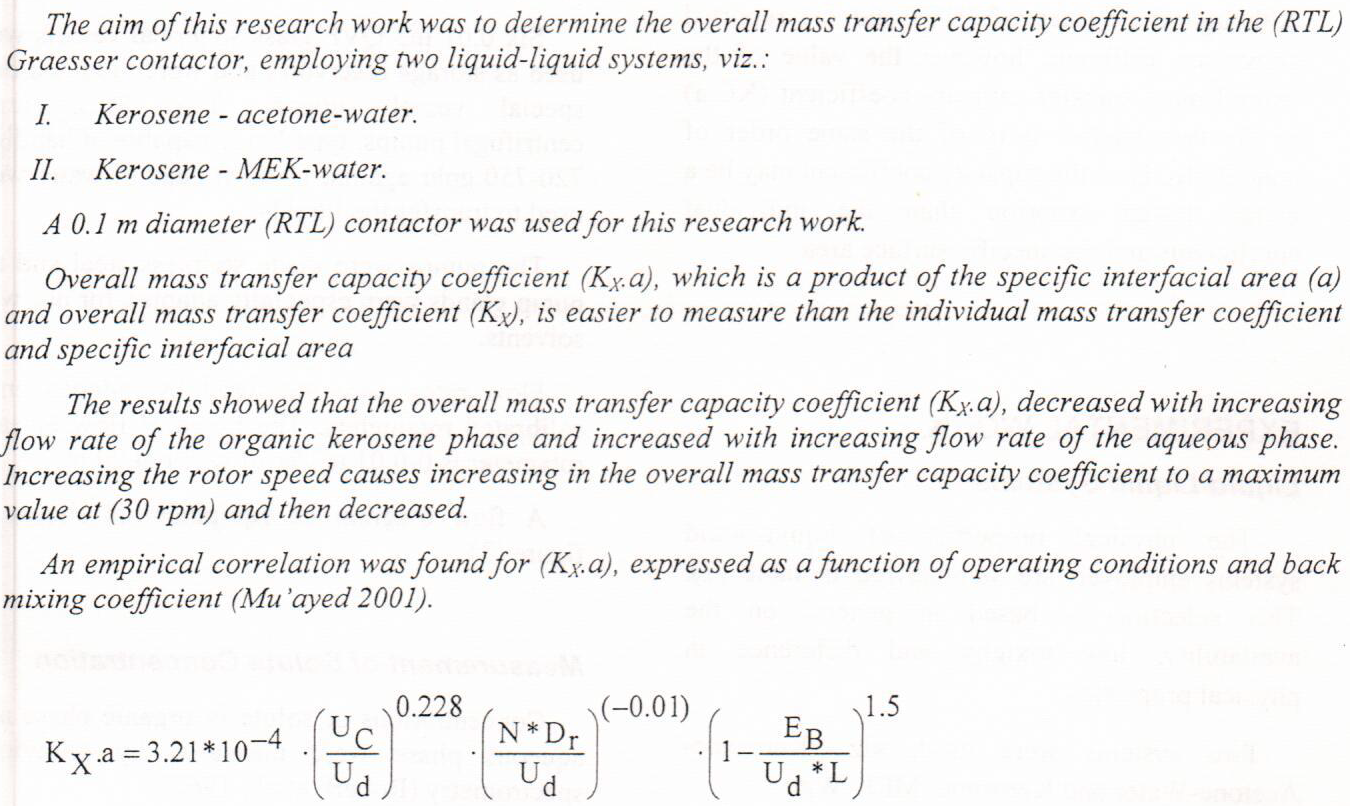

 (22)
(22)
 (16)
(16)



Convection heat transfer in a horizontal channel provided with metal foam blocks of two numbers of pores per unit of length (10 and 40 PPI) and partially heated at a constant heat flux is experimentally investigated with air as the working fluid. A series of experiments have been carried out under steady state condition. The experimental investigations cover the Reynolds number range from 638 to 2168, heat fluxes varied from 453 to 4462 W/m2, and Darcy number 1.77x10⁻⁵, 3.95x10⁻⁶. The measured data were collected and analyzed. Results show that the wall temperatures at each heated section are affected by the imposed heat flux variation, Darcy number, and Reynolds number variation. The var
... Show MoreTheoretical and experimental investigations of free convection through a cubic cavity with sinusoidal heat flux at bottom wall, the top wall is exposed to an outside ambient while the other walls are adiabatic saturated in porous medium had been approved in the present work. The range of Rayleigh number was and Darcy number values were . The theoretical part involved a numerical solution while the experimental part included a set of tests carried out to study the free convection heat transfer in a porous media (glass beads) for sinusoidal heat flux boundary condition. The investigation enclosed values of Rayleigh number (5845.6, 8801, 9456, 15034, 19188 and 22148) and angles of inclinations (0, 15, 30, 45 and 60 degree). The numerical an
... Show MoreIn this paper, an experimental analysis of conventional air-cooled and microchannel condensers in automotive vapor compression refrigeration cycle concerning heat transfer coefficient and energy using R134a as a refrigerant was presented. The performance of two condensers and cycles tested regarding ambient temperature which it was varied from 40oC to 65oC, while the indoor temperature and load have been set to be 23oC and 2200 W respectively. Results showed that the microchannel condenser has 224 % and 77 % higher refrigerant side and air side heat transfer coefficient respectively than the coefficients of the conventional condenser. Thus, the COP, in case of using the microchannel
... Show More
(4)
This article introduces a numerical study on heat exchange and corrosion coefficients of Zinc–water nanofluid stream in a circular tube fitted with swirl generator utilizing CFD emulation. Different forms of swirl generator which have the following properties of plain twisted tape (PTT) and baffle wings twisted tape (BTT) embeds with various ratio of twisting (y = 2.93, 3.91 and 4.89), baffle inclination angles (β = 0°, - 30° and 30) joined with 1%, 1.5% and 2% volume fraction of ZnO nanofluid were utilized for simulation. The results demonstrated that the heat and friction coefficients conducted by these two forms of vortex generator raised with Reynolds number, twist ratio and baffle inclination angles decreases. Likewise, t
... Show More
In this research, design of advanced material for sunlight conversion requires focused research to obtain efficient photocatalytic system. Nanostructured ZnO was synthesized using spin coating technique. The structural, morphological and optical properties of annealed nanostructured ZnO thin film at 390 Co for 3 hours were characterized by x-ray diffraction, atomic force microscope AFM and UV-VIS spectrophotometer. Nanostructured ZnO was applied for removal Methylene Blue (MB) dye from water using sunlight induced photocatalytic process. Overall degradation of MB/ZnO was achieved after 120 minutes of sunlight irradiation while it needs more time for MB alone. The reaction rate constant fit pseudo first order for MB/ZnO degradation was 0.
... Show More
(2)
A comparison between the resistance capacity of a single pile excited by two opposite rotary machines embedded in dry and saturated sandy soil was considered experimentally. A small-scale physical model was manufactured to accomplish the experimental work in the laboratory. The physical model consists of: two small motors supplied with eccentric mass 0·012 kg and eccentric distance 20 mm representing the two opposite rotary machines, an aluminum shaft with 20 mm in diameter as the pile, and a steel plate with dimensions of (160 × 160 × 20 mm) as a pile cap. The experimental work was achieved taking the following parameters into consideration, pile embedment depth ratio (L/d; length to diameter) and operating freq
... Show More
(18)
(16)
Global technological advancements drive daily energy consumption, generating additional carbon-induced climate challenges. Modifying process parameters, optimizing design, and employing high-performance working fluids are among the techniques offered by researchers for improving the thermal efficiency of heating and cooling systems. This study investigates the heat transfer enhancement of hybrid “Al2O3-Cu/water” nanofluids flowing in a two-dimensional channel with semicircle ribs. The novelty of this research is in employing semicircle ribs combined with hybrid nanofluids in turbulent flow regimes. A computer modeling approach using a finite volume approach with k-ω shear stress transport turbulence model was used in these simu
... Show More
(14)
(21)