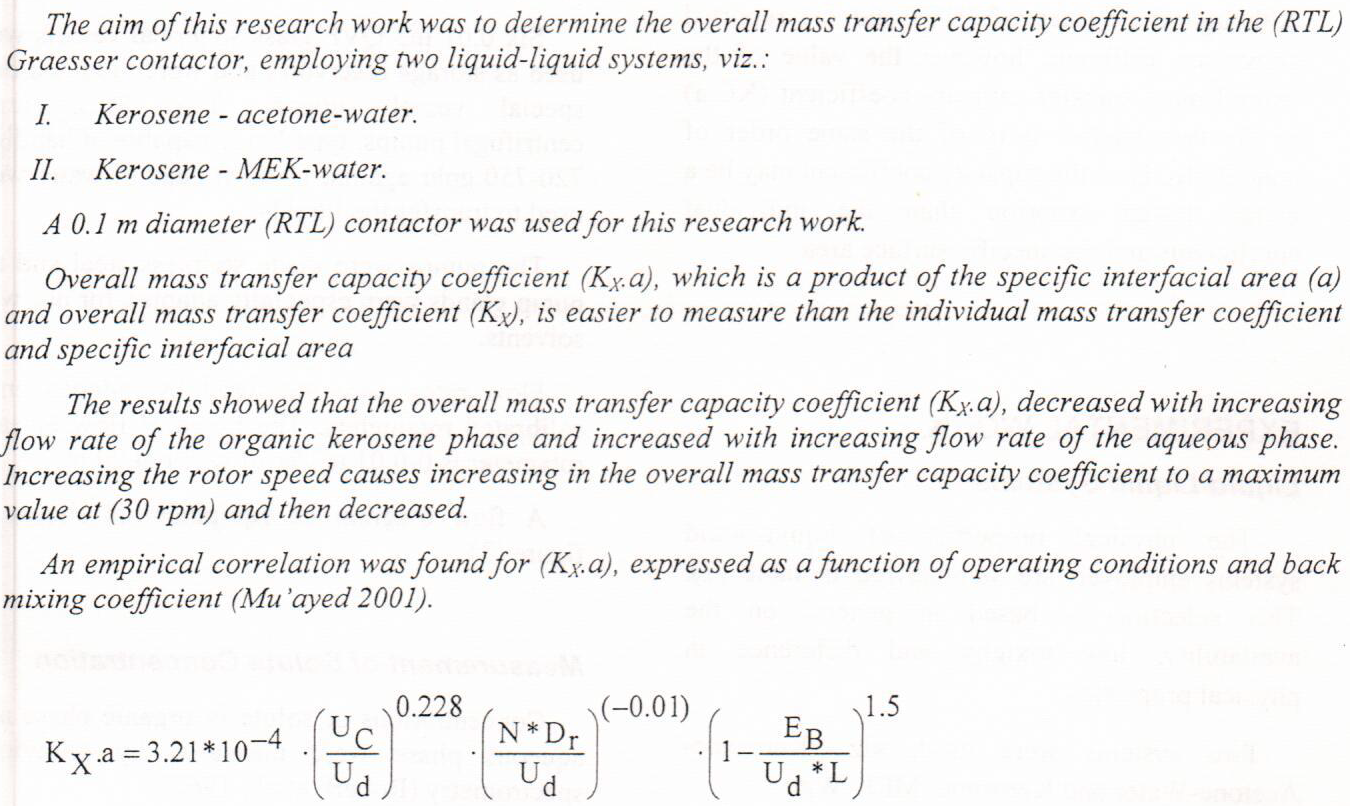
Volumetric Mass Transfer Capacity Coefficient in the RTL Extractor

New polymer blend with enhanced properties was prepared from (80 %) epoxy resin (Ep), (20%) unsaturated polyester resin (UPE) as a matrix material. The as-obtained polymer blend was further reinforced by adding Sand particles of particle size (53 μm) with various weight fraction (5, 10, 15, 20 %). Thermal conductivity and sorption measurements are performed in order to determine diffusion coefficient in different chemical solutions (NaOH, HCl) with concentration (0.3N) after immersion for specific period of time (30 days). The obtained results demonstrate that the addition of sand powder to (80%EP/20%UPE) blend leads to an increase of thermal conductivity, with an optimum/minimum diffusion coefficient in (HCl)/(NaOH), respectively.
 (3)
(3)

 (3)
(5)
(3)
(5)
 (6)
(48)
(6)
(48)
A series of laboratory model tests has been carried out to investigate the using of pomegranate sticks mat as reinforcement to increase the bearing capacity of footing on loose sand. The influence of depth and length of pomegranate sticks layer was examined. In the present research single layer of pomegranate sticks reinforcement was used to strengthen the loose sand stratum beneath the strip footing. The dimensions of the used foundation were 4*20 cm. The reinforcement layer has been embedded at depth 2, 4 and 8 cm under surcharge stresses . Reinforcing layer with length of 8 and 16 cm were used. The final model test results indicated that the inclusion of pomegranate sticks reinforcement is very effective in improvement the loading cap
... Show More
Mixed convection heat transfer in a vertical concentric annulus packed with a metallic porous media and heated at a constant heat flux is experimentally investigated with water as the working fluid. A series of experiments have been carried out with a Rayleigh number range from Ra=122418.92 to 372579.31 and Reynolds number that based on the particles diameter of Red=14.62, 19.48 and 24.36. Under steady state condition, the measured data were collected and analyzed. Results show that the wall surface temperatures are affected by the imposed heat flux variation and Reynolds number variation. The variation of the local heat transfer coefficient and the mean Nusselt number are presented and analyzed. An empirical
... Show MoreSteady natural convection in a square enclosure with wall length (L= 20 cm) partially filled by saturated porous medium with same fluid (lower layer) and air (upper layer) is investigated. The conceptual study of the achievements of the heat transfer is performed under effects of bottom heating by constant heat flux (q=150,300,450,600W/m2 ) for three heaters size (0.2,0.14,0.07)m with symmetrically cooling with constant temperature on two vertical walls and adiabatic top wall. The relevant filled studied parameters are four different porous medium heights (Hp=0.25L,0.5L, 0.75L, L), Darcey number (Da1) 3.025×10⁻⁸ and (Da2) 8.852×10⁻⁴ ) and Rayleigh number range (60.354 - 241.41), (1.304×10⁶ – 5.2166×10⁶ ) for Da1 and Da2 cases respecti
... Show MoreThe heat transfer and flow resistance characteristics for air flow cross over circular finned tube heat exchanger has been studied numerically and experimentally. The purpose of the study was to improve the heat transfer characteristics of an annular finned-tube heat exchanger for better performance. The study has concentrated on the effect of the number of perforations and perforations shapes on the heat transfer and pressure drop across a staggered finned tube heat exchanger. The Numerical part of present study has been performed using ANSYS Fluent 14.5 using SST Turbulent model, while the experimental study consist from a test rig with different models of heat exchangers and all required measurement devices were build
... Show More