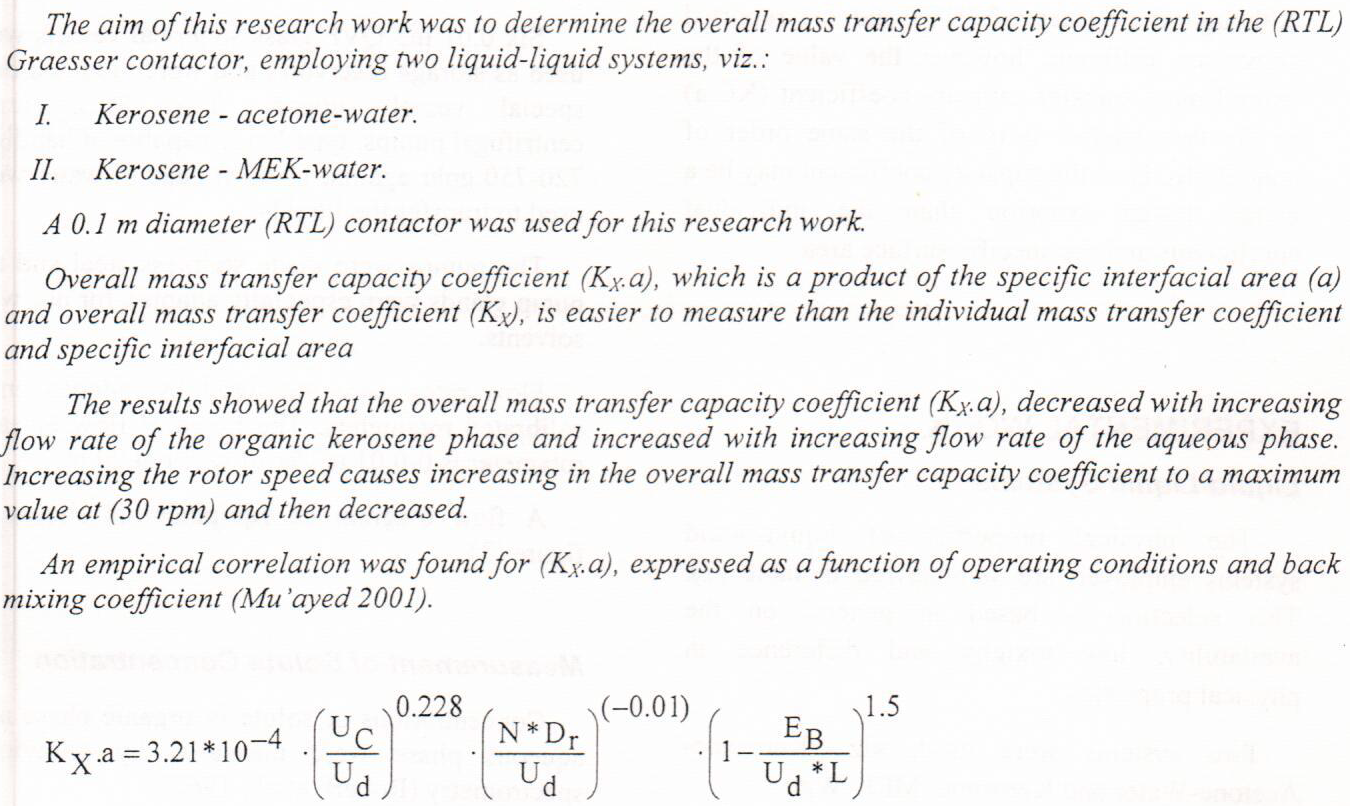
Volumetric Mass Transfer Capacity Coefficient in the RTL Extractor

إحدى أهم الطرق لتقصي توزيع المجرات عبر الزمن الكوني هي دالة اللمعان LF بدلالة كتلة القرص الباريوني ψS(Mb)، القدر . لقد درسنا تقديرًا لكثافة كتلة الباريون في عينة من المجرات الحلزونية القضيبية وغير القضيبية من الادبيات السابقة، والتي تتضمن فعليًا، لكل صنف من الاجرام السماوية ذات المحتوى الباريون المرئي، جزءًا لا يتجزأ من ناتج دالة الضيائية (LF) ونسبة الكتلة إلى الضوء. استخدمت تقنية الانحدار المتعدد لحزمة الب
... Show More (2)
(2)
 (1)
(1)


 (4)
(4)
An electrolytic process for the removal of Zn(II) from aqueous solution using a parallel amalgamated copper screens cathode operated in the flow through mode is proposed. The current-potential curves recorded at a rotating amalgamated copper disc electrode were used to determine diffusion coefficient of Zn(II). The performance of electrolytic reactor was investigated by using different flow rates at initial zinc ion concentration(48 mg/L). Taking into account the residential Zn(II) concentration, the best results were obtained for cathode potential of (-1.35 V vs. SCE) at flow rate (320 L/h). Zinc ion concentration was found to decrease from 48 mg/L to 1 mg/L during 120 min. of electrolysis. The experimental data are well correlate
... Show More
has experienced a step-change since the inception of ambient mass spectrometry removed the requirement for samples to be investigated under vacuum conditions. Approaches based on surface– plasma interactions are especially promising, including PADI. Whilst the mechanisms involved in generating PADI spectra still need to be unravelled, PADI shows significant promise to become a valuable and versatile tool in the instrumental arsenal available to the surface analyst
Background The traditional management of appendicular mass is an initial conservative treatment followed by interval appendectomy. Recently interval appendicectomy has been questioned.
Objective: The purpose of this study was to clarify the need and the role of interval appendicectomy after successful initial conservative treatment.
Method: This is a prospective study conducted in a major hospital in Basra from April 2006 to Septemper2010, included 65 patients with appendicular mass which subsequently proved postinflammmatory (phlegmonous) changes of the appendix were treated conservatively.
Results: Routine interval appendicectomy was not performed and needed after successful treatment in the majority of the patients (84.6%). F
A paraffin wax and copper foam matrix were used as a thermal energy storage material in the double passes air solar chimney (SC) collector to get ventilation effect through daytime and after sunset. Air SC collector was installed in the south wall of an insulated test room and tested with different working angles (30o, 45o and 60o). Different SC types were used; single pass, double passes flat plate collector and double pass thermal energy storage box collector (TESB). A computational model based on the finite volume method for transient tw dimensional domains was carried out to describe the heat transfer and storage in the thermal energy storage material of collector. Also, equivalent specific heat metho
... Show More
(3)
In this study, the behavior of screw piles models with continuous helix was studied by conducting laboratory experimental tests on a single screw pile that has several aspect ratios (L/D) under the influence of static axial compression loads. The screw piles were inserted in a soft soil that has a unit weight of 18.72 kN/m3 and moisture content of 30.19%. Also, the soil has a liquid limit of 55% and a plasticity index of 32%. A physical laboratory model was designed to investigate the ultimate compression capacity of the screw pile and measure the generated porewater pressure during the loading process. The bedding soil was prepared according to the field unit weight and moisture content and the failure load was assumed correspondin
... Show More
(9)
(6)
Double-layer micro-perforated panels (MPPs) have been studied extensively as sound absorption systems to increase the absorption performance of single-layer MPPs. However, existing proposed models indicate that there is still room for improvement regarding the frequency bands of absorption for the double-layer MPP. This study presents a double-layer MPP formed with two single MPPs with inhomogeneous perforation backed by multiple cavities of varying depths. The theoretical formulation is developed using the electrical equivalent circuit method to calculate the absorption coefficient under a normal incident sound. The simulation results show that the proposed model can produce absorption coefficient with wider absorption bandwidth compared w
... Show More
(23)
(19)
In this work, an explicit formula for a class of Bi-Bazilevic univalent functions involving differential operator is given, as well as the determination of upper bounds for the general Taylor-Maclaurin coefficient of a functions belong to this class, are established Faber polynomials are used as a coordinated system to study the geometry of the manifold of coefficients for these functions. Also determining bounds for the first two coefficients of such functions.
In certain cases, our initial estimates improve some of the coefficient bounds and link them to earlier thoughtful results that are published earlier.
(4)
(2)
(2)
(1)