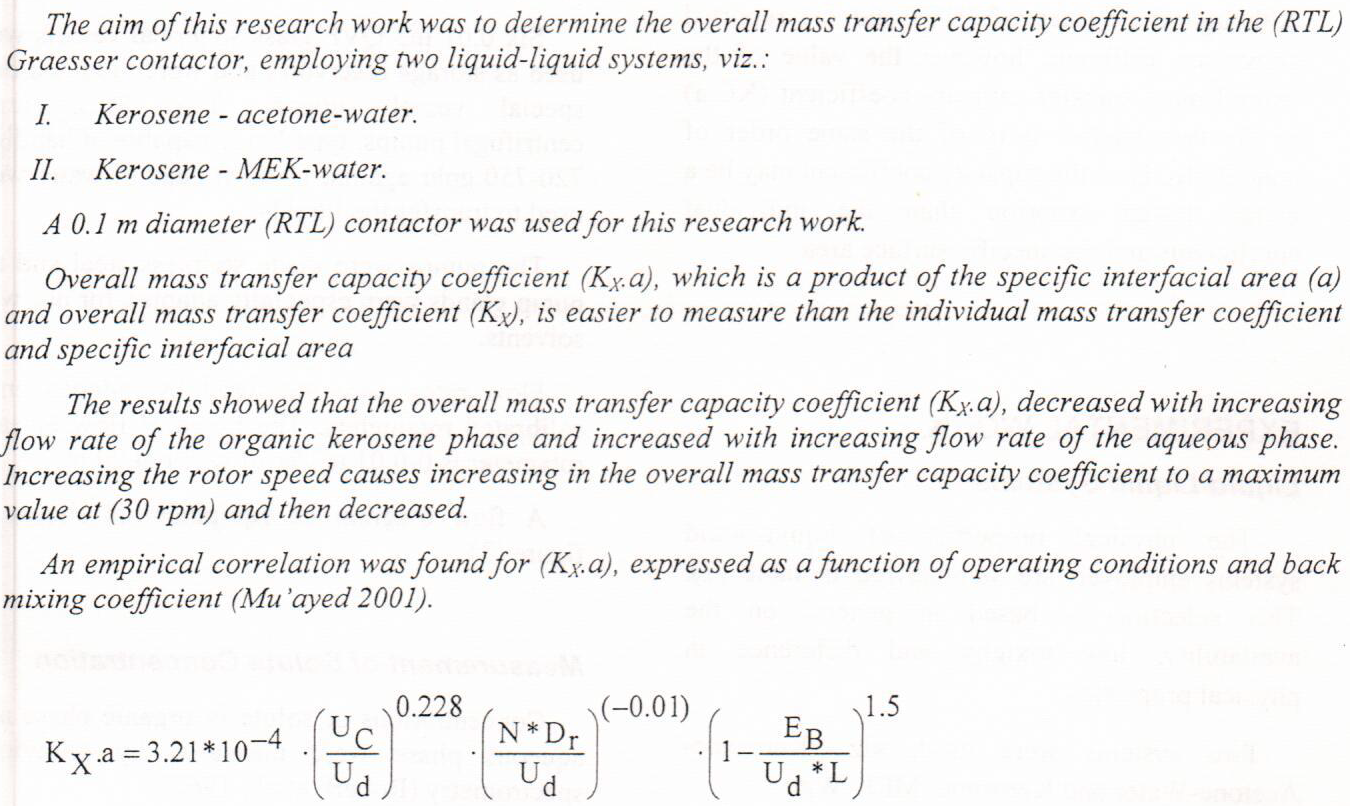
Volumetric Mass Transfer Capacity Coefficient in the RTL Extractor

An analytical approach based on field data was used to determine the strength capacity of large diameter bored type piles. Also the deformations and settlements were evaluated for both vertical and lateral loadings. The analytical predictions are compared to field data obtained from a proto-type test pile used at Tharthar –Tigris canal Bridge. They were found to be with acceptable agreement of 12% deviation.
Following ASTM standards D1143M-07e1,2010, a test schedule of five loading cycles were proposed for vertical loads and series of cyclic loads to simulate horizontal loading .The load test results and analytical data of 1.95
... Show MoreThis paper presents a comprehensive numerical analysis of the improvement in bearing capacity and settlement performance of hexagonal shallow footings with inclined skirts. Various numerical analyses were conducted using PLAXIS 3D to investigate the influence of skirt length-to-footing width (L/B) ratios and skirt inclination angles (θ) on hexagonal footings in loose sand. The models showed very good agreement with experimental data reported in previous studies, with an R² value of 0.996 and a maximum error of less than 4.31%. It was concluded that the inclusion of inclined skirts has a positive effect on bearing capacity, increasing it by up to approximately 2.97 times compared to non-inclined configurations, while significantly
... Show More

A numerical investigation has been performed to study the effect of eccentricity on unsteady state, laminar aiding mixed convection in a horizontal concentric and eccentric cylindrical annulus. The outer cylinder was kept at a constant temperature
while the inner cylinder was heated with constant heat flux. The study involved numerical solution of transient momentum (Navier-Stokes) and energy equation using finite difference method (FDM), where the body fitted coordinate system (BFC) was
used to generate the grid mesh for computational plane. The governing equations were transformed to the vorticity-stream function formula as for momentum equations and to the temperature and stream function for energy equation.
A computer progra
Transient three-dimensional natural convection heat transfer due to the influences of heating from one side of an enclosure filled with a saturated porous media, whereas the opposite side is maintained at a constant cold temperature, and the other four sides are adiabatic, were investigated in the present work experimentally. Silica sand was used as a porous media saturated with distilled water filled in a cubic enclosure heated from the side,using six electrical controlled heaters, at constant temperatures of (60, 70, 80, 90, and 100oC). The inverse side cooled at a constant temperature of (24oC) using an aluminum heat exchanger, consisted of 15 channels feeded with constant temperature water. Eighty thermocouples were used to control t
... Show More
 (6)
(2)
(6)
(2)
The evacuated tube solar collector ETC is studied intensively and extensively by experimental and
theoretical works, in order to investigate its performance and enhancement of heat transfer, for Baghdad climate
from April 2011 till the end of March 2012. Experimental work is carried out on a well instrumented collector
consists of 16 evacuated tubes of aspect ratio 38.6 and thermally insulated tank of volume 112L. The relation
between convective heat transfer and natural circulation inside the tube is estimated, collector efficiency, effect of
tube tilt angles, incidence angle modifier, The solar heating system is investigated under different loads pattern (i.e
closed and open flow) to evaluate the heat loss coefficient
 (17)
(17)
This work examines numerically the effects of particle size, particle thermal conductivity and inlet velocity of forced convection heat transfer in uniformly heated packed duct. Four packing material (Aluminum, Alumina, Glass and Nylon) with range of thermal conductivity (from200 W/m.K for Aluminum to 0.23 W/m.K for Nylon), four particle diameters (1, 3, 5 and 7 cm), inlet velocity ( 0.07, 0.19 and 0.32 m/s) and constant heat flux ( 1000, 2000 and 3000 W/ m 2) were investigated. Results showed that heat transfer (average Nusselt number Nuav) increased with increasing packing conductivity; inlet velocity and heat flux, but decreased with increasing particle size.Also, Aluminum average Nusselt number is about (0.85,2.
... Show More