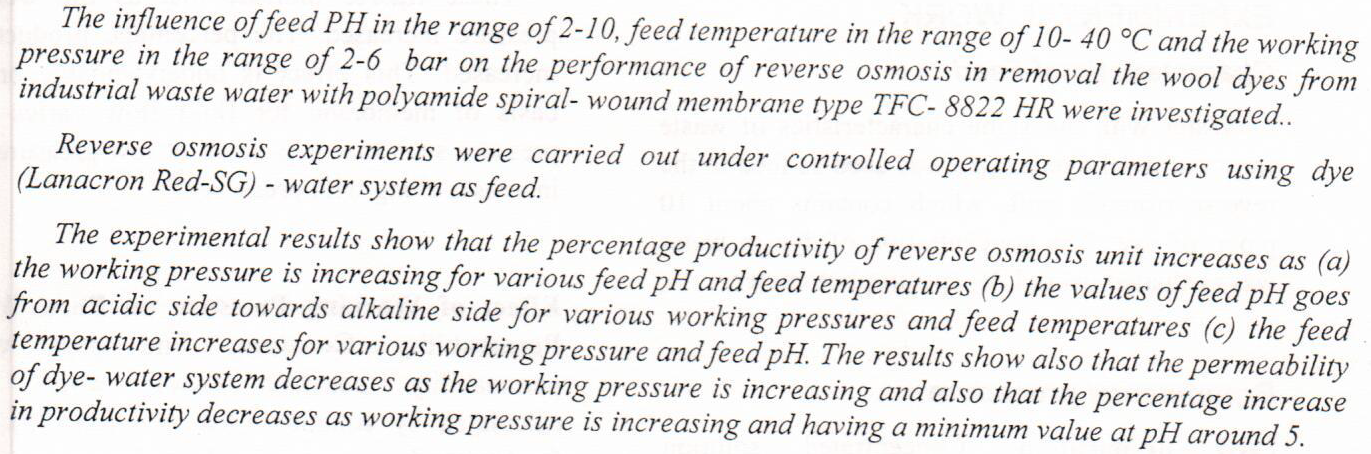
Removal of Wool Dyes from Industrial Wastewater by Reverse Osmosis Process

In this work, a local sunflower husk (SFH) was used as a natural surface for removing Basic Green-4 (BG4) dye, as a watersoluble pollutant. The effect of initial concentration, contact time, the mass of surface of the dye with the SFH as well as the medium temperature was studied. The application of Langmuir, Freundlich isotherms on the collected data of the adsorption process found to harmonize to Freundlich equation more than that of Langmuir. However, the adsorbed mass of BG4 dye showed a direct increase with the increase of SFH mass and equilibrium was achieved within a 60min window. The interaction of BG4 with SFH surface was spontaneous and exothermic. The empirical kinetic outcomes at ambient temperatures were applied to pseudo 1st a
... Show More
The approach of green synthesis of bio-sorbent has become simple alternatives to chemical synths as they use for example plant extracts, plus green synthesis outperforms chemical methods because it is environmentally friendly besides has wide applications in environmental remediation. This paper investigates the removal of ciprofloxacin (CIP) using green tea nano zero-valent iron (GT-NZVI) in an aqueous solution. The synthesized GT-NZVI was categorized using SEM, AFM, BET, FTIR, and Zeta potentials techniques. The spherical nanoparticles were found to be nano zero-valent, with an average size of 85 nm and a surface area of 2.19m2/g. The results showed that the removal efficiency of ciprofloxacin depends on the initial pH (2.5-10),
... Show More (7)
(216)
(7)
(216)
 (193)
(193)


For this research, the utilisation of electrocoagulation (EC) toremove theciprofloxacin (CIP) and levofloxacin (LVX) from aqueous solutions was examined. The effective removal efficiencies are 93.47% for CIP and 88.00% for LVX, under optimum conditions. The adsorption isotherm models with suitable mechanisms were applied to determine the elimination of CIP and LVX utilizingtheEC method. Thefindingsshowed the adsorption of CIP and LVX on iron hydroxide flocs followed the Sips isotherm, with correlation coefficient values (R2) of 0.939 and 0.937. Threekinetic models were reviewed to determine the accurate CIP and LVX elimination methods using the EC method. The results showed that itfittedfor the second-order model, which indicated that the c
... Show More
(58)
(41)
For this research, the utilisation of electrocoagulation (EC) toremove theciprofloxacin (CIP) and levofloxacin (LVX) from aqueous solutions was examined. The effective removal efficiencies are 93.47% for CIP and 88.00% for LVX, under optimum conditions. The adsorption isotherm models with suitable mechanisms were applied to determine the elimination of CIP and LVX utilizingtheEC method. Thefindingsshowed the adsorption of CIP and LVX on iron hydroxide flocs followed the Sips isotherm, with correlation coefficient values (R2) of 0.939 and 0.937. Threekinetic models were reviewed to determine the accurate CIP and LVX elimination methods using the EC method. The results showed that itfittedfor the second-order model, which indicated that the c
... Show More
(41)
A total number of 68 water samples was revealed 20 isolates being Staphylococcus aureus. Irrigation water isolates represented 25% of isolates while wastewater 75%. all isolates were identified by morphological, microscopial, biochemical tests and VITEK®2 Compact. Bacterial isolates were subjected to 16 antibiotics, all irrigation water and wastewater isolates were resistant to penicillin while they were fully sensitive to Ciprofloxcin. Irrigation water isolates showed relatively greater multi-drug resistance than wastewater, wherein irrigation water isolates showed 100% multi-drug resistance while wastewater isolates showed 73.3% multi-drug resistance, indicating the ability of S. aureus MDR to move from one site to another, which means t
... Show More
(26)
(5)
The dyes Azo have a lengthy history and are a vital part of our daily lives. There are numerous potentials uses for these substances and their derivatives in various industries and environmental and biological research. In this study conversion of various azo compounds into other derivatives, complexes, and polymers was accomplished. This review included examining the chemistry reactions, synthesis, and applications of azo dye ligands and their complexes, mentioned spectral, analytical, thermal, and morphology methods of investigation, and confirmed by mass fragment mechanisms for some azo dyes and metal complexes. One of the aims of this review is to explain the role of these azo dye derivatives and the effect of metal complexes on leather
... Show More
The dyes Azo have a lengthy history and are a vital part of our daily lives. There are numerous potentials uses for these substances and their derivatives in various industries and environmental and biological research. In this study conversion of various azo compounds into other derivatives, complexes, and polymers was accomplished. This review included examining the chemistry reactions, synthesis, and applications of azo dye ligands and their complexes, mentioned spectral, analytical, thermal, and morphology methods of investigation, and confirmed by mass fragment mechanisms for some azo dyes and metal complexes. One of the aims of this review is to explain the role of these azo dye derivatives and the effect of metal complexes on
... Show More