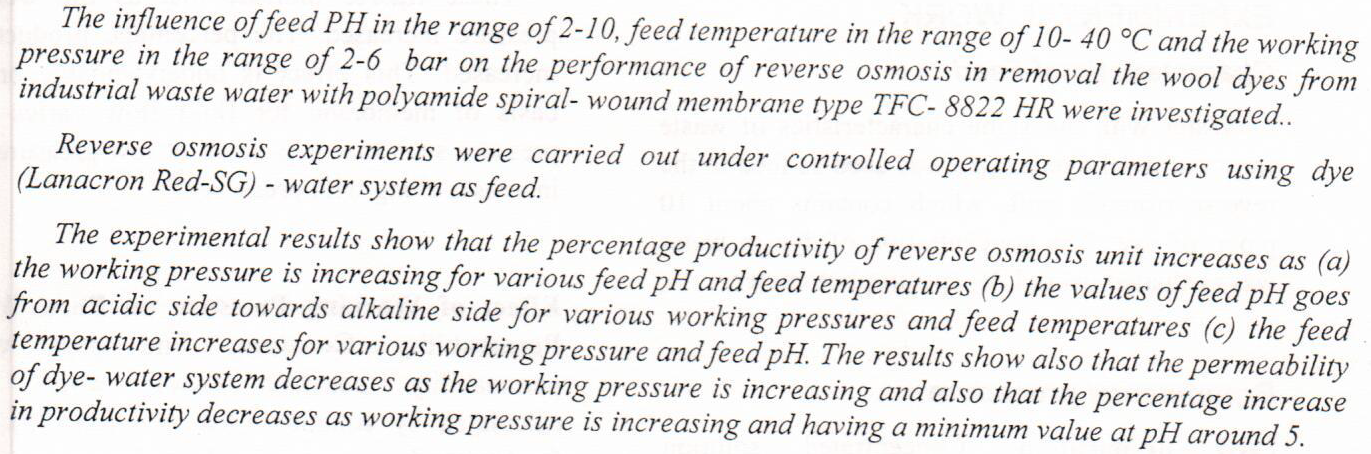
Removal of Wool Dyes from Industrial Wastewater by Reverse Osmosis Process

The regression analysis process is used to study and predicate the surface response by using the design of experiment (DOE) as well as roughness calculation through developing a mathematical model. In this study; response surface methodology and the particular solution technique are used. Design of experiment used a series of the structured statistical analytic approach to investigate the relationship between some parameters and their responses. Surface roughness is one of the important parameters which play an important role. Also, its found that the cutting speed can result in small effects on surface roughness. This work is focusing on all considerations to make interaction between the parameters (position of influenc
... Show More (1)
(1)

Incremental sheet metal forming process is an advanced flexible manufacturing process to produce various 3D products without using dedicated tool as in conventional metal forming. There are a lot of process parameters that have effect on this process, studying the effect of some parameters on the strain distributions of the product over the length of deformation is the aim of this study.
In order to achieve this goal, three factors (tool forming shape, feed rate and incremental step size) are examined depending on three levels on the strain distributions over the wall of the product. Strain measurement was accomplished by using image processing technique using MATALB program. The significance of the control factors are explored u
... Show More
Electrodeposition of metal oxides on graphite electrodes can improve their ability to remove organic substances. In this work, multicomponent oxides of Mn, Co, and Ni were electrochemically deposited on both the anode and cathode of graphite electrodes to enhance their performance in removing phenol. Formation of the deposit was achieved within 2 h in current densities of 20, 25, 30, and 35 mA/cm2 for better composite properties. The deposited layer was characterized by testing the surface structure, morphology, composition, and roughness. X-ray diffraction (XRD), scanning electron microscopy (SEM), energy dispersive X-ray (EDX), and Atomic force microscopy (AFM) techniques facilitated these tests. The composite electrodes have synthesized
... Show More (10)
(7)
(10)
(7)

The availability of low- cost adsorbent namely Al-Khriet ( a substance found in the legs of Typha Domingensis) as an agricultural waste material, for the removal of lead and cadmium from aqueous solution was investigated. In the batch tests experimental parameters were studied, including adsorbent dosage between (0.2-1) g, initial metal ions concentration between (50-200) ppm (single and binary) and contact time (1/2-6) h. The removal percentage of each ion onto Al-Khriet reached equilibrium in about 4 hours. The highest adsorption capacity was for lead (96%) while for cadmium it was (90%) with 50 ppm ions concentration, 1 g dosage of adsorbent and pH 5.5. Adsorption capacity in the binary mixture were reduce at about 8% for lead a
... Show MoreThis paper studied kinetics of flotation of emulsified paraffine in water in bubble column with sodium .dodecylsulphate as a collector agent. The effects of oil drops and air bubble diameters on the flotation rate constant were studied. The removal rate for each oil drop size was first order with respect to oil drop concentration. An experimental procedure permitting determination of the first order rate constants for removal due to bubble/drop interaction was developed, decreasing bubble diameter by adding NaCl and increasing oil drop diameter increased the rate constants. A comparison between the experimental and theoretical rate constants showed
... Show More
(61)
(44)
 (7)
(6)
(7)
(6)
The uptake of Cd(II) ions from simulated wastewater onto olive pips was modeled using artificial neural network (ANN) which consisted of three layers. Based on 112 batch experiments, the effect of contact time (10-240 min), initial pH (2-6), initial concentration (25-250 mg/l), biosorbent dosage (0.05-2 g/100 ml), agitation speed (0-250 rpm) and temperature (20-60ºC) were studied. The maximum uptake (=92 %) of Cd(II) was achieved at optimum parameters of 60 min, 6, 50 mg/l, 1 g/100 ml, 250 rpm and 25ºC respectively.
Tangent sigmoid and linear transfer functions of ANN for hidden and output layers respectively with 7 neurons were sufficient to present good predictions for cadmium removal efficiency with coefficient of correlatio
... Show MoreAromatic hydrocarbons present in Iraqi national surface water were believed to be raised principally from combustion of various petroleum products, industrial processes and transport output and their precipitation on surface water.
Polycyclic aromatic hydrocarbons (PAHs) were included in the priority pollutant list due to their toxic and carcinogenic nature. The concern about water contamination and the consequent human exposure have encouraged the development of new methods for
PAHs detection and removal.
PAHs, the real contaminants of petroleum matter, were detected in selected sites along Tigris River within Baghdad City in summer and winter time, using Shimadzu high performance liquid chromatography (HPLC) system.
Analysi
Modified bentonite has been used as effective sorbent material for the removal of acidic dye (methyl orange) from aqueous solution in batch system. The natural bentonite has been modified using cationic surfactant (cetyltrimethyl ammonium bromide) in order to obtain an efficient sorbent through converting the properties of bentonite from hydrophilic to organophilic. The characteristics of the natural and modified bentonite were examined through several analyses such as Scanning electron microscopy (SEM), Fourier transform infrared spectroscopy (FTIR), and Surface area. The batch study was provided the maximum dye removal efficiency of 88.75 % with a sorption capacity of 555.56 mg/g at specified conditions (150 min, pH= 2, 250 rpm, and 0.
... Show More
(4)