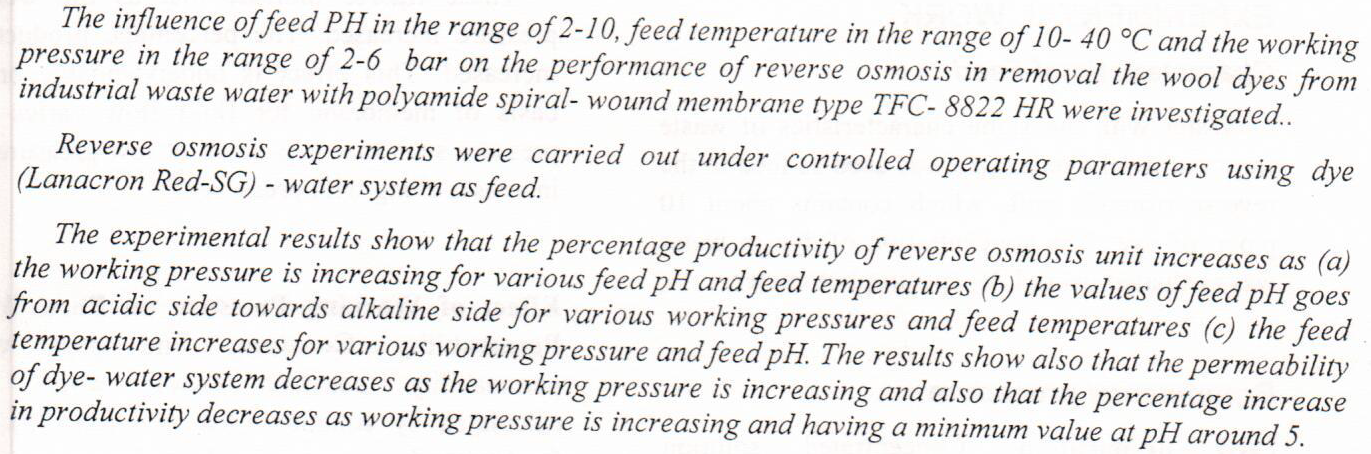
Removal of Wool Dyes from Industrial Wastewater by Reverse Osmosis Process

The aim of this investigation was to study the impact of various reaction parameters on wastewater taken from Al-Wathba water treatment plant on Tigris River in south of Baghdad, Iraq with sodium hypochlorite solution. The parameters studied were sodium hypochlorite dose, contact time, initial fecal coliform bacteria concentration, temperature, and pH. In a batch reactor, different concentrations of sodium hypochlorite solution were used to disinfect 1L of water. The amount of hypochlorite ions in disinfected water was measured using an Iodimetry test for different reaction times, whereas the Most Probable Number (MPN) test was used to determine the concentration of coliform bacteria. Total Plate Count (TPC) was utilized in this study to
... Show More
In the theoretical part, removal of direct yellow 8 (DY8) from water solution was accomplished using Bentonite Clay as an adsorbent. Under batch adsorption, the adsorption was observed as a function of contact time, adsorbent dosage, pH, and temperature. The equilibrium data were fitted with the Langmuir and Freundlich adsorption models, and the linear regression coefficient R2 was used to determine the best fitting isotherm model. thermodynamic parameters of the ongoing adsorption mechanism, such as Gibb's free energy, enthalpy, and entropy, have also been measured. The batch method was also used for the kinetic calculations, and the day's adsorption assumes first-order rate kinetics. The kinetic studies also show that the intrapar
... Show More
Arsenic is a prevalent and pervasive environmental contaminant with varied amounts in drinking water. Arsenic exposure causes cancer, cardiovascular, liver, nerve, and ophthalmic diseases. The current study aimed to find the best conditions for eliminating arsenic from simulated wastewater and their effect on biomarkers of hepatic in mice. Adsorption tests including pH, contact duration, Al-kheriat dosage, and arsenic concentrations were evaluated. Seventy-two healthy albino mice (male) were accidentally allocated into nine groups (n = 8), the first group was considered as healthy control, the second group (AL-Kheriat), and other groups received AL-Kheriat and arsenic 25, 50, 75, 100, 125, 150 and 175 mg/kg, respectively. Next 10 days, the
... Show More (3)
(3)
In this study, a packed bed was used to remove pathogenic bacteria from synthetic contaminated water. Two types of packing material substrates, sand and zeolite, were used. These substrates were coated with silver nanoparticles (AgNPs), which were prepared by decomposition of Ag ions from AgNO3 solution. The prepared coated packings were characterized using scanning electron microscopy, energy-dispersive X-ray spectroscopy and transmission electron microscopy. The packed column consisted of a PVC cylinder of 2 cm diameter and 20 cm in length. The column was packed with silver nanoparticlecoated substrates (sand or zeolite) at a depth of 10 cm. Four types of bacteria were studied: Escherichia coli, Shigella dysenteriae, Pseudomonas aerugi
... Show More
(5)
 (18)
(16)
(18)
(16)

In this study, the use of non-thermal plasma theory to remove toxic gases emitted from a vehicle was experimentally investigated. A non-thermal plasma reactor was constructed in the form of a cylindrical tube made of Pyrex glass. Two stainless steel rods were placed inside the tube to generate electric discharge and plasma condition, by connecting with a high voltage power supply (up to 40 kV). The reactor was used to remove the contaminants of a 1.25-liter 4-cylinder engine at ambient conditions. Several tests have been carried out for a ranging speed from 750 to 4,500 rpm of the engine and varying voltages from 0 to 32 kV. The gases entering the reactor were examined by a gas analyzer and the gases concentration ratio
... Show More
(4)
(45)
(31)
(25)
Deep drawing process to produce square cup is very complex process due to a lot of process parameters which control on this process, therefore associated with it many of defects such as earing, wrinkling and fracture. Study of the effect of some process parameters to determine the values of these parameters which give the best result, the distributions for the thickness and depths of the cup were used to estimate the effect of the parameters on the cup numerically, in addition to experimental verification just to the conditions which give the best numerical predictions in order to reduce the time, efforts and costs for producing square cup with less defects experimentally is the aim of this study. The numerical analysis is used to study
... Show More
(3)
The research is a vision of the future of industry in Iraq, so it is may be outside the ceiling of the capabilities of the Iraqi economy, and therefore it is exaggerated. Therefore, future plans must be applicable through the availability of capabilities. Everyone knows that the financial and administrative corruption and mismanagement of resources are the main cause of the inefficiency of the industrial sector, and the failure to exercise its real role in achieving economic development.; as well as the political situation and the dominance of parties and their insistence on addressing positions that have a strong relationship in managing the economic sector that has a significant impact on drawing the economic map in its current
... Show More
(1)