Preferred Language
Articles
/
ijcpe-625
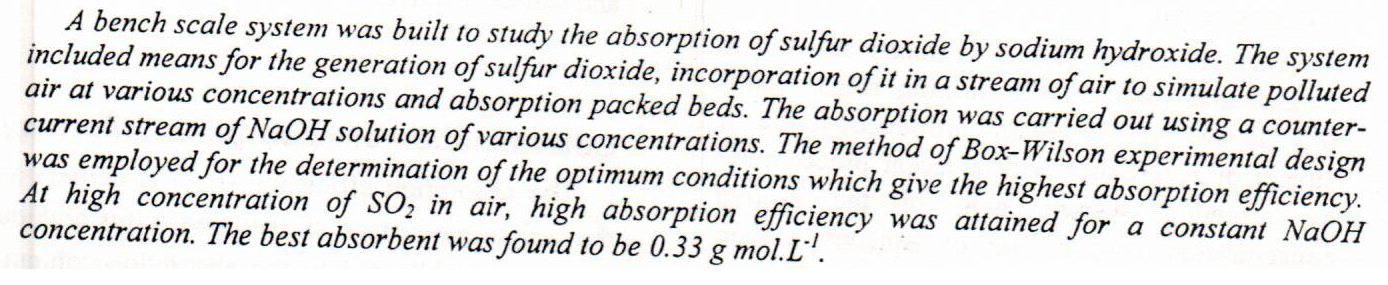
Removal of Sulfur Dioxide from Sulfuric Acid Plant Emissions
...Show More Authors

View Publication Preview PDF
Quick Preview PDF
Publication Date
Tue Jan 01 2019
Journal Name
International Journal Of Agricultural And Statistical Sciences
Effect of foliar spraying with gibberellic and humic acid on wheat growth
...Show More Authors

Scopus (11)
Scopus
Publication Date
Sat Jun 01 2019
Journal Name
Prensa Medica Argentina
The effect of niclosamide in acetic-acid induce colitis: An experimental study
...Show More Authors

Scopus (31)
Scopus
Publication Date
Sun Mar 30 2025
Journal Name
Studia Universitatis BabeČ™-bolyai Chemia
GREEN SPECTROPHOTOMETRIC METHOD FOR CONCURRENT ESTIMATION OF PIROXICAM AND MEFENAMIC ACID MIXTURE
...Show More Authors

View Publication
Scopus (2)
Crossref (1)
Scopus Clarivate Crossref
Publication Date
Mon Apr 01 2019
Journal Name
Journal Of Engineering
Application of Waste Lead Acid Battery Plastic to Produce Lightweight Masonry Units
...Show More Authors

The concrete industry consumes millions of tons of aggregate comprising of natural sands and gravels, each year. In recent years there has been an increasing trend towards using recycled aggregate to save natural resources and to produce lightweight concrete. This study investigates the possibility of using waste plastic as one of the components of lead-acid batteries to replace the fine aggregate by 50 and 70% by volume of concrete masonry units. Compared to the reference concrete mix, results demonstrated that a reduction of approximately 32.5% to 39.6% in the density for replacement of 50% to 70% respectively. At 28 days curing age, the compressive strength was decreased while the water absorption increased by increas

... Show More
View Publication Preview PDF
Crossref (2)
Crossref
Publication Date
Tue Sep 19 2023
Journal Name
Bulletin Of The Chemical Society Of Ethiopia
Exploring the biological activity of organotin carboxylate complexes with 4-sulfosalicylic acid
...Show More Authors

ABSTRACT. 4-Sulfosalicylic acid (SSA) was used as a ligand to prepare new triphenyltin and dimethyl-tin complexes by condensation with the corresponding organotin chloride salts. The complexes were identified by different techniques, such as infrared spectra (tin and proton), magnetic resonance, and elemental analyses. The 119Sn-NMR was studied to determine the prepared complexes' geometrical shape. Two methods examined the antioxidant activity of (SSA) and prepared complexes; Free radical scavenging activity (DPPH) and CUPRRAC methods. Tri and di-tin complexes gave high percentage inhibition than ligands with both methods due to tin moiety; the triphenyltin carboxylate complex was the best compared with the others. Also, antibacter

... Show More
View Publication
Scopus (10)
Crossref (1)
Scopus Clarivate Crossref
Publication Date
Thu Mar 07 2024
Journal Name
Oncology Letters
Effect of valproic acid on histone deacetylase expression in oral cancer (Review)
...Show More Authors

View Publication
Scopus (16)
Crossref (13)
Scopus Clarivate Crossref
Publication Date
Mon May 01 2023
Journal Name
Journal Of Medicine And Life
Mucoprotective effect of ellagic acid in 5 fluorouracil-induced intestinal mucositis model
...Show More Authors

View Publication
Scopus (7)
Crossref (10)
Scopus Crossref
Publication Date
Tue Jan 01 2019
Journal Name
Plant Archive
The enhancement of drought tolerance for plant onion (allium cepa l.) inoculated by arbuscular mycorrhizal fungi
...Show More Authors

Scopus (6)
Scopus
Publication Date
Sun Jun 05 2016
Journal Name
Baghdad Science Journal
Bioremediation of Lead and Cadmium Contaminated soil by Sesbania rostrata plant and AM fungi Glomus mosseae
...Show More Authors

This study was conducted to determine the activity of plant Sesbania rostrata and two isolate from arbuscular mycorrhizae fungi (A,B) as a bioremediation of soil polluted by cadmium and lead elements in north and south of Baghdad city. The results showed that the average of soil pollution by cadmium and lead elements in north of Baghdad was less than the average of soil pollution in the south of Baghdad which recorded 10.0, 9.0 mg/kg and 27.0, 25.0 mg/kg respectively. The plant Sesbania recorded ability to accumulate the lead element in shoot system 19.65 mg/kg and in root system 27.2 mg/kg and for cadmium element 19.6, 24.6 mg/kg in shoot and root respectively. The results showed that the isolate A from soil pollution is more effected

... Show More
View Publication Preview PDF
Crossref
Publication Date
Sun Jan 19 2020
Journal Name
Biochemical And Cellular Archives
Isolation and characterization of phosphate solubilizing Pseudomonas species and assess its efficacy as plant growth promoter
...Show More Authors

Preview PDF
Scopus (2)
Scopus


