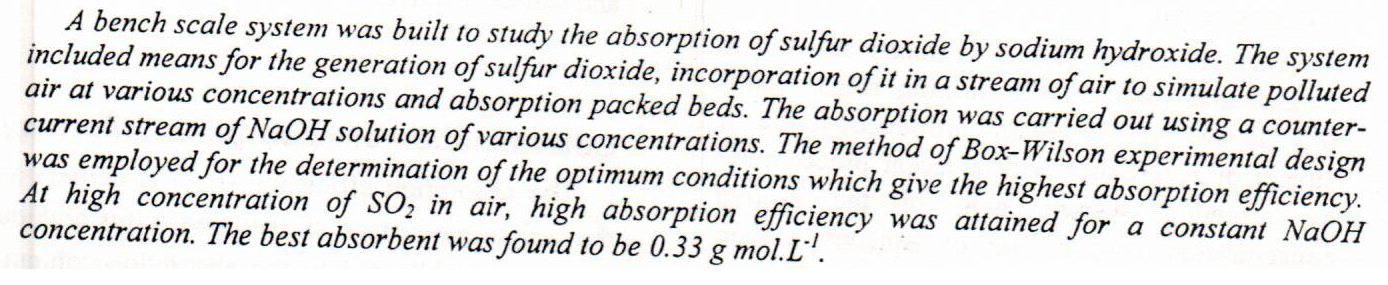
Removal of Sulfur Dioxide from Sulfuric Acid Plant Emissions

In the present work, a kinetic study was performed to the extraction of phosphate from Iraqi Akashat phosphate ore using organic acid. Leaching was studied using lactic acid for the separation of calcareous materials (mainly calcite). Reaction conditions were 2% by weight acid concentration and 5ml/gm of acid volume to ore weight ratio. Reaction time was taken in the range 2 to 30 minutes (step 2 minutes) to determine the reaction rate constant k based on the change in calcite concentration. To determine value of activation energy when reaction temperature is varied from 25 to 65 , another investigation was accomplished. Through the kinetic data, it was found that selective leaching was controlled by surface chemical reactio
... Show More (1)
(1)

This work has been done with using of epoxy resin mixed with Granite powder were weighted by percent volume (5,10,15, and 20)%and then mixed with epoxy polymer to compose polymer composite. Hand lay-up technique is used in fabrication of the composite samples. Hardness test was carried out for the proper samples in both normal condition and after immersion in HCL (1 M and 2 M) solutions for periods ranging up to 10 weeks. After comparing the results between the polymer and their composite, the hardness increased with increasing Granite weight percent, it was found that Hardness were greater for the composites before immersion compared with their values after immersion.
A Modified version of the Generlized standard addition method ( GSAM) was developed. This modified version was used for the quantitative determination of arginine (Arg) and glycine ( Gly) in arginine acetyl salicylate – glycine complex . According to this method two linear equations were solved to obtain the amounts of (Arg) and (Gly). The first equation was obtained by spectrophotometic measurement of the total absorbance of (Arg) and (Gly) colored complex with ninhydrin . The second equation was obtained by measuring the total acid consumed by total amino groups of (Arg) and ( Gly). The titration was carried out in non- aqueous media using perchloric acid in glacial acetic acid as a titrant. The developed metho
... Show More
Esterification reaction is most important reaction in biodiesel production. In this study, oleic acid was used as a suggested feedstock to study and simulate production of biodiesel. Batch esterification of oleic acid was carried out at operating conditions; temperature from 40 to 70 °C, ethanol to oleic acid molar ratio from 1/1 to 6/1, H2SO4 as the catalyst 1 and 5% wt of oleic acid, reaction time up to 180 min. The optimum conditions for the esterification reaction were molar ratio of ethanol/oleic acid 6/1, 5%wt H2SO4 relative to oleic acid, 70 °C, 90 min and conversion of oleic 0.92. The activation energy for the suggested model was 26625 J/mole for forward reaction and 42189 J/mole for equilibrium constant. The obtained results s
... Show MoreThe study dosage ethanol in the total content of acid sialic TC and acid sialic associated fat (LBSA) in blood serum and congener brain Dkor Jerd eggs study included dosage 20 animals of male rat Ald ethanol daily for a period of four weeks and concentrations 20% and 30%, 40%, 50% and size of dose 5mlThe results of the study showed that levels of TSA homogeneous in the brain and blood serum significantly reduced Ankhvaza
In the present work, a kinetic study was performed to the extraction of phosphate from Iraqi Akashat phosphate ore using organic acid. Leaching was studied using lactic acid for the separation of calcareous materials (mainly calcite). Reaction conditions were 2% by weight acid concentration and 5ml/gm of acid volume to ore weight ratio. Reaction time was taken in the range 2 to 30 minutes (step 2 minutes) to determine the reaction rate constant k based on the change in calcite concentration. To determine value of activation energy when reaction temperature is varied from 25 to 65 , another investigation was accomplished. Through the kinetic data, it was found that selective leaching was controlled by
... Show More
(1)
This work presents an investigation on the fabrication and characterization of Fe doped zeolitic imidazolate framework (ZIF-8) of 1:1 M ratio of Zn:Fe (Fe/Zn-ZIF-8) and adsorption performances of acquired materials. The synthesized Zn-ZIF-8, Fe-ZIF-8, and Fe/Zn-ZIF-8 materials were characterized for the phase structure, morphology, elemental analysis and surface area by using X-ray diffraction (XRD), Field emission scanning electron microscope (FESEM), Energy Dispersive X-Ray (EDX), and BET surface area, respectively. The results revealed the adsorption capacity was enhanced by incorporation of Fe into ZIF-8 structure. The CR dye adsorption capacities were 287, 219, and 412 mg/g for Zn-ZIF-8, Fe-ZIF-8, and Fe/Zn-ZIF-8 adsorbers, respectivel
... Show More (9)
(6)
(9)
(6)

In this work a novel drug delivery system through modification of poly acrylic acid with Methionine as a spacer between the poly acrylic acid which was converted to its acyl chloride and reacted with Methionine as spacer unit which has been reacted with Ampicillin drug. In vitro drug release study had been conducted successfully in basic medium in pH 7.4 and acidic medium in pH 1.1 at 37?. Due to many problems associated with drug release and, this modification could decrease the side effect of drug. The prepared prodrug polymer was characterized by spectra method [FTIR and 1H?NMR]. Physical properties and intrinsic viscosity of drug polymer were determined. The good results were obtained in the presence of spacer unit with compar
... Show More
(3)
(1)
To achieve safe security to transfer data from the sender to receiver, cryptography is one way that is used for such purposes. However, to increase the level of data security, DNA as a new term was introduced to cryptography. The DNA can be easily used to store and transfer the data, and it becomes an effective procedure for such aims and used to implement the computation. A new cryptography system is proposed, consisting of two phases: the encryption phase and the decryption phase. The encryption phase includes six steps, starting by converting plaintext to their equivalent ASCII values and converting them to binary values. After that, the binary values are converted to DNA characters and then converted to their equivalent complementary DN
... Show More