Preparation, Characterization, and Properties of Barium Titanate
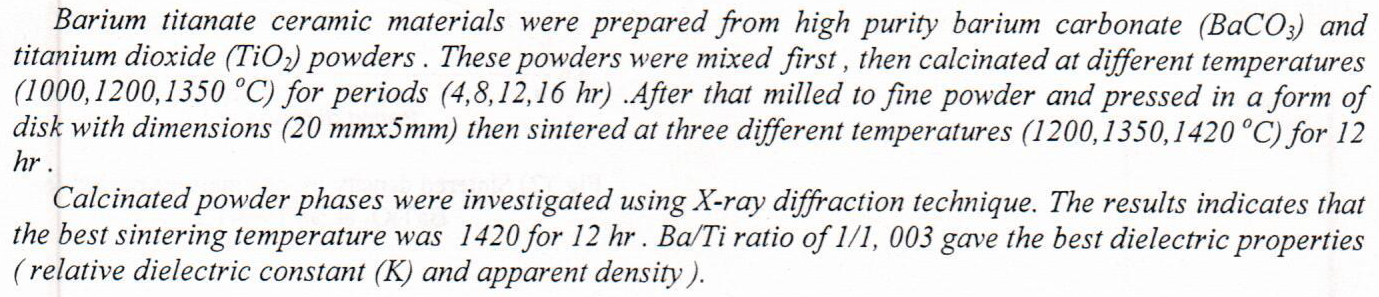

 (29)
(29)
 (11)
(11)



Biscuits are a global snack due to their convenience, variety, and durability. Biscuits with nutritious ingredients are in demand as customers become more health conscious. This change led to interest about utilizing agricultural by-products to enhance the nutritional value of widely consumed foods. Mango (Mangifera indica L.), a frequently cultivated tropical fruit, produces vital by-products during its processing, mainly comprising peels and kernels. The by-products, comprising around 35–60% of the mango fruit's weight, are high in bioactive compounds including dietary fiber, polyphenols, carotenoids, and essential fatty acids. Mango peels and kernels, even with their nutritional potential, frequently neglected, resulting in ris
... Show More
(28)
(24)
Biscuits are a global snack due to their convenience, variety, and durability. Biscuits with nutritious ingredients are in demand as customers become more health conscious. This change led to interest about utilizing agricultural by-products to enhance the nutritional value of widely consumed foods. Mango (Mangifera indica L.), a frequently cultivated tropical fruit, produces vital by-products during its processing, mainly comprising peels and kernels. The by-products, comprising around 35–60% of the mango fruit's weight, are high in bioactive compounds including dietary fiber, polyphenols, carotenoids, and essential fatty acids. Mango peels and kernels, even with their nutritional potential, frequently neglected, resulting in ris
... Show More
(28)
(24)
A variety of single-engine driven files and inematics have been introduced to improve the clinical performance of NiTi rotary files. The purpose of this in vitro study was to measure and compare the incidence of dentinal defects after root canal preparation with different single file systems.
ABSTRACT:
Microencapsulation is used to modify and retard drug release as well as to overcome the unpleasant effect
(gastrointestinal disturbances) which are associated with repeated and overdose of ibuprofen per day.
So that, a newly developed method of microencapsulation was utilized (a modified organic method) through a
modification of aqueous colloidal polymer dispersion method using ethylcellulose and sodium alginate coating materials to
prepare a sustained release ibuprofen microcapsules.
The effect of core : wall ratio on the percent yield and encapsulation efficiency of prepared microcapsules was low, whereas
, the release of drug from prepared microcapsules was affected by core: wall ratio ,proportion of coa
The present work involved synthesis of serval new substituted tetrazole via Schiff bases for trimethoprim drug by two steps. The first step involved direct reaction of different ketones and aldehydes with trimethoprim producing the corresponding Schiff bases (1-10), whereas the second step, involved preparation new tetrazoles derivatives (11-20) through reaction of the ready Schiff bases (in the first step) with sodium azidein in dioxin. The prepared compounds were characterized by UV, FT-IR, and some of them by 13C-NMR, 1H-NMR spectroscopy and physical properties.
The CIGS/CdS p-n junction thin films were fabricated and deposited at room temperature with rate of deposition 5, and 6 nm secG1 , on ITO glass substrates with 1mm thickness by thermal evaporation technique at high vacuum pressure 2×10G5 mbar, with area of 1 cm2 and Aluminum electrode as back contact. The thickness of absorber layer (CIGS) was 1 µm while the thickness of the window layer CdS film was 300 nm. The X-ray Diffraction results have shown that all thin films were polycrystalline with orientation of 112 and 211 for CIGS thin films and 111 for CdS films. The direct energy gaps for CIGS and CdS thin films were 1.85 and 2.4 eV, respectively. Atomic Force Microscopy measurement proves that both films CIGS and CdS films have nanostru
... Show MoreAlthough the profession of a marriage mediator is dominated by a social character, and it is also characterized by its practice in the midst of strict secrecy, because Eastern societies innately reject this method of searching for a life partner. The two parties play a prominent role of the will in the events of legal effects, and the obligations and rights owed by the contracting parties, which leads us to consider the agreement between the mediator and the one who wants to marry going to the purely contractual nature, and thus requires the correct legal adaptation on the contractual relationship that is achieved between the marriage mediator and his clients from Those who want to get married and therefore we will divide this research into
... Show MoreThis study investigated the effect of applying an external magnetic field on the characteristics of laser-induced plasma, such as its parameters plasma, magnetization properties, emission line intensities, and plasma coefficients, for plasma induced from zinc oxide: aluminum composite (ZO:AL) at an atomic ratio of 0.3 %. Plasma properties include magnetization and emission line intensities. The excitation was done by a pulsed laser of Nd:YAG with 400 mJ energy at atmospheric pressure. Both the electron temperature and number density were determined with the help of the Stark effect principle and the Boltzmann-Plot method. There was a rise in the amount of (ne) and (Te) that was produced
... Show More
(2)
The effects of gamma irradiation on the structure of ZnS films , which preparing by flash evaporation method, are studied using XRD. Two peaks of (111), (220) orientations are appeared in X ray chart indicating the cubic phase of the films .The lattice parameter, grain size, average internal stress, microstrain, dislocation density and degree of preferred orientation in the film are calculated and correlated with gamma irradiation.