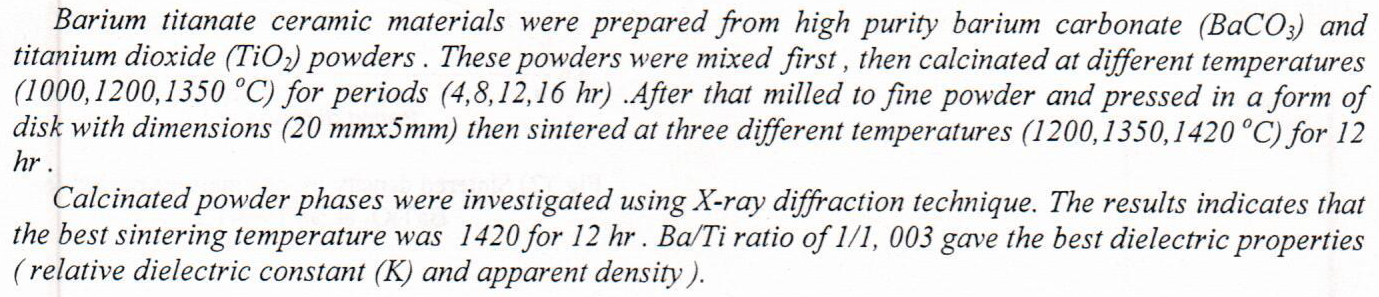
Preparation, Characterization, and Properties of Barium Titanate

The [2-aminobenzothiazole]was reacted with [2,4,6 triyhydroxy-acetophenon monohydrate] to give a new ligand [2-N-2,4,6-trihydroxyacetophenonyliden benzothiazole] [H3L]. This ligand was reacted with metal ions ( CoII, NiII,CuII and ZnII) in methanol as solvent with ( 1:2 ) metal : ligand ratio to give a series of new complexes with general formula [ M(H2L)2],(where:M= CoII, NiII ,CuIIand, ZnII).All compounds were characterized by spectroscopic methods ( I.R , U.V – vis,HPLC) atomic absorption, along with chloride content and conductivity measurements. According to the data of these measurements we suggested a tetrahedral
This study including synthesis of some new Schiff bases compounds [1‐6] from the reaction of Sulfamethoxazole drug with some aromatic aldehydes in classical Schiff base method then treatment Schiff bases with succinic anhydride to get oxazepines rings [7-11]These derivatives were characterized by melting point, FT‐IR, 1H NMR and mass spectra. Some of synthesized compounds were evaluated in vitro for their antibacterial activities against three kinds of pathogenic strains Staphylococcus aureus, Escherichia coli
The goals of endodontic preparation were to shape and clean the space of the root canal and remove microorganisms, affected dentin and pulp, the apical foramen and the canal curve should be protected from being transported during endodontic canal preparation. The aim of this study was to evaluate the curve straightening of curved root canals and apical transportation after preparation with four rotary systems. Forty mesial roots of the lower 1st molars teeth only the mesiobuccal canals were used, these roots were immersed into cold clear acrylic , the teeth roots divided into four groups according to rotary system used for preparation of the canals (ten roots for each group):. group I: ProTaper Next rotary system, group II: IRaCe Plus rotar
... Show MoreAbstract
In this research will be treated with a healthy phenomenon has a significant impact on different age groups in the community, but a phenomenon tonsillitis where they will be first Tawfiq model slope self moving averages seasonal ARMA Seasonal through systematic Xbox Cengnzla counter with rheumatoid tonsils in the city of Mosul, and for the period 2004-2009 with prediction of these numbers coming twelve months, has found that the specimen is the best representation of the data model is the phenomenon SARMA (1,1) * (2,1) 12 from the other side and explanatory variables using a maximum temperature and minimum temperature, sol

Green nanotechnology is a thrilling and rising place of technology and generation that bracesthe ideas of inexperienced chemistry with ability advantages for sustainability, protection, andthe general protection from the race human. The inexperienced chemistry method introduces aproper technique for the production, processing, and alertness of much less dangerous chemicalsubstances to lessen threats to human fitness and the environment. The technique calls for inintensity expertise of the uncooked materials, particularly in phrases in their creation intonanomaterials and the resultant bioactivities that pose very few dangerous outcomes for peopleand the environment. In the twenty-first century, nanotechnology has become a systematic
... Show More (13)
(13)
Biscuits are a global snack due to their convenience, variety, and durability. Biscuits with nutritious ingredients are in demand as customers become more health conscious. This change led to interest about utilizing agricultural by-products to enhance the nutritional value of widely consumed foods. Mango (Mangifera indica L.), a frequently cultivated tropical fruit, produces vital by-products during its processing, mainly comprising peels and kernels. The by-products, comprising around 35–60% of the mango fruit's weight, are high in bioactive compounds including dietary fiber, polyphenols, carotenoids, and essential fatty acids. Mango peels and kernels, even with their nutritional potential, frequently neglected, resulting in ris
... Show More (23)
(21)
(23)
(21)

Biscuits are a global snack due to their convenience, variety, and durability. Biscuits with nutritious ingredients are in demand as customers become more health conscious. This change led to interest about utilizing agricultural by-products to enhance the nutritional value of widely consumed foods. Mango (Mangifera indica L.), a frequently cultivated tropical fruit, produces vital by-products during its processing, mainly comprising peels and kernels. The by-products, comprising around 35–60% of the mango fruit's weight, are high in bioactive compounds including dietary fiber, polyphenols, carotenoids, and essential fatty acids. Mango peels and kernels, even with their nutritional potential, frequently neglected, resulting in ris
... Show More
(23)
(21)
The creation and characterisation of biodegradable blend films based on chitosan and polyvinyl alcohol for application in a range of packaging is described. The compatibility between the chitosan and PVA polymers was good. Composite films had a compact and homogeneous structure, according to the morphology analysis. The mechanical test result of PVA/CH at concentrations 5% showed, that The higher values of TS recorded in sample (p1, with 40 MPa) while the lower values appeared in sample (p9, with 22.09 MPa), the TS decreased gradually as the amount of PVA increased in blend film. While the blend film of pure Chitosan exhibits a poor mechanical strength which makes it a poor candidate for packaging but Blending CH with PVA together improved
... Show More
(1)
This contribution reports a comprehensive investigation into the structural, electronic and thermal properties of bulk and surface terbium dioxide (TbO2); a material that enjoys wide spectra of catalytic and optical applications. Our calculated lattice dimension of 5.36 Å agrees well with the corresponding experimental value at 5.22 Å. Density of states configuration of the bulk structure exhibits a semiconducting nature. Thermo-mechanical properties of bulk TbO2 were obtained based on the quasi-harmonic approximation formalism. Heat capacities, thermal expansions and bulk modulus of the bulk TbO2 were obtained under a wide range of temperatures and pressures. The dependency of these properties on operational pressure is very evident. Cle
... Show More
(18)
(15)

The magnetic properties of a pure Nickel metal and Nickel-Zinc-Manganese ferrites having the chemical formula Ni0.1(Zn0.4Mn0.6)0.9Fe2O4 were studied. The phase formation and crystal structure was studied by using x-ray diffraction which confirmed the formation of pure single spinel cubic phase with space group (Fd3m) in the ferrite. The samples microstructure was studied with scanning electron microstructure and EDX. The magnetic properties of the ferrite and nickel metal were characterized by using a laboratory setup with a magnetic field in the range from 0-500 G. The ferrite showed perfect soft spinel phase behavior while the nickel sample showed higher magnetic loss an
... Show More
(1)