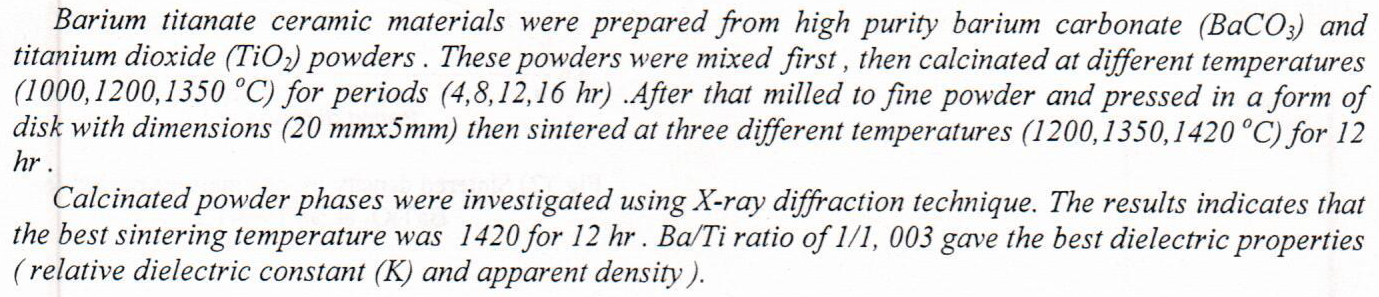
Preparation, Characterization, and Properties of Barium Titanate

Acute myeloid leukemia is a malignant disease results from mutation in a multipotent haemopoietic stemcell. The study aimed to investigate NPM1 and FLT3-ITD mutations in Iraqi patients with AML and correlateresults with other clinical and laboratory findings. Fifty-eight AML patients, admitted to Baghdad TeachingHospital from October 2019 till March 2020 in addition to 25 normal controls, were included in the study.A detailed history, laboratory investigations including FLT3-ITD and NPM1 mutations were collected fromand analyzed. FLT3-ITD was detected in 17.24% of patients, NPM1 mutation in 10.34%. Most of thepatients are presented with pallor. FLT3-ITD mutation had a higher blast cell count (74%) while NPM1mutation had higher WBCs
... Show More (1)
(1)

Coupling reaction of 2-amino benzoic acid with phenol gave the new bidentate azo ligand. The prepared ligand was identified by Microelemental Analysis, FT-IR and UV-Vis spectroscopic technique. Treatment of the prepared ligand with the following metal ions (CoII, NiII, CuII and ZnII) in aqueous ethanol with a 1:2 M:L ratio and at optimum pH, yielded a series of neutral complexes of the general formula [M(L)2]. The prepared complexes were characterized using flame atomic absorption, (C.H.N) Analysis, FT-IR and UV-Vis spectroscopic methods as well as magnetic susceptibility and conductivity measurements. The nature of the complexes formed were studied following the mole ratio and continuous variation methods, Beer's law obeyed over a concentr
... Show MoreChitosan-schiff base with three different ratios of para-Dimethyl aminobenzaldehyde& chitosan Schiff base hydrogels have been prepared for controlled drug release study. The synthesized chitosan Schiff base and chitosan Schiff base hydrogel were characterized by FT-IR, UV-Visible, SEM, analysis. Swelling properties of the hydrogel were investigated at three different media pH (2, 7, 10). The swelling degree varied with the pH, amount of crosslinking agent glutaraldehyde and with the amount of paraDimethylaminobenzaldehyde for the hydrogels. All hydrogels were used for controlled drug release system. Aspirin was used as model drug, in three different buffer solution (2, 7, 10) as release media. The rate of release of drugs in the pH2 is m
... Show More (2)
(2)

The synthesis of nanoparticles (GNPs) from the reduction of HAuCl4 .3H2O by aluminum metal was obtained in aqueous solution with the use of Arabic gum as a stabilizing agent. The GNPs were characterized by TEM, AFM and Zeta potential spectroscopy. The reduction process was monitored over time by measuring ultraviolet spectra at a range of λ 520-525 nm. Also the color changes from yellow to ruby red, shape and size of GNP was studied by TEM. Shape was spherical and the size of particles was (12-17.5) nm. The best results were obtained at pH 6.
(4)
(2)
This research included the preparation of 2-mercaptobenzoxazole (N1) by the reaction of ortho-aminophenol with carbon disulfide in an alcoholic potassium hydroxide solution. The 2-mercapto benzoxazole (N1) was then treated with hydrazine to obtain the 2-hydrazino benzoxazole (N2). A number of hydrazones (N3-N5) were prepared through the reaction of N2 with different benzaldehydes. The compound (N6) was also prepared whereby the ring closing of hydrazone (N3) using chloroacetylchloride, while the compound (N7) was prepared by treating 2-hydrazino benzoxazole with acetylacetone. When the compound (N1) was treated with formaldehyde, it afforded the compound (N8). Also, the N9 was obtained from the reaction of N1 with chloroacetic acid in th
... Show More
(17)
(17)
Coblatcomplex has been prepared by reaction between C16H19N3O3S (L) as ligand and metal salt (II). The prepared complex were characterized by infrared spectra, electromic spectra, magnetic susceptibility, molar conductivity measurement and metal analysis by atomic absorption and (C.H.N) analysis. From these studies tetrahedral geometry structure for the complex was suggested. The photodegredation of complex were study using photoreaction cell and preparednanoTiO2 catalyst in different conditions (concentration, temperatures, pH).The results show that the recation is of a first order with activation energy equal to (6.6512 kJ /mol).
(1)

We prepared polythiophene (PTH) with single wall carbon nanotube (SWCNT) nanocomposite thin films for Nitrogen dioxide (NO2) gas sensing applications. Thin films were synthesized via electrochemical polymerization method onto (Indium tin oxide) ITO coated glass substrate of thiophene monomer with magnesium perchlorate and different concentration from SWCNT (0.012 and 0.016) % in the presence130mL of Acetonitrile used. X-ray diffraction (XRD), Field Emission Scanning Electron microscopy (FE-SEM), Atomic Force Microscope (AFM) and Fourier Transform Infrared Spectroscopy (FT-IR) were used to characterized these nanocomposite thin films. The response of these nanocomposite for NO2 gas was evaluated via monitoring the change
... Show More
(9)
(4)
Background: The synthesis and characterization of novel liquid crystalline compounds have garnered signi|cant attention due to their potential applications in biomedical sciences, including drug delivery systems, biosensing, and diagnostic tools. This study focuses on synthesizing and characterizing new thiazolothiadiazole-based liquid crystals and evaluating their mesophase properties. Methods: A series of novel compounds containing 5H-thiazolo[4,3−b][1,3,4] thiadiazole units were synthesized via multi-step chemical reactions. The synthesis involved the reaction of chloroethyl acetate with 4−hydroxybenzaldehyde to yield an aldehyde intermediate, followed by subsequent transformations using hydrazine hydrate, ethylacetoacetate, and 1,2
... Show MoreThe monomer phenyl acrylamide was synthesized by reacting acrylamide with chloro benzene in the presence of pyridine. Copolymer of phenyl acrylamide (PAM) with methyl methacrylate (MMA) was synthesized by free radical technique using dimethylsulfoxide (DMSO) as solvent and benzoyl peroxide (BPO) as initiator. The overall conversion was kept low (≤ 15% wt/wt) for all studies copolymers samples. The synthesized copolymers were characterized using fourier transform infrared spectroscopy (FT-IR), and their thermal properties were studied by thermogravimetric analysis (TGA) and differential scanning calorimetry (DSC). The copolymers compositions were determined by elemental analysis. The monomer reactivity ratios have been calculated b
... Show More
(10)
(4)