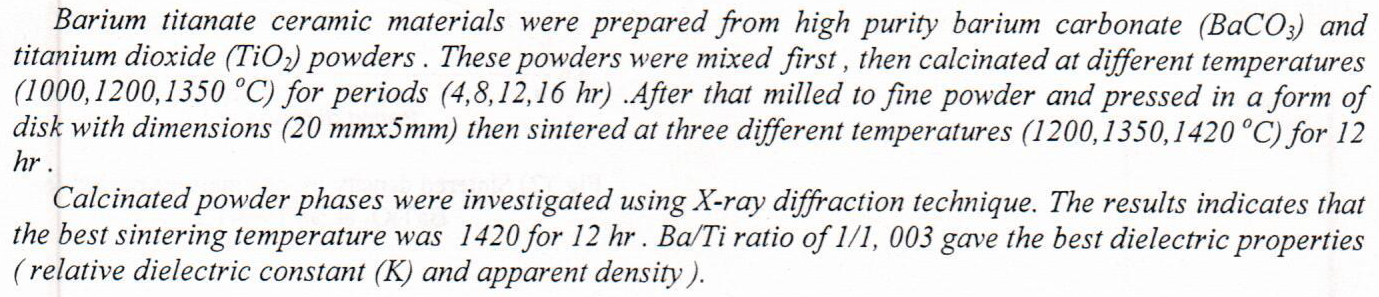
Preparation, Characterization, and Properties of Barium Titanate

 (15)
(15)
 (12)
(12)



A first step in this research was to synthesize Schiff's bases(1-3)using an Amoxcilline intensification reaction with different aromatic aldehydes in absolute ethanol. In benzene and refluxing conditions,Schiff's bases were cyclized with succinic and Phthalic anhydride to give a new sequence of 1,3-oxazepine derivatives(4-6) and (7-9),respectively.The last step,cyclization reactions with sodium azide in THF solvent resulted in the formation of [10 and 11], which are supposed to be biologically significant.FT.IR, 1H-NMR and 13C-NMR (for compound 4,7,9, and 11),as well as melting points reported, were used to characterize these prepared compounds ,Bacillus (G+), Staphylococcus (G+), and E.Coli (G-)were screened against these compounds. . To i
... Show MoreThis work concerned on nanocrystalline NiAl2O4 and ZnAl2O4 having spinel structure prepared by Sol–gel technique. The structural and characterization properties for the obtained samples were examined using different measurements such as X-ray diffraction (XRD), Fourier transform infrared spectroscopy (FTIR), finally, Field emission scanning electron microscope (FESEM).The Spinel-type for two prepared compound (NiAl2O4) and (ZnAl2O4) at different calcination temperature examined by XRD. Williamson-Hall Methods used to estimate crystallite size, Average distribution crystallite size of two compound were, 34.2 nm for NiAl2O4 and32.6 for ZnAl2O4, the increase in crystallite size affecting by increasing in calcination temperature for both comp
... Show More
A variety of new phenolic Schiff bases derivatives have been synthesized starting from Terephthaladehyde compound, all proposed structures were supported by FTIR, 1H-NMR, 13C-NMR, Elemental analysis, some derivatives evaluated by Thermal analysis (TGA).
Coblatcomplex has been prepared by reaction between C16H19N3O3S (L) as ligand and metal salt (II). The prepared complex were characterized by infrared spectra, electromic spectra, magnetic susceptibility, molar conductivity measurement and metal analysis by atomic absorption and (C.H.N) analysis. From these studies tetrahedral geometry structure for the complex was suggested. The photodegredation of complex were study using photoreaction cell and preparednanoTiO2 catalyst in different conditions (concentration, temperatures, pH).The results show that the recation is of a first order with activation energy equal to (6.6512 kJ /mol).
(1)
Coupling reaction of 4-amino antipyrene with 2,6-dimethyl phenol gave bidentate azo ligand. The prepared ligand was identified by Microelemental Analysis, 1HNMR, FT-IR and UV-Vis spectroscopic techniques. Treatment of the prepared ligand with the following metal ions (CoII, NiII, CuII, ZnII, CdII, and HgII) in aqueous ethanol with a 1:2 M:L ratio and at optimum pH, yielded a series of neutral complexes of the general formula [M(L)2Cl2]. The prepared complexes were characterized using flame atomic absorption, (C.H.N) Analysis, FT-IR and UVVis spectroscopic methods as well as magnetic susceptibility and conductivity measurements. Chloride ion content was also evaluated by (Mohr method). The nature of the complexes formed were studied followin
... Show MoreIn the present study, chalcone derivatives were synthesized via the Claisen-Schmidt condensation of 2-methyl acetanilide or 4-nitro acetanilide with p-dimethyl amino benzaldehyde in an ethanolic sodium hydroxide solution. The resulting chalcone reacted with urea or thiourea to produce several novel pyrimidine derivatives. All the synthesized compounds were characterized by FTIR, 1HNMR and 13CNMR spectroscopy. Before the synthesis process, molecular docking studies were performed to evaluate the potential of the synthesized molecules as drug candidates. Thus, molecular docking studies were performed using the CCDC GOLD suite (version 2025). The molecular docking results showed that the synthesized molecules had a noticeable affinity towards
... Show More
New hydrazone derivatives of Fenoprofen were synthesized and evaluated for their anti-inflammatory activity by means of egg white induced paw edema method. All the synthesized target compounds were characterized by FT-IR spectroscopy, 1HNMR analysis and by measure of their physical properties. The synthesis of the target compounds(H1-H4) was accomplished by multistep reaction procedures. The synthesized target compounds were show activity in reducing paw edema thickness and their anti-inflammatory effect was comparable to that of the standard (Fenoprofen) except for compound H3 which show anti-inflammatory activity higher than Fenoprofen.
(11)
(4)
Nano-crystalline iron oxide nanoparticles (magnetite) was synthesized by open vessel ageing process. The iron chloride solution was prepared by mixing deionized water and iron chloride tetrahydrate. The product was characterized by X-Ray, Surface area and pore volume by Brunauer-Emmet-Teller, Atomic Force Microscope (AFM) and Fourier Transform Infrared Spectroscopy(FTIR) . The results showed that the XRD in compatibility of the prepared iron oxide (magnetite) with the general structure of standard iron oxide, and in Fourier Transform Infrared Spectroscopy, it is strong crests in 586 bands, because of the expansion vibration manner related to the metal oxygen absorption band (Fe–O bonds in the crystals of iron ox
... Show MoreAbstract Bilastine, a second-generation antihistamine, is commonly prescribed for managing allergic rhinoconjunctivitis and urticaria due to its prolonged action. However, its therapeutic potential is constrained by poor water solubility and low oral bioavailability. This study aimed to enhance bilastine dissolution and patient compliance by formulating a nanosuspension-based orodispersible film (ODF). An anti-solvent precipitation method was employed to produce nanosuspension using different hydrophilic stabilizers (Soluplus®, Poloxamer 188, and PEG 6000). The influence of formulation parameters, such as the stabilizer ratio, the anti-solvent ratio, stirring speed, and the stabilizer type, on particle size and polydispersity index (PDI)
... Show More
(6)
(4)