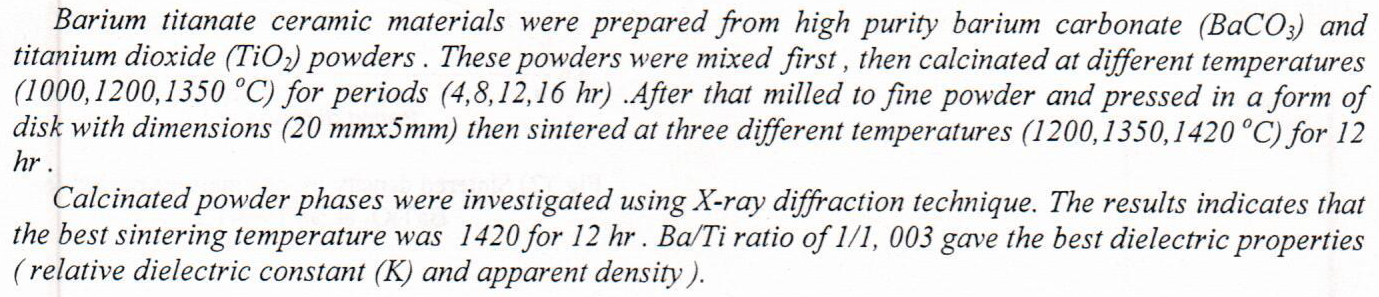
Preparation, Characterization, and Properties of Barium Titanate

In this work, a composite material was prepared from Low-density polyethylene (LDPE) with different weight percent of grain and calcinations kaolin at temperature of (850oC) using single screw extruder and a mixing machine operated at a temperature between (190-200oC). Some of mechanical and physical properties such as tensile strength, tensile strength at break, Young modulus, and elongation at break, shore hardness and water absorption were determined at different weight fraction of filler (0, 2, 7, 10 and 15%). It was found that the addition of filler increases the modulus of elasticity, elongation at break, shore hardness and impact strength; on other hand, it decreases the tensile strength and tensile strength
... Show MoreNuclear structure of 29-34Mg isotopes toward neutron dripline have been investigated using shell model with Skyrme-Hartree–Fock calculations. In particular nuclear densities for proton, neutron, mass and charge densities with their corresponding rms radii, neutron skin thicknesses and inelastic electron scattering form factors are calculated for positive low-lying states. The deduced results are discussed for the transverse form factor and compared with the available experimental data. It has been confirmed that the combining shell model with Hartree-Fock mean field method with Skyrme interaction can accommodate very well the nuclear excitation properties and can reach a highly descriptive and predictive power when investiga
... Show More
 (12)
(12)
 (12)
(12)


Development of improved methods for the synthesis of metal oxide nanoparticles are of high priority for the advancement of material science and technology. Herein, the biosynthesis of ZnO using hydrahelix of beta vulgaris and the seed of abrus precatorius as an aqueaus extracts adduced respectivily as stablizer and reductant reagent. The support are characterized by spectroscopic methods ( Ft-IR, Uv-vis ).The FTIR confirmed the presence of ZnO band. The Uv-visible showed absorption peak at corresponds to the ZnO nanostructures. X-ray diffraction, scaning electron microscopy (SEM), dispersive X-ray spectroscopy (EDX) techniques are taken to investigation the size, structure and composition of synthesised ZnO nanocrystals. The XRD pattern mat
... Show More
(1)
Dental casts come into direct contact with impression materials and other items that are contaminated by saliva and blood from a patient's mouth, leaving the casts susceptible to cross-contamination. The disinfectant solutions of the impression materials cause various adverse reactions. Therefore, disinfection of dental casts may be effective in preventing cross infection. This study was carried out to evaluate the surface hardness, dimensional accuracy, reproduction of details and surface porosity of type III, type IV and type IV extra hard dental stone after immersion in and spray by using SOLO and Sodium hypochlorite disinfectant solutions. Materials and methods: 240 Stone samples were prepared in rubber rings, A total of 60 test block w
... Show More
(2)
Background: Dental casts come into direct contact with impression materials and other items that are contaminated by saliva and blood from a patient's mouth, leaving the casts susceptible to cross-contamination. The disinfectant solutions of the impression materials cause various adverse reactions. Therefore, disinfection of dental casts may be effective in preventing cross infection. This study was carried out to evaluate the surface hardness, dimensional accuracy, reproduction of details and surface porosity of type III, type IV and type IV extra hard dental stone after immersion in and spray by using SOLO and Sodium hypochlorite disinfectant solutions. Materials and methods: 240 Stone samples were prepared in rubber rings, A total of 60
... Show MoreBackground: Dental casts come into direct contact with impression materials and other items that are contaminated by saliva and blood from a patient's mouth, leaving the casts susceptible to cross-contamination. The disinfectant solutions of the impression materials cause various adverse reactions. Therefore, disinfection of dental casts may be effective in preventing cross infection. This study was carried out to evaluate the surface hardness, dimensional accuracy, reproduction of details and surface porosity of type III, type IV and type IV extra hard dental stone after immersion in and spray by using SOLO and Sodium hypochlorite disinfectant solutions. Materials and methods: 240 Stone samples were prepared in rubber rings, A total of 60
... Show More
(43)
This study reports the fabrication of tin oxide (SnO2) thin films using pulsed laser deposition (PLD). The effect of 60Co (300, 900, and 1200 Gy) gamma radiation on the structural, morphological, and optical features is systematically demonstrated using X-ray diffraction (XRD), field emission scanning electron microscopy (FE-SEM), atomic force microscopy (AFM), and ultraviolet-visible light analysis (UV-Vis), respectively In XRD tests, the size of the crystallites decreased from 45.5 to 40.8 nm for the control samples and from 1200 Gy to 60Co for the irradiated samples. Using FESEM analysis, the particle diameter revealed a similar trend to that attained using XRD; in particular, the average diameters were 93.8 and
... Show More
(1)