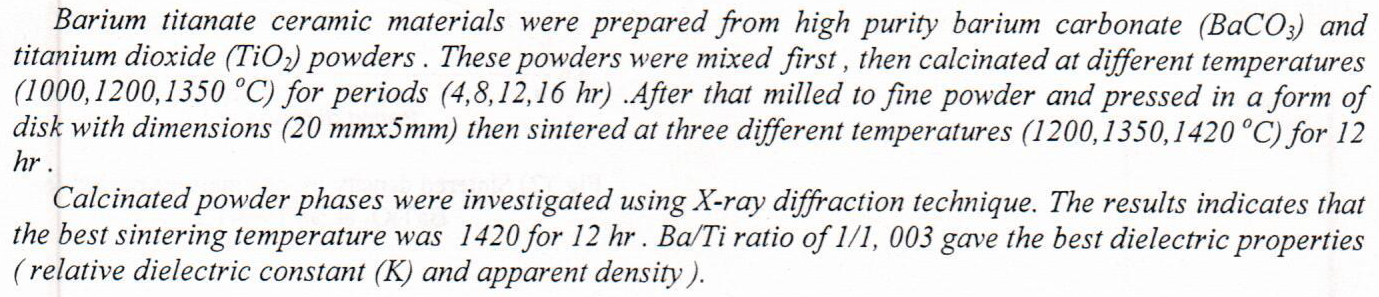
Preparation, Characterization, and Properties of Barium Titanate

Coupling reaction of 4-amino antipyrene with 4-amino benzoic acid gave bidentate azo ligand. The prepared ligand was identified by Microelemental Analysis, 1HNMR, FT-IR and UV-Vis spectroscopic techniques. Treatment of the prepared ligand with the following metal ions (CoII, NiII, CuII and ZnII) in aqueous ethanol with a 1:2 M:L ratio and at optimum pH, yielded a series of neutral complexes of the general formula [M(L)2]Cl2 . The prepared complexes were characterized using flame atomic absorption, (C.H.N) Analysis, FT-IR and UV-Vis spectroscopic methods as well as magnetic susceptibility and conductivity measurements. Chloride ion content was also evaluated by (Mohr method). The nature of the complexes formed were studied following the mol
... Show MoreObjective:This study involved synthesis of a new series of different five-membered heterocyclic derivatives, testing their antioxidant activity, and examining their potential in vitro antimicrobial agents. Methods: The synthesis of the derivatives involved a three-step process. Initially, succinyl chloride was reacted with methanol, followed by a reaction with 80% hydrazine hydrate through a nucleophilic addition-elimination mechanism, resulting in the formation of succinohydrazide (I). This compound was then employed as a precursor for the synthesis of Schiff bases (II), and (III) by reacting it with m-nitro benzaldehyde and p-nitro benzaldehyde. Following this, a ring closure reaction was applied using thioglycolic acid, glycolic acid,
... Show More (1)
(1)
 (2)
(2)



Metal complexes chrome(III), manganese(II), iron(III), cobalt(II), nickel(II), cupper(II) and zinc(II) with diazonium of 3-amino-2-chloropyridine of general formula [2-Cl-C5H3N≡N]n[MXm], where n=2 or 3 for divalent and trivalent metal, m= 4 or 6 were synthesized. The complexes have been characterized by flame atomic absorption, (C.H.N), molar conductance, magnetic susceptibility UV-vis spectra, infrared spectra,1H-NMR spectroscopy and thermo gravimetric analysis (TGA and DTA). The measurements showed that the divalent metal ion complexes (M2+) have (1:2) M:L ratio with tetrahedral geometry around metal ions while the trivalent metal ions (M3+) formed (1:3) m
... Show More
A significant increase in the incidence of non-O157 verotoxigenic Escherichia coli (VTEC) infections have become a serious health issues, and this situation is worsening due to the dissemination of plasmid mediated multidrug-resistant microorganisms worldwide. This study aims to investigate the presence of plasmid-mediated verotoxin gene in non-O157 E. coli. Standard microbiological techniques identified a total of 137 E. coli isolates. The plasmid was detected by Perfectprep Plasmid Mini preparation kit. These isolates were subjected to disk diffusion assay, and plasmid curing with ethidium bromide treatment. The plasmid containing isolates were subjected to a polymerase chain reaction (PCR) for investigating
... Show More
(4)
(2)
(5)
2-amino-4-(4-chloro phenyl)-1,3-thiazole (1) was synthesized by refluxing thiourea with para-chloro phenacyl bromide in absolute methanol. The condensation of amine compound (1) with phenylisothiocyanate in the presence of pyridine will produce 1-(4-(4-chlorophenyl)thiazol-2-yl)-3-phenylthiourea(2), which is upon treatment with 2,4 dinitrophenyl hydrazine by conventional method, afforded 1- ( 4 - ( 4 – chlorophenyl ) thiazol – 2 – yl ) – 3 - phenylhydrazonamide,N' - ( 2 , 4 -dinitrophenyl) ,(3).The characterization of the titled compounds were performed utilizing FTIR spectroscopy, 1HNMR and CHNS elemental analysis, and by me
... Show More
(7)
(3)
In the present article, mixed ligand metal (II) complexes have been synthesized with Schiff base (1E, 5Z, 6E)-1,7 bis (4-hydroxy-3- methoxyphenyl)-5-(3-hydroxyphenyl) imino) hepta-1,6-dien-3-one derived from Curcumin and 3-aminophenol as primary ligand and L-dopa as a secondary ligand. The Schiff base act as bidentate and arrange to the metals through the azomethine (C=N) nitrogen and (C=O) oxygen atom. The mode of bonding of the Schiff base has been affirmed on the infrared by the UV-Visible, 1H, and 13C NMR spectroscopic techniques. The magnetic susceptibility and the UV-Vis data of the complexes propose octahedral geometry around the central metal ion. The information appears that the complexes have the structure of [L-M-(L-dopa)] system
... Show More
(5)
Ebastine, a second-generation H1 antihistamine, exhibits poor aqueous solubility and consequently low oral bioavailability, limiting its clinical therapeutic efficacy. Novasome is an advanced vesicular nanocarrier system that offers a promising approach to enhance the solubility and dissolution behavior of a poorly water solubility drug. Therefore, this study aimed to develop, optimize, and characterize ebastine-loaded novasomes and to compress them into tablets to enhance drug solubility, dissolution, and oral bioavailability.
Thin films ZrO2: MgO nanostructure have been synthesized by a radio frequency magnetron plasma sputtering technique at different ratios of MgO (0,6, 8 and 10)% percentage to be used as the gas sensor for nitrogen dioxide NO2. The samples were investigated by X-ray diffraction (XRD), atomic force microscopy (AFM), scanning electron microscopy (SEM), energy-dispersive X-ray (EDX) and sensing properties were also investigated. The average particle size of all prepared samples was found lower than 33.22nm and the structure was a monoclinic phase. The distribution of grain size was found lower than36.3 nm and uninformed particles on the surface. Finally, the data of sensing properties have been discussed, where the
... Show More
(10)
(2)