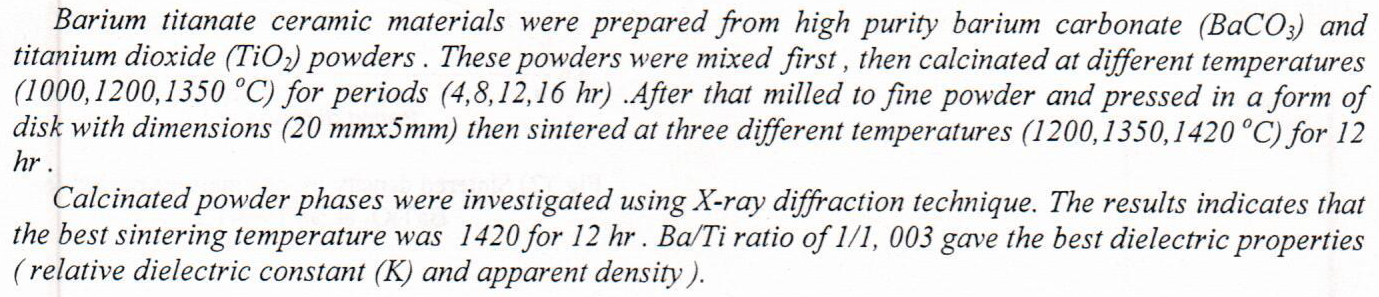
Preparation, Characterization, and Properties of Barium Titanate

New nitrone and selenonitrone compounds were synthesized. The condensation method between N-(2-hydroxyethyl) hydroxylamine and substituted carbonyl compounds such as [benzil, 4, 4́-dichlorobenzil and 2,2́ -dinitrobenzil] afforded a variety of new nitrone compounds while the condensation between N-benzylhydroxylamine and substituted selenocarbonyl compounds such as [di(4-fluorobenzoyl) diselenide and (4-chlorobenzoyl selenonitrile] obtained selenonitrone compounds. The condensation of N-4-chlorophenylhydroxylamine with dibenzoyl diselenide obtained another type of selenonitrone compounds. The structures of the synthesized compounds were assigned based on spectroscopic data (FT-IR,
... Show More (6)
(6)



In this study, the new azo dye,5,5-[1,2-phenylenebis(2,1-biazenediyl)] bis[8-quinolino], was used to synthesize complexes with Co2+, Ni2+, Cu2+, Zn2+, and Cd2+ ions. The compounds were characterized using 1H and 13C nuclear magnetic resonance (NMR) spectroscopy, Fourier transform infrared (FT-IR) spectroscopy, ultraviolet-visible (UV-Vis) spectroscopy, mass spectrometry, thermo gravimetric analysis (TGA), diffevential scanning calovimltry (DSC), CHN analysis. Further, conductivity, magnetic susceptibility, and metal and chlorine content analysis using FT-IR spectroscopy revealed that the ligand chelates as a bidentate (OH) phenol group and a bidentate (C=N) ring group. The ligand exhibited tetradentate behavior, forming tetrahedral complexe
... Show More
(10)
 (7)
(7)
In this research PbS and PbS:Cu films were prepered with thicknesses (0.85±0.05)?m and (0.55±0.5)?m deposit on glass and silicon substrate respectively using chemical spray pyrolysis technique with a substrate temperature 573K, from lead nitrate salt, thiourea and copper chloride. Using XRD we study the structure properties for the undoped and doped films with copper .The analysis reveals that the structure of films were cubic polycrystalline FCC with a preferred orientation along (200) plane for the undoped films and 1% doping with copper but the orientation of (111) plane is preferred with 5% doping with the rest new peaks of films and appeared because of doping. Surface topography using optical microscope were be checked, it was found
... Show More
The present study investigates deep eutectic solvents (DESs) as potential media for enzymatic hydrolysis. A series of ternary ammonium and phosphonium-based DESs were prepared at different molar ratios by mixing with aqueous glycerol (85%). The physicochemical properties including surface tension, conductivity, density, and viscosity were measured at a temperature range of 298.15 K – 363.15 K. The eutectic points were highly influenced by the variation of temperature. The eutectic point of the choline chloride: glycerol: water (ratio of 1: 2.55: 2.28) and methyltriphenylphosphonium bromide:glycerol:water (ratio of 1: 4.25: 3.75) is 213.4 K and 255.8 K, respectively. The stability of the lipase enzyme isolated from porcine pancreas (PPL) a
... Show More
(27)
Soil defilement with "raw petroleum" is a standout amongst the most across the board and genuine ecological issues going up against both the industrialized and oil country like Iraq. Along these lines, the impact of "raw petroleum" on soil contamination is one of most critical subjects that review these days. The present examination expects to research "unrefined oil"effectson the mechanical and physical properties of clayey soils. The dirt examples were acquired from Al-Doura area in Baghdad city and arranged by the "Brought together Soil Grouping Framework (USCS)" as silty mud of low pliancy (CL). Research center tests were done on contaminated and unpolluted soil tests with same thickness. The dirtied tests are set up by blending
... Show More
(10)
(8)
This paper introduces a novel non-classical probability distribution, termed the Logistic Map distribution, which is constructed by transforming a polynomial function derived from the second iteration of the logistic map. The logistic map a well-known discrete-time dynamical system has been extensively employed in diverse scientific domains, including population dynamics (to model bounded growth under environmental constraints), physics (to study nonlinear dynamics and deterministic chaos), and economics (to represent complex, nonlinear patterns in financial and economic time series). The proposed distribution is fully characterized by two parameters: a scale parameter and a shape parameter, with the constraint ensuring the non-negat
... Show More
Titanium-dioxide (TiO2) nanoparticles suspended in water, and ethanol based fluids have been prepared using one step method and characterized by scanning electron microscopy (SEM), and UV–visible spectrophotometer. The TiO2 nanoparticles were added to base fluids with different volume concentrations from 0.1% to1.5% by dispersing the synthesized nanoparticles in deionized water and ethanol solutions. The effective thermal conductivity, viscosity and pH of prepared nanofluids at different temperatures from 15 to 30 oC were carried out and investigated. It was observed that the thermal conductivity, pH, and viscosity of nanofluids increases with the increase in TiO2 nanoparticle volume fraction
... Show More1-[4-(4-Acetyl-2-hydroxy-phenylazo)-phenyl]-ethanone (L1) and 1-[3-Hydroxy-4(4-nitro-phenylazo)-phenyl]-ethanone (L2) were readied by combination the diazonium salts of amines with 3-hydroxyacetophenone. (C.H.N) analyses, infrared spectra, UV–vis electronic absorption spectra, 1H and 13CNMR spectral mechanisms are use to identified of the ligands. Complexes of Ni+2 and Cu+2 were performed as well depicted. The formation of complexes has been identified by using atomic absorption of flame, elemental analysis, infrared spectra and UV-Vis spectral process as well conductivity and magnetic quantifications. Nature of compounds produced have been studied obeyed the mole ratio and continuous contrast methods, Beer's law followed during a concent
... Show More1-[4-(2-Hydroxy-4, 6-dimethyl-phenylazo)-phenol]-ethanone (HL1) and 2-(4-methoxy-phenylazo)-3, 5-dimethyl-phenol (HL2) were produced by combination the diazonium salts of amines with 3, 5-dimethylphenol. The geometry of azo compounds was resolved on the basis of (C.H.N) analyses, 1H and 13CNMR, FT-IR and UV-Vis spectroscopic mechanisms. Complexes of La (III) and Rh (III) have been performed and depicted. The formation of complexes has been identified by using elemental analysis, FT-IR and UV-Vis spectroscopic process as well, conductivity molar quantifications. Nature of complexes produced have been studied obeyed mole ratio and continuous alteration ways, Beer's law followed through a concentration scope (1×10⁻⁴ - 3×10⁻⁴ M). H
... Show More