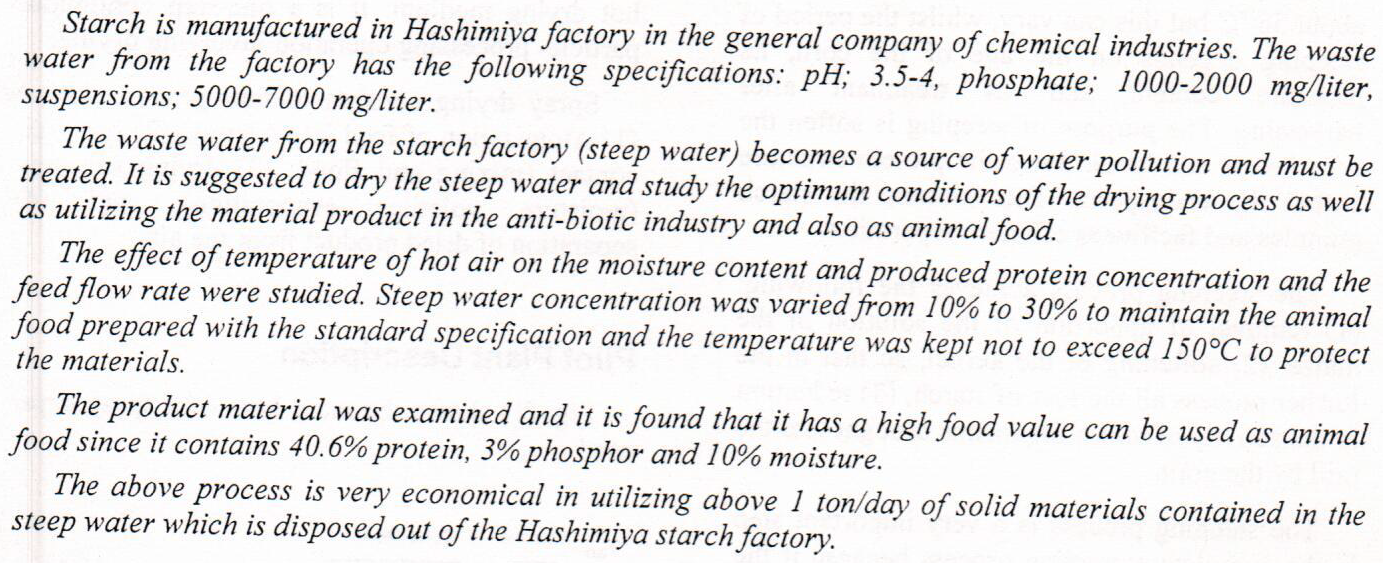
Effects of Drying Conditions on the Properties of Dried Particles of Powdered steep Liquor

The element carbon Carbon dioxide emissions are increasing primarily as a result of people's use of fossil fuels for electricity. Coal and oil are fossil fuels that contain carbon that plants removed from the atmosphere by photosynthesis over millions of years; and in just a few hundred years we've returned carbon to the atmosphere. The element carbon Carbon dioxide concentrations rise primarily as a result of the burning of fossil fuels and Freon for electricity. Fossil fuels such as coal, oil and gas produce carbon plants that were photosynthesized from the atmosphere over many years, since in just two centuries, carbon was returned to the atmosphere. Climate alter could be a noteworthy time variety in weather designs happening ov
... Show More (2)
(2)
 (1)
(1)

 (20)
(18)
(20)
(18)

S a mples of compact magnesia and alumina were evaporated
using CO2-laser .The
Processed powders were characterized by electron microscopy
and both scanning and transmission electron microscope. The results
indicated that the particle size for both powders have reduced largely
to 0.003 nm and 0.07 nm for MgO and Al2O3, with increasing in
shape sphericity.
Tin oxide films (SnO2) of thickness (1 ?m) are prepared on glass substrate by post oxidation of metal films technique. Films were irradiated with Nd:YAG double frequency laser of wavelength (532 nm) pulses of three energies (100, 500, 1000) mJ. The optical absorption, transmission, reflectance, refractive index and optical conductivity of these films are investigated in the UV-Vis region (200-900) nm. It was found that the average transmittance of the films is around (80%) at wavelength (550 nm) and showed high transmission (? 90 %) in the visible and near infrared region. The absorption edge shifts towards higher energies, which is due to the Moss-Burstien effect and it lies at (4 eV). The optical band gap increased with increasing of ene
... Show More
In this study, plastic wastes named (PET and PVC) were used to prepare polymer matrix composite (PMC) which can be used in different applications. Composite materials were prepared by mixing unsaturated polyester resin (UP) with plastic wastes, two types of plastic waste were used in this work included polyethylene-terephthalate (PET) and Polyvinyl chloride (PVC) with various weight fractions (0, 5,10,15, 20 and 25%) added as a filler in flakes form. In this work, some of the tests that were carried out included (tensile, bending, and compressive strength) as mechanical tests, in addition to (thermal conductivity and water absorption) as physical tests. The values of tensile, compressive strength and Young's modulus of UP increased after
... Show MoreABSTRACT Background: Bracket rebonding is a common problem in orthodontics which may result in many drawbacks. The aims of this study were to evaluate the effects of application of two enamel protective agents “Icon†and “ProSeal†on shear bond strength before and after rebonding of stainless steel orthodontic brackets using conventional orthodontic adhesive and to assess the site of bond failure. Materials and methods: Fifty sound extracted human upper first premolar teeth were selected and randomly divided into two equal groups; the first time bonding and the rebonding groups (n=30). Each group was subdivided into control, Icon and ProSeal subgroups. The enamel protective agents were applied after etching (precondi
... Show More
(5)
Rheumatoid arthritis is an autoimmune diseasecharacterized by chronic inflammationthat affects joints and cartilage. Bone complications such asRA-relatedosteoporosis are one of the most extra-articular manifestations. Many inflammatory mediators are released during RA disease pathophysiology; these mediators stimulate osteoclast genesis of bone by direct effects on RANKL and OPG. The study aimedto measure RANKL, OPG in RA patients treated with Etanercept only and other groups treated with Methotrexate onlyat baseline and after three months to evaluate bone state. An observational case-control prospective study was done on 30 RA patients who received MTX, 30 RA patients who received ETN, and 30 healthy,age-matched control groups. The
... Show More
(1)
(63)
(50)
Copper oxide thin films were deposited on glass substrate using Successive Ionic Layer Adsorption and Reaction (SILAR) method at room temperature. The thickness of the thin films was around 0.43?m.Copper oxide thin films were annealed in air at (200, 300 and 400°C for 45min.The film structure properties were characterized by x-ray diffraction (XRD). XRD patterns indicated the presence of polycrystalline CuO. The average grain size is calculated from the X-rays pattern, it is found that the grain size increased with increasing annealing temperature. Optical transmitter microscope (OTM) and atomic force microscope (AFM) was also used. Direct band gap values of 2.2 eV for an annealed sample and (2, 1.5, 1.4) eV at 200, 300,400oC respect
... Show More
(1)