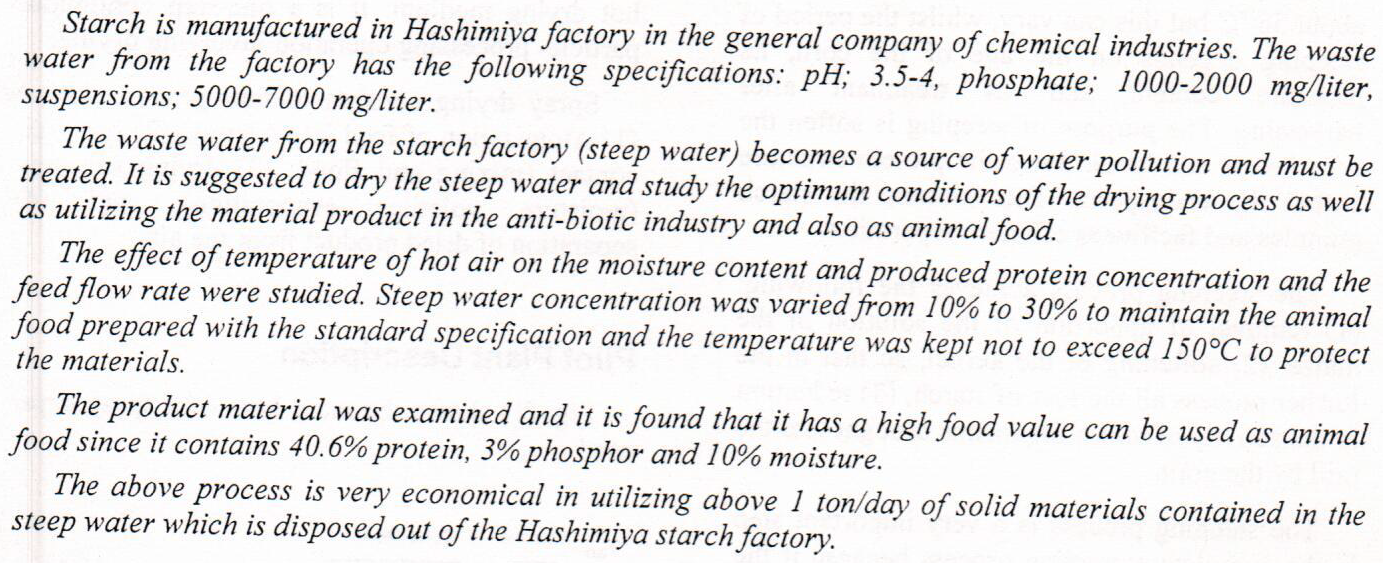
Effects of Drying Conditions on the Properties of Dried Particles of Powdered steep Liquor

 (1)
(1)


In this article, the influence of group nano transition metal oxides such as {(MnO2), (Fe2O3) and (CuO)} thin films on the (ZnO-TiO2) electric characteristics have been analyzed. The prepared films deposited on glass substrate laser Nd-YAG with wavelength (ℷ =1064 nm) ,energy of (800mJ) and number of shots (400). The density of the film was found to be (200 nm) at room temperature (RT) and annealing temperature (573K).Using DC Conductivity and Hall Effect, we obtained the electrical properties of the films. The DC Conductivity shows that that the activation energies decrease while the σRT at annealing temperature with different elements increases the formation of mixed oxides. The Hall effect, the elec
... Show More (2)
(2)
A polycrystalline PbxS1-x alloys with various Pb content ( 0.54 and 0.55) has been prepared successfully. The structure and composition of alloys are determined by X-ray diffraction (XRD), atomic absorption spectroscopy (AAS) and X-ray fluorescence (XRF) respectively. The X-ray diffraction results shows that the structure is polycrystalline with cubic structure, and there are strong peaks at the direction (200) and (111), the grain size varies between 20 and 82 nm. From AAS and XRF result, the concentrations of Pb content for these alloys were determined. The results show high accuracy and very close to the theoretical values. A photoconductive detector as a bulk has been fabricated by taking pieces of prepared alloys and polished chemic
... Show More
(1)
(1)
(14)
(13)

CdS films were prepared by thermal evaporation technique at thickness 1 µm on glass substrates and these films were doped with indium (3%) by thermal diffusion method. The electrical properties of these have been investigated in the range of diffusion temperature (473-623 K)> Activation energy is increased with diffusion temperature unless at 623 K activation energy had been decreased. Hall effect results have shown that all the films n-type except at 573 and 623 K and with increase diffusion temperature both of concentration and mobility carriers were increased.
In this paper, we used two monomers, 3,3',4,4'-benzophenone tetracarboxylic dianhydride (BTDA) and m,m'-diaminobenzophenone (m, m’-DABP), to produce polyamide acid and then converted it to polyimide (PI). The effects of phosphoric acid (H3PO4) molarity (1, 2, and 3 M) on the structural, thermal, mechanical, and electrical characteristics of the polyimides/polyaniline (PI/PANI) nanocomposites were studied. Two sharp reflection peaks were developed by the addition of PANI to PI. When 3 M H3PO4 is added, the crystalline sharp peak loses some of its intensity. The complex formation of PI/PANI-H3PO4 was confi
... Show More
(19)
(16)
Acidizing is one of the most used stimulation techniques in the petroleum industry. Several reports have been issued on the difficulties encountered during the stimulation operation of the Ahdeb oil field, particularly in the development of the Mishrif reservoir, including the following: (1) high injection pressures make it difficult to inject acid into the reservoir formation, and (2) only a few acid jobs have been effective in Ahdeb oil wells, while the bulk of the others has been unsuccessful. The significant failure rate of oil well stimulation in this deposit necessitates more investigations. Thus, we carried out this experimental study to systematically investigate the influence of acid treatment on the geomechanical properties of Mi4
... Show More
(23)
(13)
Nano-structural of vanadium pentoxide (V2O5) thin films were
deposited by chemical spray pyrolysis technique (CSPT). Nd and Ce
doped vanadium oxide films were prepared, adding Neodymium
chloride (NdCl3) and ceric sulfate (Ce(SO4)2) of 3% in separate
solution. These precursor solutions were used to deposit un-doped
V2O5 and doped with Nd and Ce films on the p-type Si (111) and
glass substrate at 250°C. The structural, optical and electrical
properties were investigated. The X-ray diffraction study revealed a
polycrystalline nature of the orthorhombic structure with the
preferred orientation of (010) with nano-grains. Atomic force
microscopy (AFM) was used to characterize the morphology of the
films. Un-do
(3)