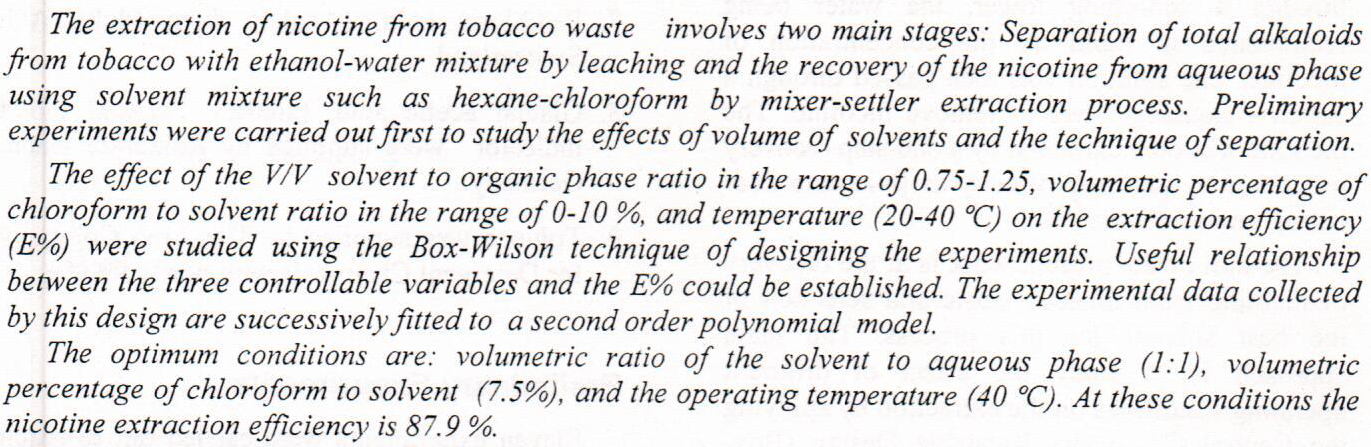
The Nicotine Extraction from Tobacco Wastes

 (33)
(33)
 (33)
(33)


 (1)
(1)
Gingival crevicular fluid (GCF) may reflect the events associated with orthodontic tooth movement. Attempts have been conducted to identify biomarkers reflecting optimum orthodontic force, unwanted sequallea (i.e. root resorption) and accelerated tooth movement. The aim of the present study is to find out a standardized GCF collection, storage and total protein extraction method from apparently healthy gingival sites with orthodontics that is compatible with further high-throughput proteomics. Eighteen patients who required extractions of both maxillary first premolars were recruited in this study. These teeth were randomly assigned to either heavy (225g) or light force (25g), and their site specific GCF was collected at baseline and aft
... Show More
(8)
(5)
Oil from Brassca campestris (local variety) was extracted with hexane using Soxhlet. The extracted oil was characterized and its antimicrobial activity was determined as well. The content of extracted oil was 40% with 0.5% of volatile oil .Oil was immiscible with polar solvent such as ethanol, acetone and water, while it was easily miscible with chloroform due to its hydrophobicity. The result of organoleptic tests revealed that the oil is clear yellow in color and odorless with acceptable taste. The oil was stable at 4 -25 C? for a month. Refractive index (RI) of oil was 1.4723 with density of 0.914, [both at 4-25 C?]. Boiling point 386 C?. Infra red spectroscopy (IR) indicated the presence of different chemical groups (C=C
... Show More
Image classification is the process of finding common features in images from various classes and applying them to categorize and label them. The main problem of the image classification process is the abundance of images, the high complexity of the data, and the shortage of labeled data, presenting the key obstacles in image classification. The cornerstone of image classification is evaluating the convolutional features retrieved from deep learning models and training them with machine learning classifiers. This study proposes a new approach of “hybrid learning” by combining deep learning with machine learning for image classification based on convolutional feature extraction using the VGG-16 deep learning model and seven class
... Show More
(6)
(4)
This work reports the development of an analytical method for the simultaneous analysis of three fluoroquinolones; ciprofloxacin (CIP), norfloxacin (NOR) and ofloxacin (OFL) in soil matrix. The proposed method was performed by using microwave-assisted extraction (MAE), solid-phase extraction (SPE) for samples purification, and finally the pre-concentrated samples were analyzed by HPLC detector. In this study, various organic solvents were tested to extract the test compounds, and the extraction performance was evaluated by testing various parameters including extraction solvent, solvent volume, extraction time, temperature and number of the extraction cycles. The current method showed a good linearity over the concentration ranging from
... Show More
(7)
(3)
(6)
(9)
(9)
A single step extraction-cleanup procedure using porous membrane-protected micro-solid phase extraction (μ-SPE) in conjunction with liquid chromatography–tandem mass spectrometry for the extraction and determination of aflatoxins (AFs) B1, B2, G1 and G2 from food was successfully developed. After the extraction, AFs were desorbed from the μ-SPE device by ultrasonication using acetonitrile. The optimum extraction conditions were: sorbent material, C8; sorbent mass, 20 mg; extraction time, 90 min; stirring speed, 1000 rpm; sample volume, 10 mL; desorption solvent, acetonitrile; solvent volume, 350 μL and ultrasonication period, 25 min without salt addition. Under the optimum conditions, enrichment factor of 11, 9, 9 and 10 for AFG2, AFG1
... Show More
(65)
(64)
Awsaj (Lycium barbarum) is a plant belong to family Solanaceae serves as a good source of bioactive compounds like phytosterols which have many important biological activity. Literature survey available so far revealed that there was no studies about Iraqi wild Awsaj phytosterols especially B-sitosterol, there for the objective of this study was to examine the efficiency of ultrasound assisted extraction (probe and bath) as compared to the conventional (Soxhlet) extraction method for extraction of phytosterols especially B-sitosterol from fruits, leaves, stems and roots of Iraqi wild Awsaj plant. This goal was achieved by comparing the extraction mass yield, also by a quick and easy approach for identification and quantification of bioac
... Show More
(1)