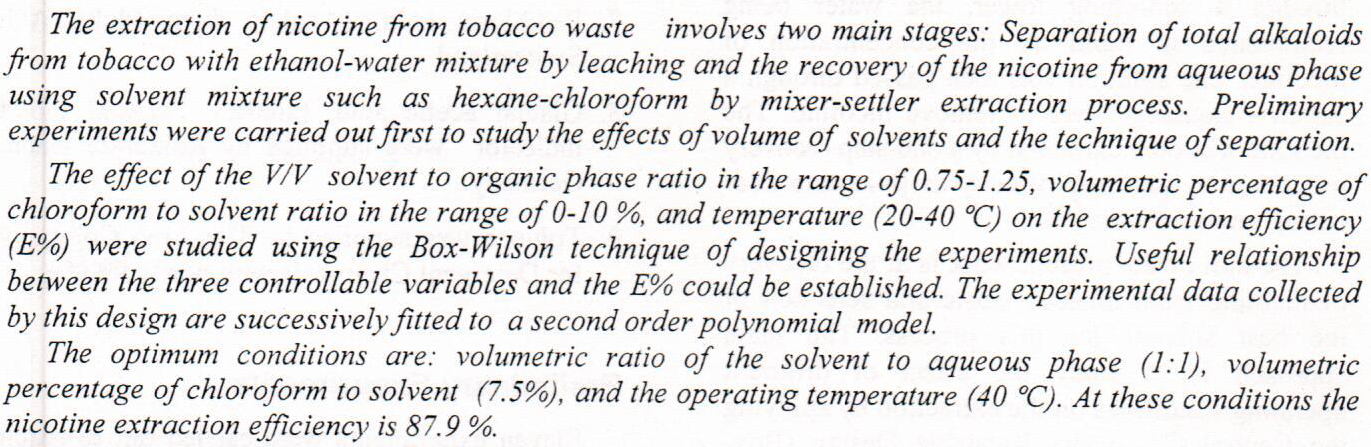
The Nicotine Extraction from Tobacco Wastes

Two simple methods spectrophotometric were suggested for the determination of Cefixime (CFX) in pure form and pharmaceutical preparation. The first method is based without cloud point (CPE) on diazotization of the Cefixime drug by sodium nitrite at 5Cº followed by coupling with ortho nitro phenol in basic medium to form orange colour. The product was stabilized and measured 400 nm. Beer’s law was obeyed in the concentration range of (10-160) μg∙mL-1 Sandell’s sensitivity was 0.0888μg∙cm-1, the detection limit was 0.07896μg∙mL-1, and the limit of Quantitation was 0.085389μg∙mL-1.The second method was cloud point extraction (CPE) with using Trtion X-114 as surfactant. Beer
... Show More (3)
(3)
 (1)
(1)



Cyber security is a term utilized for describing a collection of technologies, procedures, and practices that try protecting an online environment of a user or an organization. For medical images among most important and delicate data kinds in computer systems, the medical reasons require that all patient data, including images, be encrypted before being transferred over computer networks by healthcare companies. This paper presents a new direction of the encryption method research by encrypting the image based on the domain of the feature extracted to generate a key for the encryption process. The encryption process is started by applying edges detection. After dividing the bits of the edge image into (3×3) windows, the diffusions
... Show More
(9)
(6)
(56)
(49)
Background: The surgical extraction of impacted third molar usually results in postoperative inflammation manifested as pain, facial swelling and trismus which may cause deterioration in the patient’s quality of life. Methods: This randomized controlled study included 56 patients indicated for surgical extraction of IMTM under local anesthesia. These patients were randomly assigned into two groups: a study group that included patients who received Tibrolin® postoperatively and a control group that did not. The predictor variable was whether to use SET or not. Pain measured by the pain numerical rating scale (NRS), facial swelling, and the degree of trismus were the outcome variables. The Arabic version of the Oral Health Impact P
... Show More
(2)
(3)
(9)
(3)
In current article an easy and selective method is proposed for spectrophotometric estimation of metoclopramide (MCP) in pharmaceutical preparations using cloud point extraction (CPE) procedure. The method involved reaction between MCP with 1-Naphthol in alkali conditions using Triton X-114 to form a stable dark purple dye. The Beer’s law limit in the range 0.34-9 μg mL-1 of MCP with r =0.9959 (n=3) after optimization. The relative standard deviation (RSD) and percentage recoveries were 0.89 %, and (96.99–104.11%) respectively. As well, using surfactant cloud point extraction as a method to extract MCP was reinforced the extinction coefficient(ε) to 1.7333×10⁵L/mol.cm in surfactant-rich phase. The small volume of organi
... Show More
(14)
(4)
Abstract—The upper limb amputation exerts a significant burden on the amputee, limiting their ability to perform everyday activities, and degrading their quality of life. Amputee patients’ quality of life can be improved if they have natural control over their prosthetic hands. Among the biological signals, most commonly used to predict upper limb motor intentions, surface electromyography (sEMG), and axial acceleration sensor signals are essential components of shoulder-level upper limb prosthetic hand control systems. In this work, a pattern recognition system is proposed to create a plan for categorizing high-level upper limb prostheses in seven various types of shoulder girdle motions. Thus, combining seven feature groups, w
... Show More
(6)
(3)
In this study, simple, low cost, precise and speed spectrophotometric methods development for evaluation of sulfacetamide sodium are described. The primary approach contains conversion of sulfacetamide sodium to diazonium salt followed by a reaction with p-cresol as a reagent in the alkaline media. The colored product has an orange colour with absorbance at λmax 450 nm. At the concentration range of (5.0-100 µg.mL-1), the Beer̆ s Low is obeyed with correlation coefficient (R2= 0.9996), limit of detection as 0.2142 µg.mL-1, limit of quantification as 0.707 µg.mL-1 and molar absorptivity as 1488.249 L.mol-1.cm-1. The other approach, cloud point extraction w
... Show More
(9)