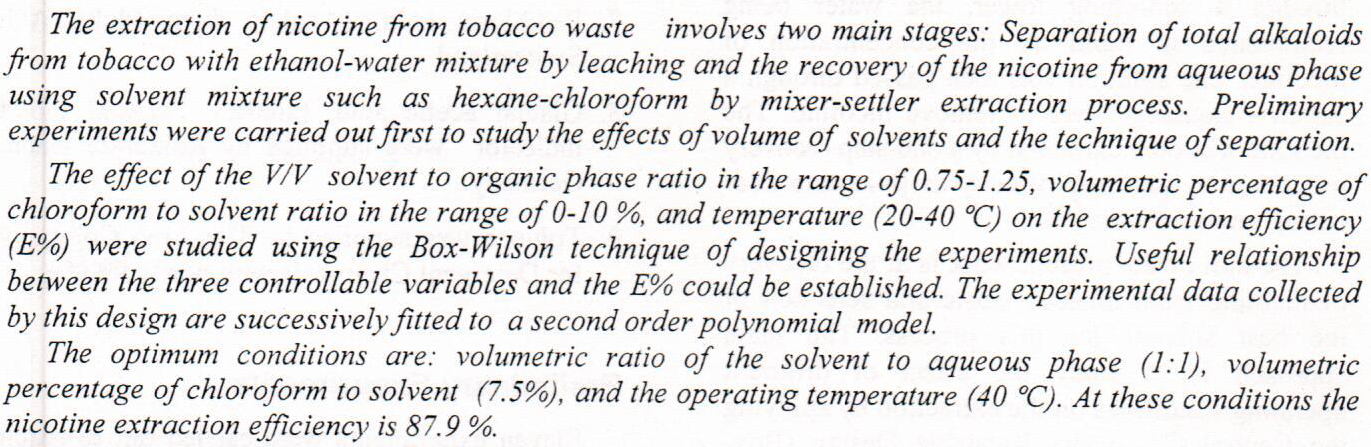
The Nicotine Extraction from Tobacco Wastes

 (4)
(4)
 (6)
(6)


A simple and highly sensitive cloud point extraction process was suggested for preconcentration of micrograms amount of isoxsuprine hydrochloride (ISX) in pure and pharmaceutical samples. After diazotization coupling of ISX with diazotized sulfadimidine in alkaline medium, the azo-dye product quantitatively extracted into the Triton X-114 rich phase, dissolved in ethanol and determined spectrophotometrically at 490 nm. The suggested reaction was studied with and without extraction and simple comparison between the batch and CPE methods was achieved. Analytical variables including concentrations of reagent, Triton X-114 and base, incubated temperature, and time were carefully studied. Under the selected opti
... Show More
(2)
(39)
(35)

The aim of this study was extraction of jojoba oil using different solvents. A mixture of waterhexane and water-ethanol are used as solvents to extract jojoba oil in a batch extraction process and compared with a pure solvent extraction process. The effects of particle size of crushed seeds, solvent-to-water ratio and time on jojoba oil extraction were investigated. The best recovery of oil was obtained at the boiling temperature of the solvent and four hour of extraction time. When seed particle size was 0.45 mm and a pure ethanol was used (45% yield of oil extraction), whereas, it was 40% yield of oil at 25% water-hexane mixture. It was revealed that the water-ethanol and water-hexane mixtures have an effect on the oil extraction yield. T
... Show More
Cloud point extraction is a simple, safe, and environmentally friendly technique for preparing many different kinds of samples. In this review, we discussed the CPE method and how to apply it to our environmental sample data. We also spoke about the benefits, problems, and likely developments in CPE. This process received a great deal of attention during preconcentration and extraction. It was used as a disconnection and follow-up improvement system before the natural mixtures (nutrients, polybrominated biphenyl ethers, pesticides, polycyclic sweet-smelling hydrocarbons, polychlorinated compounds, and fragrant amines) and inorganic mixtures were examined and many metals like (silver, lead, cadmium, mercury, and so on). We also find
... Show More
(5)
(2)
Cloud point extraction is a simple, safe, and environmentally friendly technique for preparing many different kinds of samples. In this review, we discussed the CPE method and how to apply it to our environmental sample data. We also spoke about the benefits, problems, and likely developments in CPE. This process received a great deal of attention during preconcentration and extraction. It was used as a disconnection and follow-up improvement system before the natural mixtures (nutrients, polybrominated biphenyl ethers, pesticides, polycyclic sweet-smelling hydrocarbons, polychlorinated compounds, and fragrant amines) and inorganic mixtures were examined and many metals like (silver, lead, cadmium, mercury, and so on). We also find
... Show More
(5)
(2)
Cassava, a significant crop in Africa, Asia, and South America, is a staple food for millions. However, classifying cassava species using conventional color, texture, and shape features is inefficient, as cassava leaves exhibit similarities across different types, including toxic and non-toxic varieties. This research aims to overcome the limitations of traditional classification methods by employing deep learning techniques with pre-trained AlexNet as the feature extractor to accurately classify four types of cassava: Gajah, Manggu, Kapok, and Beracun. The dataset was collected from local farms in Lamongan Indonesia. To collect images with agricultural research experts, the dataset consists of 1,400 images, and each type of cassava has
... Show More
(11)
(5)
(46)
(35)