The Nicotine Extraction from Tobacco Wastes
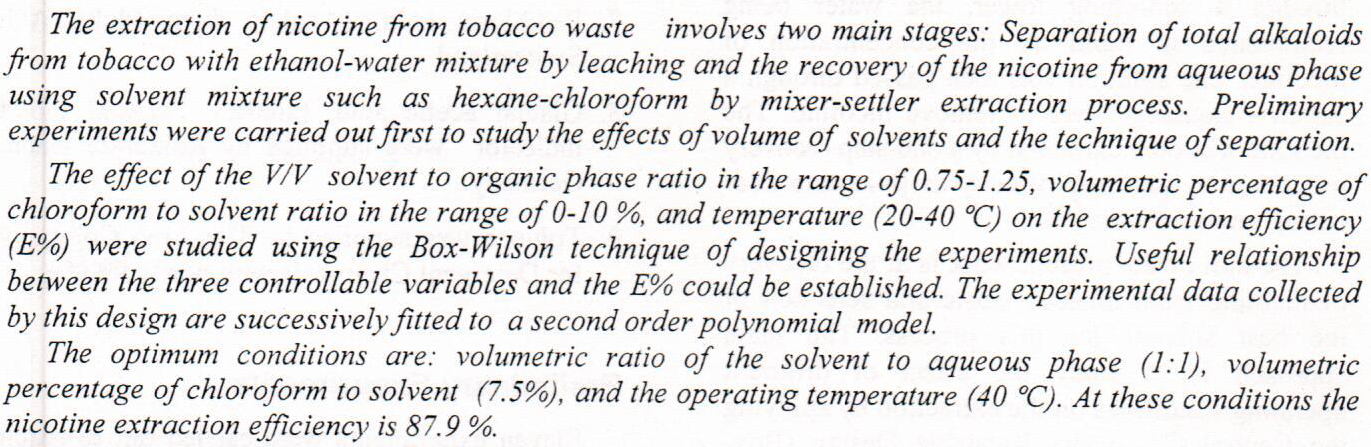

 (3)
(3)
 (3)
(3)
 (3)
(3)

 (6)
(1)
(40)
(38)
(6)
(1)
(40)
(38)
An investigation was conducted for the study of extraction of metal ions using aqueous biphasic systems. The extraction of iron, zinc and copper from aqueous sulphate media at different kinds of extractants SCN− , Cl- and I- , different values of pH of the feed solution, phase ratio, concentration of metals, concentration of extractant, concentration of polymer, and concentration of salt was investigated. Atomic absorption spectrophotometer was used to measure the concentration of iron, zinc and copper in the aqueous phase throughout the experiments. The results of the extraction experiments showed the use of SCN− as extractant, pH=2.5, phase ratio=1.5, concentration of metals 1g/l, concentration of extractant 0.06 %, concentration o
... Show More
(4)
(11)
(9)
<span>One of the main difficulties facing the certified documents documentary archiving system is checking the stamps system, but, that stamps may be contains complex background and surrounded by unwanted data. Therefore, the main objective of this paper is to isolate background and to remove noise that may be surrounded stamp. Our proposed method comprises of four phases, firstly, we apply k-means algorithm for clustering stamp image into a number of clusters and merged them using ISODATA algorithm. Secondly, we compute mean and standard deviation for each remaining cluster to isolate background cluster from stamp cluster. Thirdly, a region growing algorithm is applied to segment the image and then choosing the connected regi
... Show More
(15)
(6)
In the present work studies were carried out to extract a cationic dye (Methylene Blue MB) from an aqueous solution using emulsion liquid membrane process (ELM). The organic phase (membrane phase) consists of Span 80 as emulsifier, sulfuric acid solution as stripping agent and hexane as diluent.
In this study, important factors influencing the extraction of methylene blue dye were studied. These factors include H2SO4 concentration in the stripping phase, agitation speed in the dye permeation stage, Initial dye concentration and diluent type.
More than (98%) of Methylene blue dye was extracted at the following conditions: H2SO4 concentration (1.25) M, agitation
... Show More
(18)
Aims: This study was done to investigate the effect of low energy laser therapy on bone healing at the extraction site. Materials and methods:(24) male albino rats were exposed to the extraction procedure of the maxillary first molar on the first day of a seven day experiment and these animals were divided into two main groups; the control group and the laser group. The laser experiment involved using (Ga-As infrared diode laser) from optodent by directing the probe over the extraction site. The control group consisted of 4 rats, and the laser group was subdivided into 5 subgroups of 4 rats each. The laser dose was as follows: B1: a single dose of 5 minutes immediately after extraction.,
... Show MoreA simple and highly sensitive cloud point extraction process was suggested for preconcentration of micrograms amount of isoxsuprine hydrochloride (ISX) in pure and pharmaceutical samples. After diazotization coupling of ISX with diazotized sulfadimidine in alkaline medium, the azo-dye product quantitatively extracted into the Triton X-114 rich phase, dissolved in ethanol and determined spectrophotometrically at 490 nm. The suggested reaction was studied with and without extraction and simple comparison between the batch and CPE methods was achieved. Analytical variables including concentrations of reagent, Triton X-114 and base, incubated temperature, and time were carefully studied. Under the selected optimum conditions,
... Show More
(2)