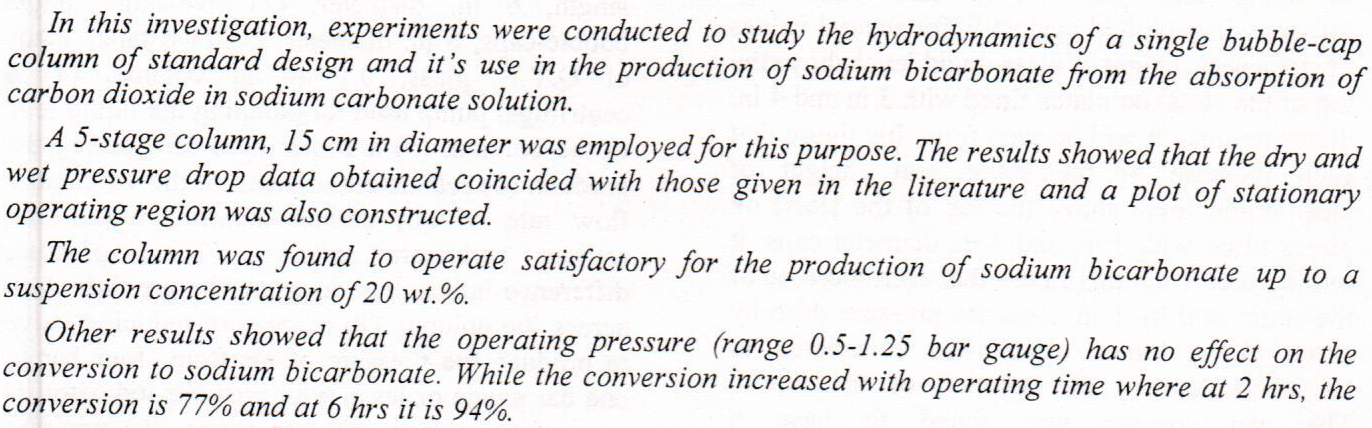
A Study of Absorption Column with Single Bubble Cap Tray in the Production of Sodium Bicarbonate

The successful implementation of deep learning nets opens up possibilities for various applications in viticulture, including disease detection, plant health monitoring, and grapevine variety identification. With the progressive advancements in the domain of deep learning, further advancements and refinements in the models and datasets can be expected, potentially leading to even more accurate and efficient classification systems for grapevine leaves and beyond. Overall, this research provides valuable insights into the potential of deep learning for agricultural applications and paves the way for future studies in this domain. This work employs a convolutional neural network (CNN)-based architecture to perform grapevine leaf image classifi
... Show More (33)
(33)
 (27)
(27)

 (4)
(3)
(4)
(3)

This paper discusses using H2 and H∞ robust control approaches for designing control systems. These approaches are applied to elementary control system designs, and their respective implementation and pros and cons are introduced. The H∞ control synthesis mainly enforces closed-loop stability, covering some physical constraints and limitations. While noise rejection and disturbance attenuation are more naturally expressed in performance optimization, which can represent the H2 control synthesis problem. The paper also applies these two methodologies to multi-plant systems to study the stability and performance of the designed controllers. Simulation results show that the H2 controller tracks a desirable cl
... Show More
(5)
(4)
(13)
(8)
Copper oxide (CuO) nanoparticles were synthesized through the thermal decomposition of a copper(II) Schiff-base complex. The complex was formed by reacting cupric acetate with a Schiff base in a 2:1 metal-to-ligand ratio. The Schiff base itself was synthesized via the condensation of benzidine and 2-hydroxybenzaldehyde in the presence of glacial acetic acid. This newly synthesized symmetric Schiff base served as the ligand for the Cu(II) metal ion complex. The ligand and its complex were characterized using several spectroscopic methods, including FTIR, UV-vis, 1H-NMR, 13C-NMR, CHNS, and AAS, along with TGA, molar conductivity and magnetic susceptibility measurements. The CuO nanoparticles were produced by thermally decomposing the
... Show More
(4)
(4)
In this research, experimental and numerical studies were carried out to investigate the performance of encased glass-fiber-reinforced polymer (GFRP) beams under fire. The test specimens were divided into two peer groups to be tested under the effect of ambient and elevated temperatures. The first group was statically tested to investigate the monotonic behavior of the specimens. The second group was exposed to fire loading first and then statically tested to explore the residual behavior of the burned specimens. Adding shear connectors and web stiffeners to the GFRP beam was the main parameter in this investigation. Moreover, service loads were applied to the tested beams during the fire. Utilizing shear connectors, web stiffeners,
... Show More
(37)
(37)
Bacterial infections pose an ongoing challenge due to resistance developed by infectious bacteria. So much research targeting designing new antibacterials is published annually. Our goal is to synthesize compounds that have given antibacterial activity according to molecular docking against the chosen target protein and that have acceptable ADMET properties that can be synthesized and used in the future. New 2-(5-methoxy-1-(4-chlorobenzene)-2-methyl-1H-indol-3-yl)acetohydrazide derivatives’ antibacterial efficacy against two common strains of Gram-negative and Gram-positive microorganisms has been developed, produced, and investigated. Sophisticated, modern analytical methods, including ATR-FTIR and 1H NMR spectroscopy, were used
... Show More
(11)
(6)
(4)
(1)
(39)
(33)
(27)
(23)