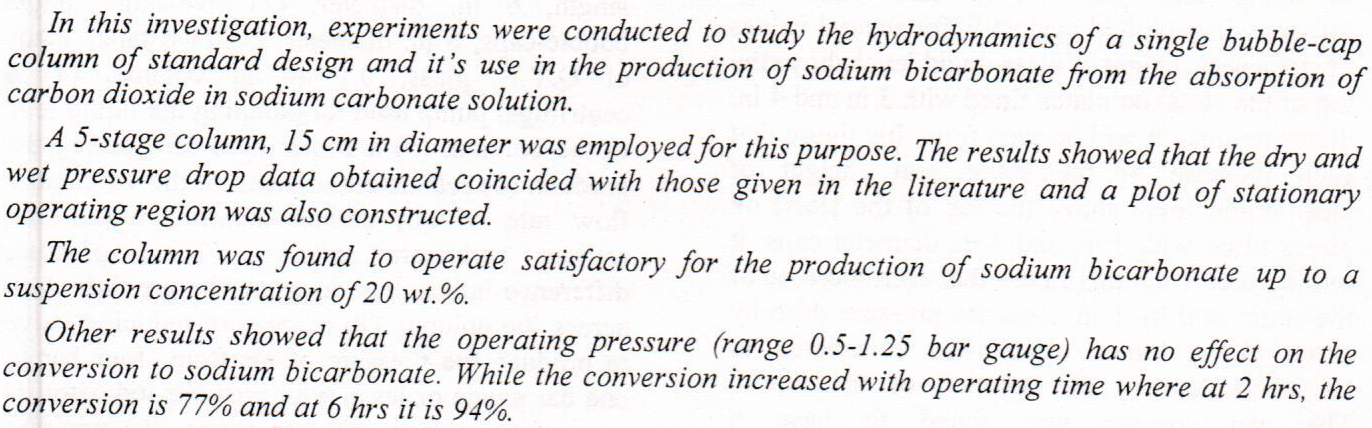
A Study of Absorption Column with Single Bubble Cap Tray in the Production of Sodium Bicarbonate

A new set of metal complexes by the general formula [M(C)2(H2O)2]Cl2 has been prepared through the interaction of the new Ligand [N1, N4-bis(4-chlorophenyl)succinamide] (C) derived from succinyl chloride with 4-Chloroaniline with the transition metal ions Mn(II), Co(II), Ni(II), Hg(II), Cu(II) and Cd(II). Compounds diagnosed by TGA, 1 H, 13CNMR and Mass spectra (for (C)), Fourier-transform infrared and Electronic spectrum, Magnetic measurement, molar conduct, (%M, %C, %H, %N). These measurements indicate that (C) is associated with the metal ion in a bi-dentate fashion by nitrogen atoms (the amide group) and the octahedral composition of these complexes is suggested. The anti-bacterial action of the compounds towards three types of bacteria
... Show More (6)
(6)

This work aimed to investigate the prevalence of pathogenic fungi and evaluate the antifungal activity of Trichoderma orientale FMR12486 crude extract against pathogenic fungi isolated from patients attending the National Center for Thoracic and Respiratory Diseases (having a history of tuberculosis) and consultant of Dermatology of Baghdad hospital, Iraq. A total of 80 clinical specimens were collected: 20 skin scrapings specimens and 60 sputum specimens. The results of direct examination by KOH 10% and culture showed that 11 (55%) cases from 20 skin specimens were positive for fungal infections, while in the sputum specimens, 28 (47%) cases from 60 were positive. Candida albicans represented the most common fungal infection isolat
... Show More
(4)
 (2)
(2)
 (64)
(57)
(64)
(57)
 (6)
(10)
(11)
(11)
(6)
(10)
(11)
(11)
The importance of specifying proper aggregate grading for achieving satisfactory performance in pavement applications has long been recognized. To improve the specifications for superior performance, there is a need to understand how differences in aggregate gradations within the acceptable limits may affect unbound aggregate base behavior. The effects of gradation on strength, modulus, and deformation characteristics of high-quality crushed rock base materials are described here. Two crushed rock types commonly used in constructing heavy-duty granular base layers in the State of Victoria, Australia, with three different gradations each were used in this study. The gradations used represent the lower, medium, and upper gradation li
... Show More
(5)
(4)
Mishrif Formation was deposited during The Cenomanian-Early Turonian, which has been studied in selected Tuba and Zubair OilFields, these wells (TU-5, TU-24, TU-40, ZB-41, ZB-42, and ZB-46) are located within Mesopotamian basin at southern Iraq and considered as a major carbonate reservoir in Iraq and the Arabian Gulf. The palaeontological investigations mainly depending on benthonic foraminifera of the studied wells of Tuba and Zubair Oilfields in Mishrif Formation, twenty-four species belonging to fourteen genera are recognized of benthonic foraminifera, which has been recognized through this study, especially benthonic foraminiferal, indicating four zones as follows:
(3)
(3)
Mauddud formation is one of the most prominent formations in Northeastern Iraq due to its significant hydrocarbon reserves, making accurate geomechanical characterization essential for safe drilling operations and informed development planning. This study constructs a calibrated post-drill one dimensional mechanical earth model (1D-MEM) for selected wells, levering Techlog software to integrate rock mechanical data, image logs, multi-arm caliper measurements, conventional well logs, drilling reports, and core analyses. The methodology provides a detailed workflow for estimating geomechanical properties from log and image analysis to model calibration. Validation of the 1-D MEM performed through cross-comparison with direct me
... Show More
ABSTRACT. The reaction between benzil and hexamethylenediamine formed a new ligand [L], [(1Z,3Z)-2,3-diphenyl-5,6,7,8,9,10-hexahydro-1,4-diazecine], of the type [N2], was synthesized by the condensation reaction through Schiff base reaction between benzil and hexamethylenediamine. The new Schiff base ligand reacts with Mnп, Niп and Coп metal ions to give the complexes with the general formula: [M(L)Cl2]. The elemental investigations have been used to analyze the ligand and its complexes by CHN, FT-IR, UV-Vis, TLC, mass spectrum, melting point with the study of biological activity to the formed compounds. From the data obtained, the proposed molecular structure adopts square planar structure about the metal ions. The study reveals
... Show More
(6)
(5)
(2)