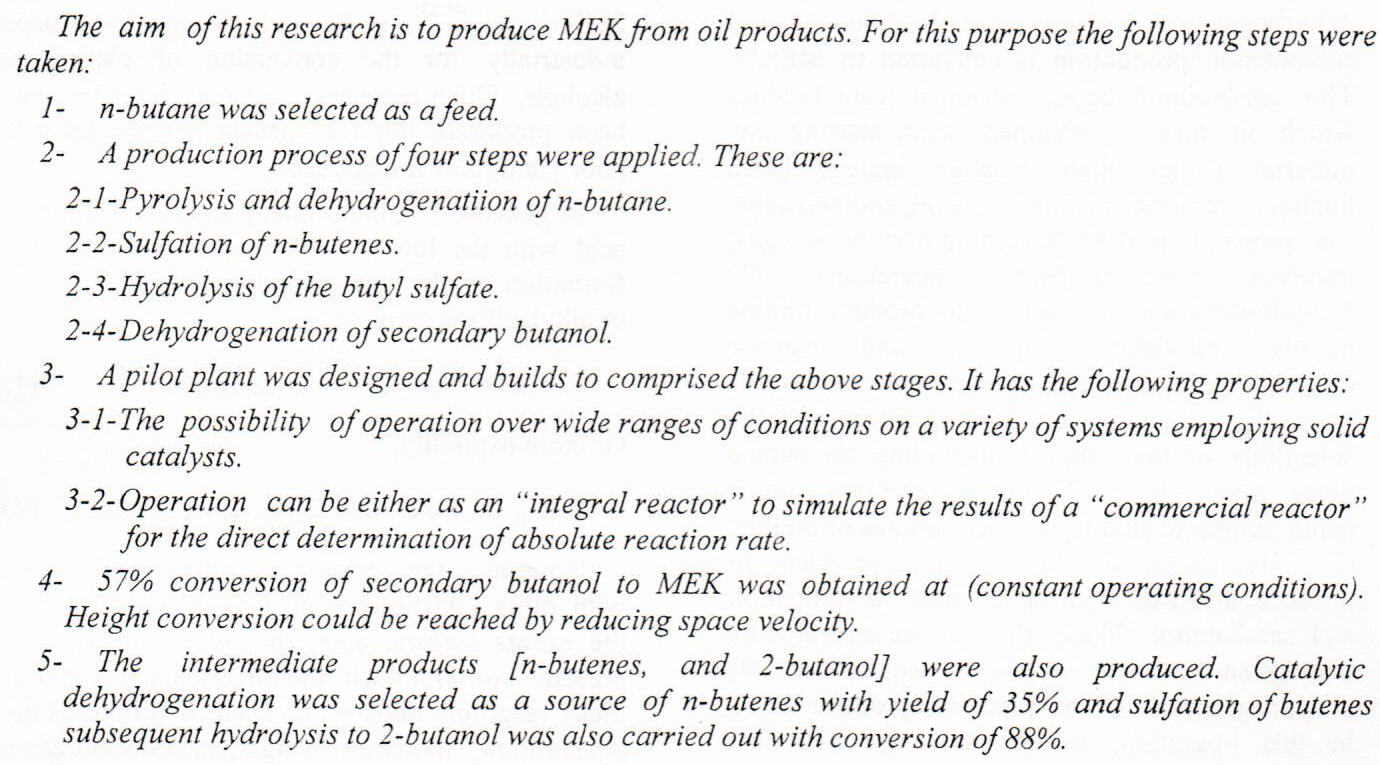
Production of Methyl Ethyl Ketone from N-Butane

Sixty four local isolated of Klebsiella spp. have been isolated from environment samples (soil and water). These isolates were identified and diagnosis according to phenotype and biochemical tests. These isolates were subjected to primary and secondary screening, to select the isolate with the highest laccase activity. Fifteen isolates chosen from primary screening for screening their enzyme activity in secondary screening. It has been found the Klebsiella(K7) has the highest productivity of the enzyme (12 Unit/ml).Klebsiella(K7) isolate was diagnosis by Vitak 2 system, it was identified asK. pneumonia. The laccase purified was characterization, the experiments showed that: The molecular weight of laccase was 120KD and the optimum pH for th
... Show More
Bacteria strain H7, which produces flocculating substances, was isolated from the soil of corn field at the College of Agriculture in Abu-Ghrib/Iraq, and identified as Bacillus subtilis by its biochemical /physiological characteristics. The biochemical analysis of the partially purified bioflocculant revealed that it was a proteoglycan composed of 93.2 % carbohydrate and 6.1 % protein. The effects of bioflocculant dosage, temperature, pH, and different salts on the flocculation activity were evaluated. The maximum flocculation activity was observed at an optimum bioflocculant dosage of 0.2 mL /10 mL (49.6%). The bioflocculant had strong thermal stability within the range of 30-80 °C, and the flocculating activity was over 50 %. The biofloc
... Show MoreIn this study, nickel cobaltite (NC) nanoparticles were created using the sol-gel process and used as an adsorbent to adsorb methyl green dye (MG) from aqueous solutions. The adequate preparation of nickel cobaltite nanoparticles was verified using FT-IR, SEM, and X-ray diffraction (XRD) studies. The crystalline particle size of NC nanoparticles was 10.53 nm. The effects of a number of experimental variables, such as temperature, adsorbent dosage, and contact time, were examined. The optimal contact time and adsorbent dosage were 120 minutes and 4.5 mg/L, respectively. Four kinetic models—an intraparticle diffusion, a pseudo-first-order equation, a pseudo-second-order equation, and the Boyd equation—were employed to monitor the adsorpti
... Show MoreBacteria could produce bacterial nanocellulose through a procedure steps: polymerization and crystallization, that occur in the cytoplasm of the bacteria, the residues of glucose polymerize to (β-1,4) lineal glucan chains that produced from bacterial cell extracellularly, these lineal glucan are converted to microfbrils, after that these microfbrils collected together to shape very pure three dimensional pored net. It could be obtained a pure cellulose that created by some M.O, from the one of the active producer organism like Acetic acid bacteria (AAB), that it is a gram -ve, motile and live in aerobic condition. The bacterial nanocellulose (BNC) have great consideration in many fields because of its flexible properties, features
... Show More
 (27)
(27)

Saccharomyces Cerevisiae cells were immobilized in calcium alginate beads and activated charcoal for use in the
production of ethanol from batch fermentation of sugar beet waste. Treatment of the waste with NaOH to increase the
ability of lignocellulose material to hydrolysis by acid (2N H2SO4) to monosaccharide and disaccharide (mainly glucos).
The high reducing sugar concentration obtained was equal to 9.2gm/100ml (10Brix) after treatment. Fermentation
parameters, are (pH, glucose concentration (2.5-25 gm/100ml), immobilized agent concentration (2.5-25 gm/100ml)
were studied to find the optimum physiological condition. And the highest ethanol concentration obtained from the
fermentation in the presence of 20%(wt/v) ca
Bis-anthraquinones with a unique molecular backbone, (+)-2,2’-epicytoskyrin A (epi) and (+)-1,1′-bislunatin (bis), was produced by endophytic fungi Diaporthe sp GNBP-10 associated with Gambir plant (Uncaria gambier). Epi and bis possess robust antimicrobial activity toward various pathogens. This study focus on knowing the optimum condition of epi and bis production from Diaporthe sp GNBP-10. A series of culture media with various nutrient compositions was investigated in epi and bis production. The content of epi and bis was determined by measuring the area under the curve from TLC-densitometric (scanner) experiment. The linear regression analysis was then applied to obtain the results. The optimi
... Show More
(1)
 (1)
(1)
The present work concerns with simulating unsteady state equilibrium model for production of methyl oleate (biodiesel) from reaction of oleic acid with methanol using sulfuric acid as a catalyst in batch reactive distillation. MESHR equations of equilibrium model were solved using MATLAB (R2010a). The validity of simulation model was tested by comparing the simulation results with a data available in literature. UNIQUAC liquid phase activity coefficient model is the most appropriate model to describe the non-ideality of OLAC-MEOH-MEOL-H2O system. The chemical reactions rates results from EQ model indicating the rates are controlled by chemical kinetics. Several variables was studied such as molar ratio of methanol to oleic acid 4:1, 6:1
... Show More