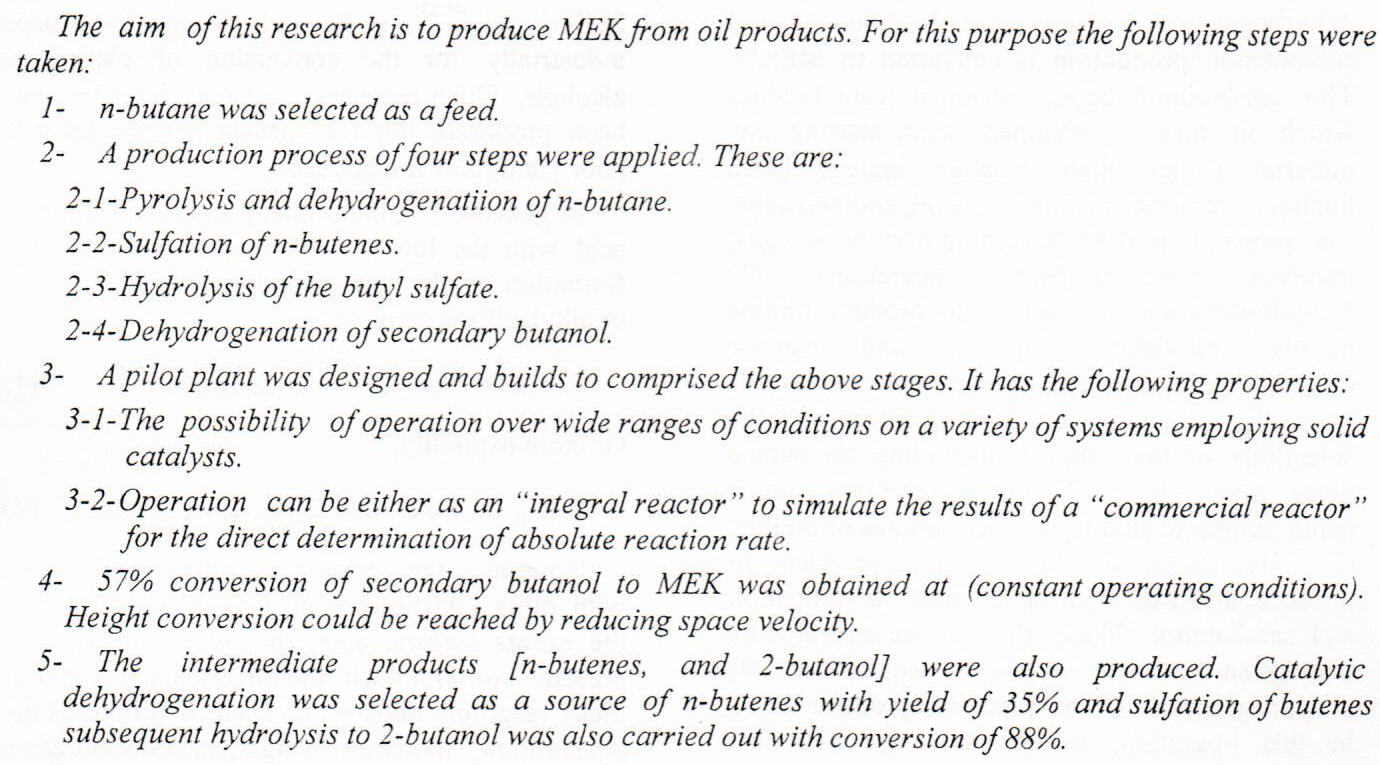
Production of Methyl Ethyl Ketone from N-Butane

In the present study, 1-ethyl -3-methyllimidazolium acetate ionic liquid is introduced for extractive desulfurization of Iraqi kerosene (1622ppm) and compared with 1-ethyl -3- methyllimidazolium tetrafloroborate. The effect of ionic liquid/ fuel ratio (1/9, 1/4, 1/2), temperature (25, 30,40oC), stirring speed (300,450rpm) and time (10, 30, 90, 180, 360 min) were studied. Sulfur compound analysis was performed using X-Ray fluorescence. The ionic liquid with acetate anion (OAc) showed better performance than tetrafloborate (BF4). The maximum extraction efficiency was 32% achieved at 1/2 IL/Fuel and 40oC after 90min. The oxidation step using hydrogen peroxide (8ml/200ml), catalyzed by acetic acid (2ml) and followed by ionic liquid extraction h
... Show More (7)
(7)
 (3)
(3)


Morus alba, member of the Moraceae family, is a perennial tree utilized in folk medicine, preparing the modern drug, and considered the main food for silkworms. However, data on chemical content in the leaves is still limited; the main objective of this study is to detect the presence and determine the concentration of different polyphenolic constituents in the leaves of the Morus alba plant by reverse phase-high performance liquid chromatography (RP-HPLC) and evaluate the cytotoxic effect of ethyl acetate extract of this plant on human breast cancer (AMJ-13) cell line. Phytochemical analysis of the Morus alba leaves ethyl acetate extract led to identifying and quantification of six polyphenolic constituents designated as phenolic a
... Show More
(7)
Five Saccharomyces cerevisiae isolated from the ability of chitinase production from the isolates were studied. Quantitative screening appeared that Saccharomyces cerevisiae S4 was the highest chitinase producer specific activity 1.9 unit/mg protein. The yeast was culture in liquid and solid state fermentation media (SSF). Different plant obstanases were used for (SSF) with the chitine, while liquid media contained chitine with the diffrented nitrogen source. The favorable condition for chitinase producers were incubated at 30 ºC at pH 6 and 1% colloidal chitine.
Pyrolysis of virgin polyethylene plastics was studied in order to produce hydrocarbon liquid fuel. The pyrolysis process carried out for low and high-density polyethylene plastics in open system batch reactor in temperature range of 370 to 450°C.
Thermo-gravimetric analysis of the virgin plastics showed that the degradation ranges were between 326 and 495 °C. The results showed that the optimum temperature range of pyrolysis of polyethylene plastics that gives highest liquid yield (with specific gravity between 0.7844 and 0.7865) was 390 to 410 °C with reaction time of about 35 minutes. Fourier Transform Infrared spectroscopy gave a quite evidence that the produced hydrocarbon liquid fuel consisted ma
... Show More
(22)
(12)
In this study, Zizphus spina-christi leaf powder was applied for the adsorption of methyl orange. The effect of different operating parameters on the Batch Process adsorption was investigated such as solution pH (2-12), effect of contact time (0-60 min.), initial dye concentration (2-20 mg/L), effect of adsorbent dosage (0-4.5 g) and effect of temperature (20-50ᵒC). The results show a maximum removal rate and adsorption capacity (%R= 23.146, qe = 2.778 mg/g) at pH = 2 and equilibrium was reached at 40 min. The pseudo- second-order kinetics were found to be best fit for the removal process (R2 = 0.997). Different isotherm models (Langmuir, Freundlich, Dubini-Radushkevich,Temkin) were applied in this stud
... Show More
(4)
(1)
A new copolymer (MFA) was prepared from condensation of melamine (M) with p- methyl – anisole (A) in the presence of condensation agent like 37% (w/v) of formaldehyde. The new copolymer was characterized by elemental, IR and HNMR spectra. The chelating ion-exchange property of this polymer was studied for methylene blue dye in aqueous solution in 100-200ppm concentrations. The adsorption study was carried out over a wide range of pH, shaking time and in media of various kinetic parameters models. Thermal parameters like enthalpy, entropy and Gibbs free energy of adsorption process of methylene blue on surface of MFA resin were determined on the basis of kinetic parameters at different temperatures. To describe the equilibrium of adsorp
... Show More
(1)
(74)
(72)
