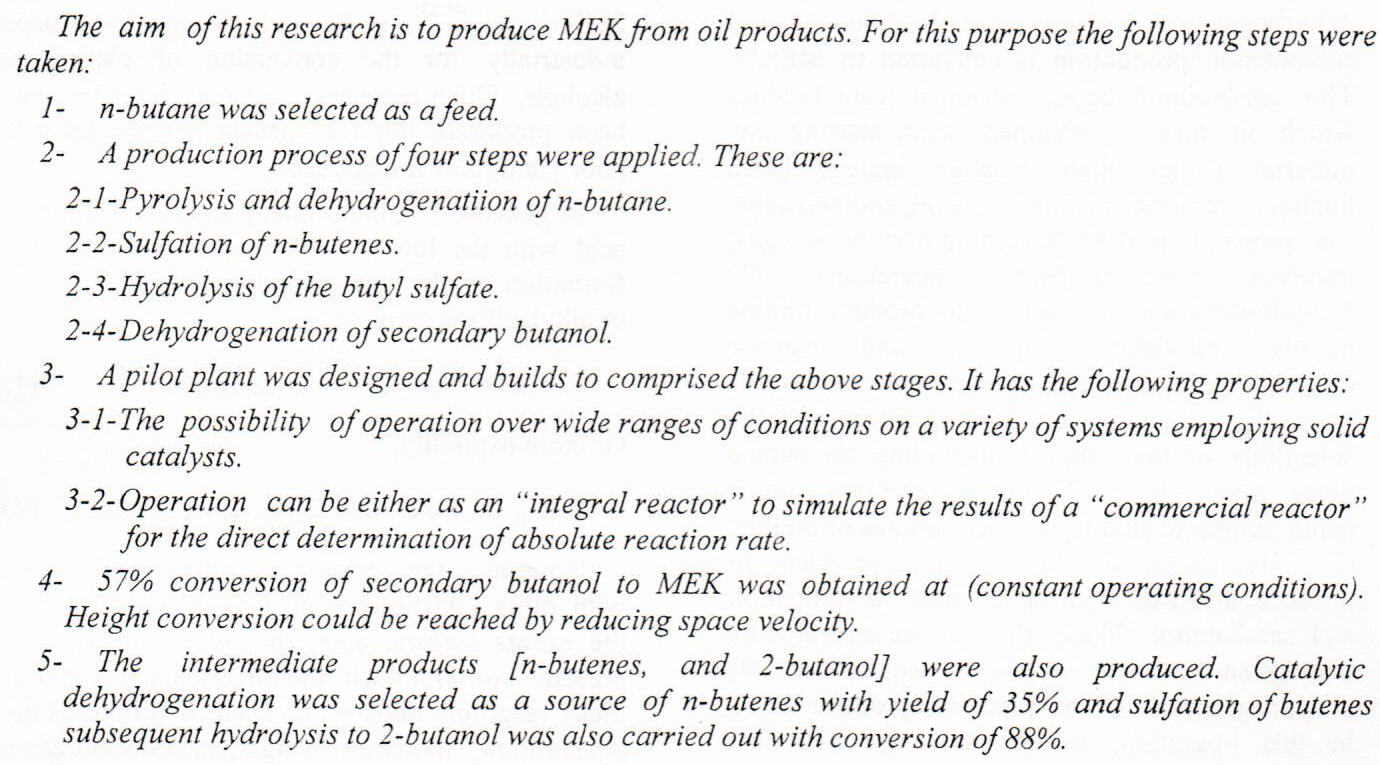
Production of Methyl Ethyl Ketone from N-Butane

Background: Heat-cured poly (methyl methacrylate) the principal material for the fabrication of denture base have a relatively poor mechanical properties. The aim of this study was to investigate the effect of glass flakes used as reinforcement on the surface hardness and surface roughness of the heat-processed acrylic resin material. Material and method: Glass flakes (product code: GF002) pretreated with silane coupling agent were added to Triplex® denture base powder using different concentrations. A total of 100 specimens of similar dimensions (65 x 10 x 2.5) mm were prepared, subdivided into 2 main groups of 50 specimens for each of the study tests. Ten specimens for the control group and 40 specimens for each of the experimental gro
... Show MoreBackground: Polymethylmethacrylate (PMMA) has relatively unsatisfactory mechanical properties such as low flexural strength and impact strength also dimensional instability. Material and method: Zirconium silicate nanoparticles were coated with a layer of trimethoxysilylpropylmethacrylate (TMSPM) before sonication in monomer (MMA) with the percentages 1% and 1.5% by weight then mixed with powder using conventional procedure, (150) samples were prepared and divided into three groups, each group consisted of (50) samples, the first group prepared from PMMA without addition (control), another group with the addition of 1% wt Zrsio4 nanoparticles (experimental) and the third one with 1.5% wt Zrsio4 nanoparticles (experimental). Each group
... Show MoreEuropean Chemical Bulletin (ISSN 2063-5346) is a peer-reviewed journal that publishes original research papers, short communications, and review articles in all areas of chemistry. European Chemical Bulletin has eight sections, namely
This study deals with the elimination of methyl orange (MO) from an aqueous solution by utilizing the 3D electroFenton process in a batch reactor with an anode of porous graphite and a cathode of copper foam in the presence of granular activated carbon (GAC) as a third pole, besides, employing response surface methodology (RSM) in combination with Box-Behnk Design (BBD) for studying the effects of operational conditions, such as current density (3–8 mA/cm2), electrolysis time (10–20 min), and the amount of GAC (1–3 g) on the removal efficiency beside to their interaction. The model was veiled since the value of R2 was high (>0.98) and the current density had the greatest influence on the response. The best removal efficiency (MO Re%)
... Show More (5)
(5)
 (4)
(4)


Two simple methods for the determination of eugenol were developed. The first depends on the oxidative coupling of eugenol with p-amino-N,N-dimethylaniline (PADA) in the presence of K3[Fe(CN)6]. A linear regression calibration plot for eugenol was constructed at 600 nm, within a concentration range of 0.25-2.50 μg.mL–1 and a correlation coefficient (r) value of 0.9988. The limits of detection (LOD) and quantitation (LOQ) were 0.086 and 0.284 μg.mL–1, respectively. The second method is based on the dispersive liquid-liquid microextraction of the derivatized oxidative coupling product of eugenol with PADA. Under the optimized extraction procedure, the extracted colored product was determined spectrophotometrically at 618 nm. A l
... Show More
(5)
(6)

M(II) Ions using amino acid L- proline as a primary ligand and either Nicotinamide or 8- hydroxyqinoline as secondary ligand, respectively: a. The mixed ligand complexes of composition,[M(pro)2(na)2]. b. The mixed ligand complexes of composition , Na[M(pro)2(Q)]. Where proline (C5H9NO2) symbolized as pro H , Nicotinamide (C6H6N2O) symbolized as (NA) , 8- hydroxyqinoline, (C9H7NO2) symbolized as (8-HQ). The ligands and the metal chlorides were brought into reaction at room temperature (37ºc) in ethanol as solvent .The reaction required the following molar ratios [(1:2:2) metal:2NA:2pro-] and [(1:1:2) metal:Q:2pro-] with M+2 ions, where M = [Mn (II), Co(II), Ni(II), Cu(II), Zn(II), Cd(II) and pd(II)]. Products were found to be solid crystall
... Show More
(2)
(1)
A simple indirect spectrophotometric method for determination of mebendazol in pure and pharmaceutical formulation was presented in this study. UV-Visible spectrophotometry using the optimal conditions was developed for determination of mebendazole in pure drug and different preparation samples. The method is based on the oxidation of drug by nbromosuccinimide with hydrochloric acid and the left amount of oxidizing agent was determined by the reaction with tartarazine and the absorbance was measured at 428 nm. Calibration curves were linear in the range of 5 to 30 µg.mL-1 with molar absorptivity 8437.2 L.mol-1 .cm-1 . The limits of detection and quantification were determined and found to be 0.7770 µg.mL-1 and 2.3400 µg.mL-1 respec
... Show More