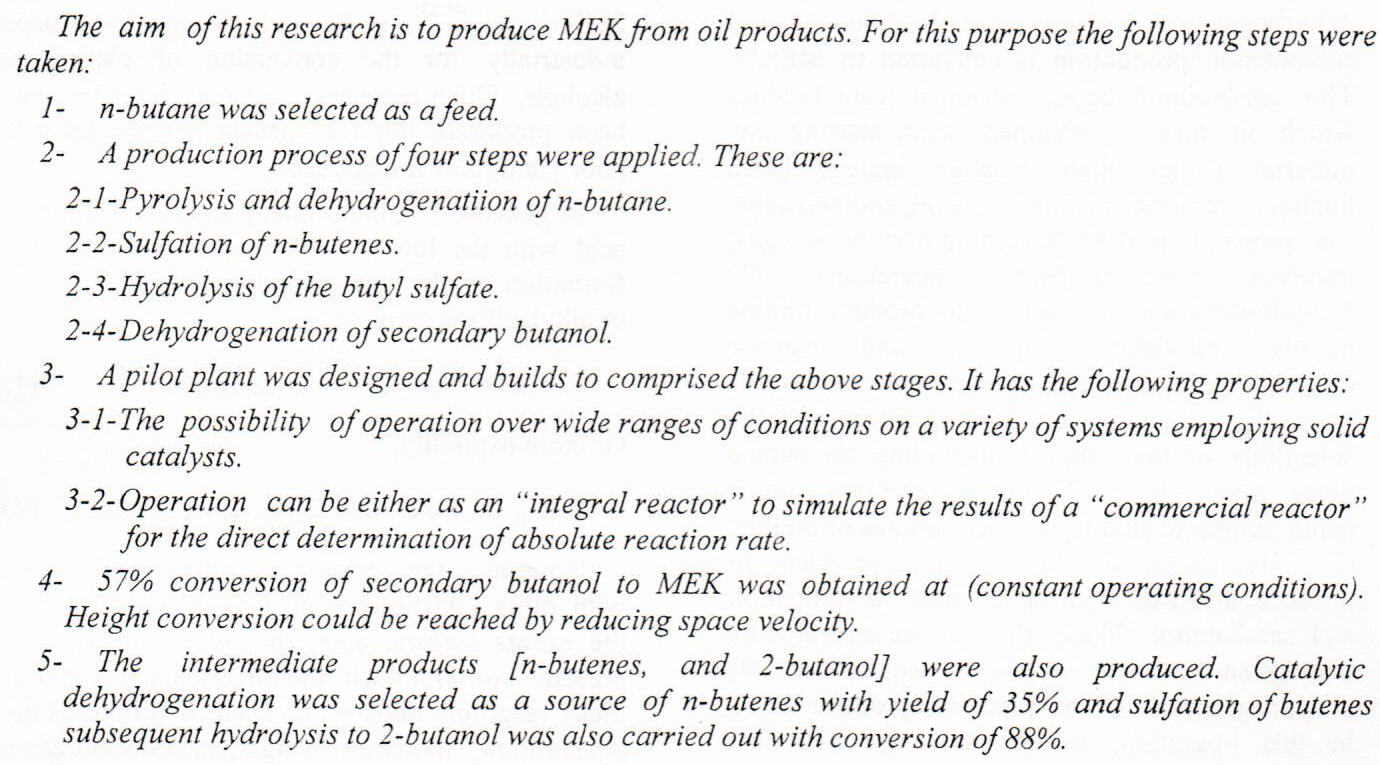
Production of Methyl Ethyl Ketone from N-Butane

This study was conducted to determine the effects of concentration of hydrochloric acids, temperature, and time on the hydrolysis of soya proteins (defatted soya flour) by determining the value of total protein nitrogen concentration, and amino nitrogen concentration of protein, peptides, and amino acids, and then calculated the hydrolysis rate of proteins.
The variables of the conditions of hydrolysis process was achieved in this study with the following range value of tests parameter:
In the present study, cytogenetic and molecular techniques were conducted to detect the chromosomal aneuploidy and the involvement of N and H genes in squamous larynx carcinoma cell line Hep-2.Our results showed that numerical and structural abnormalities were involved in larynx cancer Hep-2.The total number of chromosomes ranging from tripolyploidy in passage187to more than that in passage207.The more frequent chromosomes involved in numerical aberrations were chromosomes1,7,16,17 and 18. Structural chromosomal aberrations were also detected.Deletion of short arm was detected in chromosome 1(del 1p) and the long arm of chromosome 1(del 1q)and 6(del 6q).Gaining on short arms were also recorded in chromosomes 3(3p+) and 12(12p+).At the mole
... Show More
Photodetector based on Rutile and Anatase TiO2 nanostructures/n-Si Heterojunction
In this paper a new method is proposed to perform the N-Radon orthogonal frequency division multiplexing (OFDM), which are equivalent to 4-quadrature amplitude modulation (QAM), 16-QAM, 64-QAM, 256-QAM, ... etc. in spectral efficiency. This non conventional method is proposed in order to reduce the constellation energy and increase spectral efficiency. The proposed method gives a significant improvement in Bit Error Rate performance, and keeps bandwidth efficiency and spectrum shape as good as conventional Fast Fourier Transform based OFDM. The new structure was tested and compared with conventional OFDM for Additive White Gaussian Noise, flat, and multi-path selective fading channels. Simulation tests were generated for different channels
... Show More (4)
(4)
 (4)
(4)


Refuse derived fuel (RDF) is considered one of the most important types of low cost thermal energy which can be tapped in the industry, especially the cement industry in particular being the need of high thermal energy during the production processes, and in this paper we have implemented the use of a derivative of the fuel RDF as a substitute for gasoline , to reduce production costs and thereby achieve production efficiency, and the methodology used in this research statistical analysis as well as the use of the cost of kaizen target for the purpose of reducing costs and achieve production efficiency, and this has reduced the cost total cement production by which led to reduce total costs of cement production by 8.4% and an incre
... Show More
Due to the increase in the number of the satellite channels which resulted from the satellite broadcasting, the demand for the television drama production has increased dramatically, and there has been a significant competitive market, which encouraged the producers to adopt many carrots among them the inclusion of TV series large scenes whose main purpose is to show the volume of the production in the series, let alone achieving the dramatic function. The researcher called this type of scenes (the productive scenes), a name which has not been used before. The researcher studied these scenes and determined his research subject under the title (the production scenes in the TV series) where the research problem has been determined through
... Show More
Abstract
Oil is the most important natural resources in Iraq and represents the goal to others as well as Iraqi people. It is gift from God to all Iraqi people now and future. So we must maintain it and invest its revenue that achieve development in country and ensure the next generations' rights in it without external costs or negative externalities from extracted and invested it.
The most problems that we attempt to solve by this research are the exhausted, environmental degradation and theft from next generation that produced with oil contracts between Iraq and foreign companies. From here was th
... Show More
(15)
(6)
The aim of this study was to increasing natural carotenoides production by a locally isolate Rodotorula mucilagenosa M. by determination of the optimal conditions for growth and production of this agents, for encouragest to use it in food application permute artificial pigments which harmfull for consumer health and envieronmental. The optimal condition of carotenoides production from Rhodotorula mucilaginosa M were studied. The results shows the best carbon and nitrogen source were glucose and yeast extract. The carotenoids a mount production was 47430 microgram ̸ litter and 47460 microgram ̸ litter, respectively, and the optimum temperature was 30°C, PH 6, that the carotenoides a mount was 47470 microgram ̸ litter and 47670 microgr
... Show More