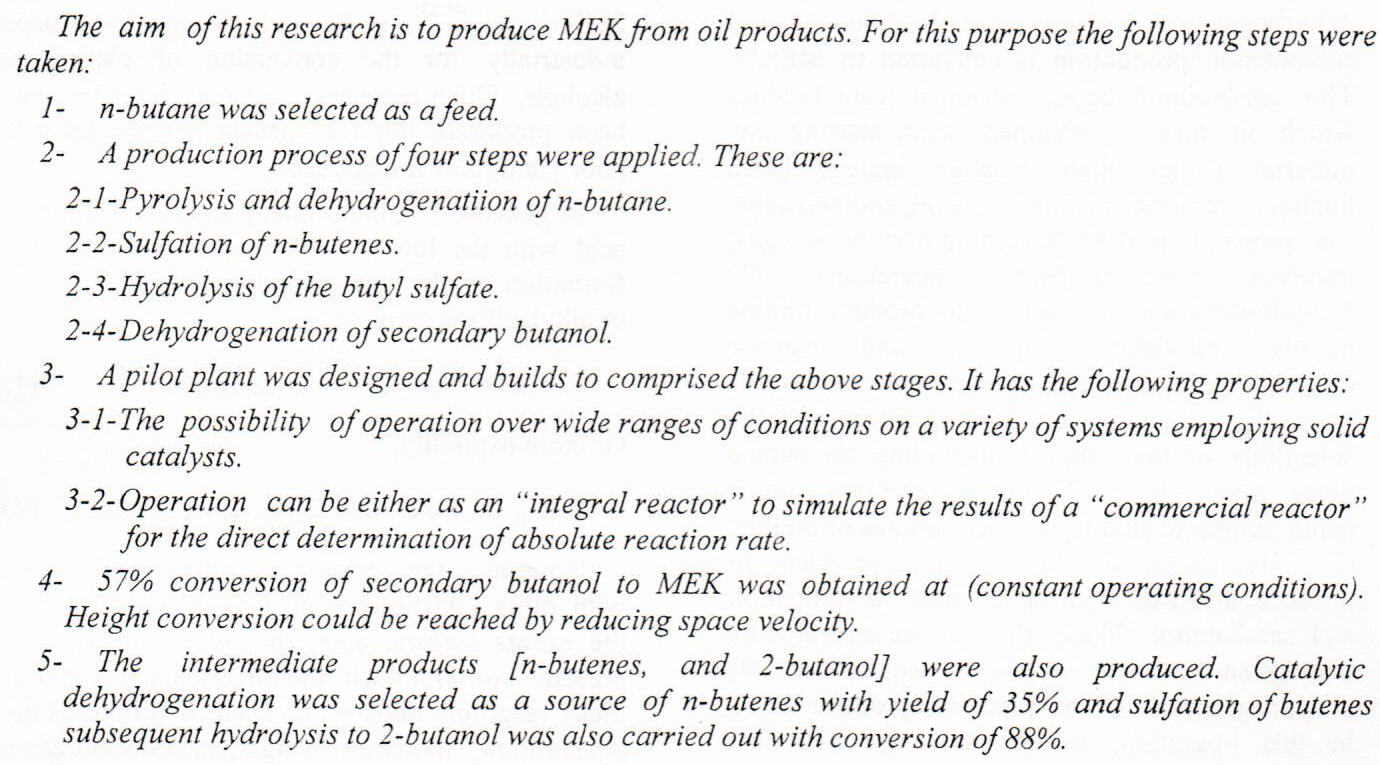
Production of Methyl Ethyl Ketone from N-Butane

Biodiesel define as the mono-alkyl esters of vegetable oil and animal fats is an alternative diesel fuel that is steadily gaining attention because the combustion of fossil fuels such as coal, oil and natural gas has been identify as a major cause of the increase in the concentration of carbon dioxide in the earth’s atmosphere and causing global warming.
The present work concerns with estimating the physical properties experimentally such as kinematic viscosity, density, flash point and carbon residue of biodiesel that produced by the esterification reaction of methanol and oleic acid with homogeneous catalysts H2SO4 in a lab-scale packed reactive distillation column using the best operating conditions of methanol to oleic acid 8:1,
Modified unsaturated polyester (MUPE) was blended with Cellulose (Cls) and with ethyl cellulose (ECls) at ambient conditions in the presence of ethyl methyl ketone peroxide (EMKP) as hardener. The blends containing different weight percentages (5-25 %) of Cls or ECls. Mechanical properties (impact strength, hardness, and bending) and dielectric constant were determined. The results observed that Cls increases the impact strength, hardness, and dielectric constant and decreases the bending of the MUPS, while ECls causes an increase in the three mechanical behaviours and a decrease in the dielectric constant of the MU-PS.
 (11)
(11)
 (2)
(2)



In this paper a stirred-bed performed of the copper catalyzed synthesis of ethylchlorosilanes from silicon and ethyl chloride was described. A Si-catalyst mixture prepared by reaction of CuCl and Si was employed. The compositions of products were mainly ethyltrichlorosilane, diethyldichlorosilane, and ethyldichlorosilane and mainly depended on the extent of Cu in the mixture and the reaction temperature. A promoting effect on the extent of adsorption was observed on the addition of certain additives. The kinetic data revealed the direct depended of the reaction rate on C2H5Cl pressure.
In this paper, we introduce the concept of fuzzy n-fold KUideal in KU-algebras, which is a generalization of fuzzy KU-ideal of KUalgebras and we obtain a few properties that is similar to the properties of fuzzy KU-ideal in KU-algebras, see [8]. Furthermore, we construct some algorithms for folding theory applied to KU-ideals in KU-algebras.
The optimum conditions for the production of neutral protease from local strain Aspergillus niger var carbonarius by solid – state fermentation system (Wheat bran) moisted with 0.2 M phosphate buffer (PH7.0) . the hydration ratio was 1:5 (V:W) . the concentration of inoculum was 1×10⁶ spores per 10 gram of solid materials , initial P H 6.5 and 96 hours of incubation period at 30? C .the enzyme activity was 1300 unit / ml and specific activity was 1550 unit / mg protein .
(2)
(6)
(3)
Biodiesel is an environmentally friendly fuel and a good substitution for the fossil fuel. However, the purity of this fuel is a major concern that challenges researchers. In this study, a calcium oxide based catalyst has been prepared from local waste eggshells by the calcination method and tested in production biodiesel. The eggshells were powdered and calcined at different temperatures (700, 750, 800, 850 and 900 °C) and periods of time (1, 2, 3, 4 and 5 hr.). The effect of calcination temperature and calcination time on the structure and activity of the solid catalyst were examined by X-ray Diffraction (XRD), Scanning Electron Microscopy (SEM), and Brunaure-Emmett-Teller (BET). The optimum catalyst performance was obtained at 900 °C
... Show More
(12)
Background: Poly-ether-ether-ketone(PEEK) has been introduced to many dental fields. Recently it was tested as a retainer wire‎ following orthodontic treatment. This study aimed to investigate the effect of changing the bonding spot size and location on the performance of PEEK retainer wires. Methods: A biomechanical study involving four three-dimensional finite element models was performed. The basic model was with a 0.8 mm cylindrical cross-section PEEK wire, bonded at the center of the lingual surface of the mandibular incisors with 4 mm in diameter composite spots. Two other models were designed with 3 mm and 5 mm composite sizes. The last model was created with the composite bonding spot of the canine away from the center of t
... Show More
(16)
(13)
Background: Poly-ether-ether-ketone(PEEK) has been introduced to many dental fields. Recently it was tested as a retainer wire‎ following orthodontic treatment. This study aimed to investigate the effect of changing the bonding spot size and location on the performance of PEEK retainer wires. Methods: A biomechanical study involving four three-dimensional finite element models was performed. The basic model was with a 0.8 mm cylindrical cross-section PEEK wire, bonded at the center of the lingual surface of the mandibular incisors with 4 mm in diameter composite spots. Two other models were designed with 3 mm and 5 mm composite sizes. The last model was created with the composite bonding spot of the canine away from the center
... Show More
(16)
(13)