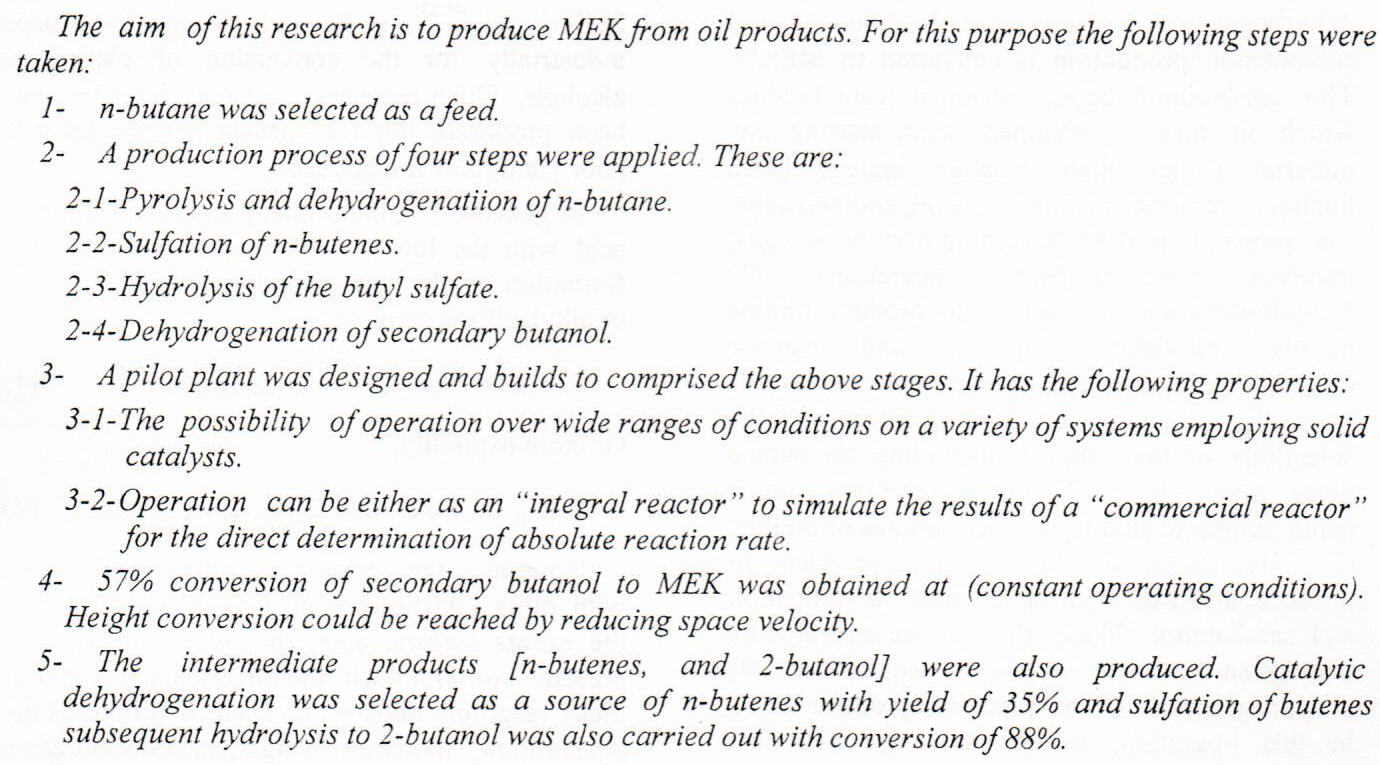
Production of Methyl Ethyl Ketone from N-Butane

Background: Pumpkin seeds are a valuable source of high-quality protein and can be utilized as functional food ingredients due to their properties, such as solubility, foam formation, and stability. This study aims to produce protein isolate and its enzymatic hydrolysates from local pumpkin seeds to study their properties. Methodology: Preparing defatted pumpkin seeds for protein extraction, followed by the enzymes’ hydrolysis using Trypsin and Pepsin enzymes separately and together in two methods. The determination of amino acids and the degree of hydrolysis was conducted; moreover, protein properties were studied, including solubility, emulsifying activity, stability index, foaming capacity, and stability. Results: A protein sample was
... Show More (3)
(3)
 (1)
(1)



Several toxigenic cyanobacteria produce the cyanotoxin (microcystin). Being a health and environmental hazard, screening of water sources for the presence of microcystin is increasingly becoming a recommended environmental procedure in many countries of the world. This study was conducted to assess the ability of freshwater cyanobacterial species Westiellopsis prolifica to produce microcystins in Iraqi freshwaters via using molecular and immunological tools. The toxigenicity of W. prolifica was compared via laboratory experiments with other dominant bloom-forming cyanobacteria isolated from the Tigris River: Microcystis aeruginosa, Chroococcus turigidus, Nostoc carneum, and Lyngbya sp. signifi
... Show More
(6)
In the current study, a direct method was used to create a new series of charge-transfer complexes of chemicals. In a good yield, new charge-transfer complexes were produced when different quinones reacted with acetonitrile as solvent in a 1:1 mole ratio with N-phenyl-3,4-selenadiazo benzophenone imine. By using analysis techniques like UV, IR, and 1H, 13C-NMR, every substance was recognized. The analysis's results matched the chemical structures proposed for the synthesized substances. Functional theory of density (DFT)
has been used to analyze the molecular structure of the produced Charge-Transfer Complexes, and the energy gap, HOMO surfaces, and LUMO surfaces have all been created throughout the geometry optimization process ut
(2)
The cost-effective carbon cross-linked Y zeolite nanocrystals composite (NYC) was prepared using an eco-friendly substrate prepared from bio-waste and organic adhesive at intermediate conditions. The green synthesis method dependent in this study assures using chemically harmless compounds to ensure homogeneous distribution of zeolite over porous carbon. The greenly prepared cross-linked composite was extensively characterized using Fourier transform infrared, nitrogen adsorption/desorption, Field emission scanning electron microscope, Dispersive analysis by X-ray, Thermogravimetric analysis, and X-ray diffraction. NYC had a surface area of 176.44 m2/g, and a pore volume of 0.0573 cm3/g. NYC had a multi-function nature, sustained at a long-
... Show More
(44)
This work comprises the synthesis of new phenoxazine derivatives containing N-substituted phenoxazine starting from phenoxazine (1). Synthesis of ethyl acetate phenoxazine (2) through the reaction of phenoxazine with ethylchloroacetate, which reacted with hydrazine hydrate to give 10-aceto hydrazide phenoxazine (3), then reacted with formic acid to give 10-[N-formyl acetohydrazide] phenoxazine (4). Reaction of compound (4) with phosphorous pentaoxide or phosphorus pentasulphide to gave 10-[N-methylene-1,3,4-oxadiazole] phenoxazine (5) and 10-[N-methylene-1,3,4-thiadiazole] phenoxazine (6).
The main purpose of this work is to introduce the concept of higher N-derivation and study this concept into 2-torsion free prime ring we proved that:Let R be a prime ring of char. 2, U be a Jordan ideal of R and be a higher N-derivation of R, then , for all u U , r R , n N .
The primary purpose of this paper is to introduce the, N-coprobabilistic normed space, coprobabilistic dual space of N-coprobabilistic normed space and give some facts that are related of them.
The present study aims to detection optimal conditions of production of amylase enzyme from isolate of B. subtillis A4. Nine carbonic sources were represented by starch, maltose, fructose, sucrose, glucose, arabinose, xylose, sorbitol and mannitol) at concentration of 1% for each source. It was found that the best was represented by starch carbonic, which showed higher activity and qualitative activity of 7.647 Unit/ ml and 461.56 Unit/ mg. Ten nitrogen sources were selected, including yeast extract, peptone, trypton, gelatin, urea and meat extract as organic sources Ammonium sulphate, Sodium nitrate, Potassium nitrate and Ammonium chloride as inorganic sources. These sources were added at aconcentration of 0.5% to the production medium. Th
... Show More
(2)