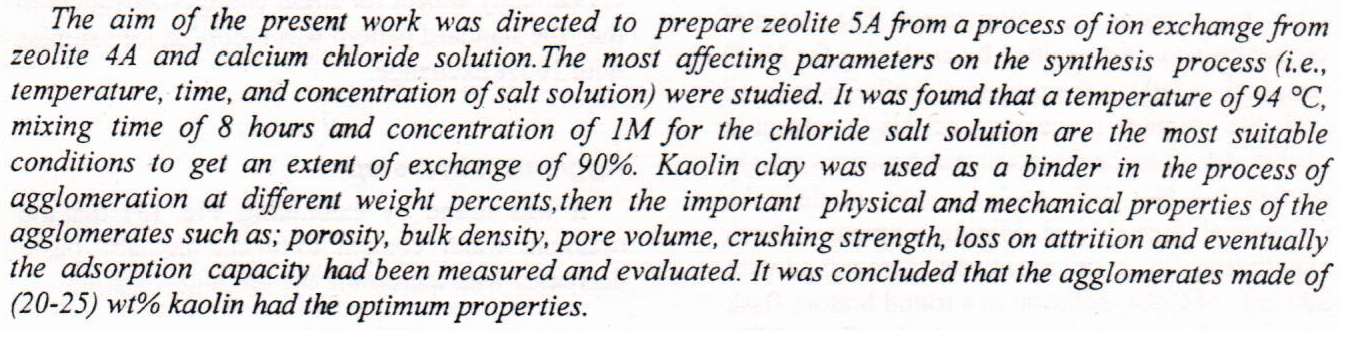
Preparation and Agglomeration of Zeolite 5A from Locally Available Raw Materials

Abstract
In the present study, composites were prepared by Hand lay-up molding. The composites constituents were epoxy resin as a matrix, 6% volume fractions of glass fibers (G.F) as reinforcement and 3%, 6% volume fractions of preparation natural material (Rice Husk Ash, Carrot Powder, and Sawdust) as filler. Studied the erosion wear behavior and coating by natural wastes (Rice Husk Ash) with epoxy resin after erosion. The results showed the non – reinforced epoxy have lower resistance erosion than natural based material composites and the specimen (Epoxy+6%glass fiber+6%RHA) has higher resistance erosion than composites reinforced with carrot powder and sawdust at 30cm , angle 60
... Show MoreA novel ligand, (E)-5-((2-hydroxy-4,6-dimethylphenyl)diazenyl)-2,3-dihydrophthalazine-1,4- dione, was synthesized through the reaction of 3,5-dimethylphenol with the diazonium salt of 5-amino-2,3-dihydrophthalazine-1,4-dione. The ligand underwent characterization through the utilization of diverse spectroscopic methods, including UV-Vis, FT-IR, 13C, and 1H-NMR, alongside Mass spectroscopy and micro elemental analysis (Carbon, Hydrogen, Nitrogen, and Oxygen). Metal chelates of transition metals were prepared and analyzed using elemental analysis, mass spectra, atomic absorption, UV-Vis, FT-IR spectral analysis, as well as conductivity and magnetic measurements. The investigation into the compounds’ nature was conducted by utilizing mole r
... Show MorePoly (viny1 alcohol) (PVA) of 72000 g mol -1 molar mass was cross linked through cold cast esterification with different mol % of MA and EDTA (10 % , 20 % and 30 % ), and two different mol % mixture of MA l EDTA (20 %/5% and 20%/10% .
Background: Ceramic veneers represent the treatment of choice in minimally invasive esthetic dentistry; one of the critical factors in their long term success is marginal adaptation. The aim of the present study is to evaluate the marginal gap of ceramic veneers by using two different fabrication techniques and two different designs of preparation. Material and methods: A typodont maxillary central incisor used in the preparation from which metal dies were fabricated, which were in turn used to make forty stone dies. The dies divided into four experimental groups, each group had ten samples: A1: prepared with butt-joint incisal reduction and restored with IPS e.max CAD, A2: prepared with overlapped incisal reduction and restored with IPS e.
... Show MoreSpin coating technique has been applied in this work to prepared Xerogel films doped with Rhodamine 6G laser dyes. The solid host of laser dye modifies its spectroscopic properties with respect to liquid host. During the spin coating process the dye molecules suffer from changing their environment. The effects of three parameters were studied here: the spinning speed, multilayer coating and formaldehyde addition
Silver selenide telluride Semiconducting (Ag2Se0.8Te0.2) thin films were by thermal evaporation at RT with thickness350 nm at annealing temperatures (300, 348, 398, and 448) °K for 1 hour on glass substrates .using X-ray diffraction, the structural characteristics were calculated as a function of annealing temperatures with no preferential orientation along any plane. Atomic force microscopy (AFM) and X-ray techniques are used to analyze the Ag2SeTe thin films' physical makeup and properties. AFM techniques were used to analyze the surface morphology of the Ag2SeTe films, and the results showed that the values for average diameter, surface roughness, and grain size mutation increased with annealing temperature (116.36-171.02) nm The transm
... Show MoreBackground: The world is in front of two emerging problems being scarceness of virgin re-sources for bioactive materials and the gathering of waste production. Employment of the surplus waste in the mainstream production can resolve these problems. The current study aimed to prepare and characterize a natural composite CaO-SiO2 based bioactive material derived from naturally sustained raw materials. Then deposit this innovative novel bioactive coating composite materials overlying Yttria-stabilized tetragonal zirconia substrate. Mate-rials and method; Hen eggshell-derived calcium carbonate and rice husk-derived silica were extracted from natural resources to prepare the composite coating material. The manufac-tured powder was characterized
... Show More (10)
(10)
 (8)
(8)


Silver selenide telluride Semiconducting (Ag2Se0.8Te0.2) thin films were by thermal evaporation at RT with thickness350 nm at annealing temperatures (300, 348, 398, and 448) °K for 1 hour on glass substrates .using X-ray diffraction, the structural characteristics were calculated as a function of annealing temperatures with no preferential orientation along any plane. Atomic force microscopy (AFM) and X-ray techniques are used to analyze the Ag2SeTe thin films' physical makeup and properties. AFM techniques were used to analyze the surface morphology of the Ag2SeTe films, and the results showed that the values for average diameter, surface roughness, and grain size mutation increased with annealing temperature (116.36-171.02) nm The transm
... Show MoreThe mucilage was isolated from mustard seeds and identification by some different methods like, thermo gravimetric, FTlR., X-ray powdered, proton NMR, FTIR spectra of the three gums contain different functional group in the gums, major peaks bands noticed were belong to OH (3410.15 – 3010.88) group from hydroxyl group, CH aliphatic (2925-2343.51), C-O (1072.42-1060.85) group and C=O 1743.65, Thermo chemical parameters of mucilage was evaluated and compared with the standard gums, Results indicated the mucilage was decomposed in 392°C and mass loss 55%, The X ray process found the mucilage had single not sharp peak
... Show MoreA pulsed (TEA-0O2) laser was used to dissociate molecules of silane ethylene (C2I-14) and ammonia (NH3) gases, through collision assisted multiple photon dissociation (MPD) to deposit(SiC i_xNx) thin films, where the X-values are 0, 0.13 and 0.33, on glass substrate at T,----648 K. deposition rate of (0.416-0.833) nm/pulse and thickness of (500-1000)nm .Fourier transform infrared spectrometry (FT-IR) was used to study the nature of the chemical bonds that exist in the films. Results revealed that these films contain complex networks of the atomic (Si, C, and N), other a quantity of atomic hydrogen and chemical bonds such as (Si-N, C-N, C-14 and N-H).Absorbance and Transmittance spectra in the wavelength range (400-1100) nm were used to stud
... Show More