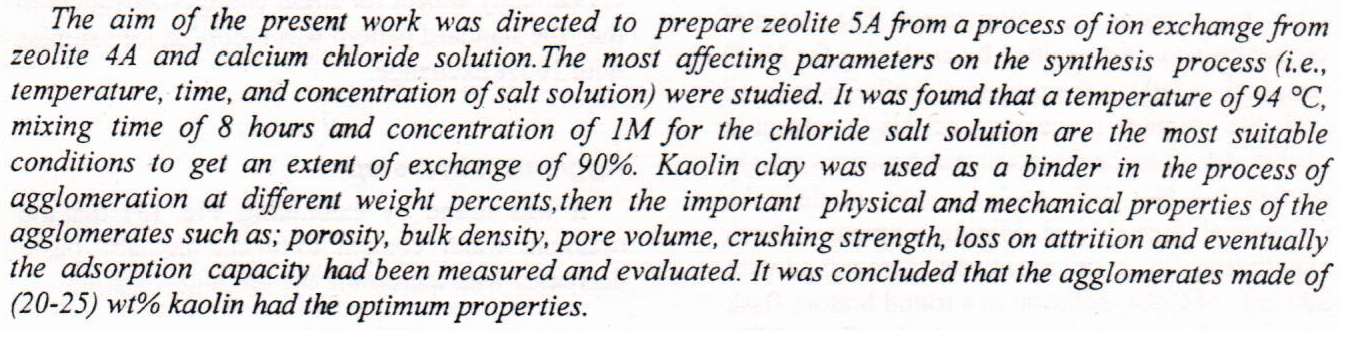
Preparation and Agglomeration of Zeolite 5A from Locally Available Raw Materials

Reactive Powder Concrete (RPC) can be incorporate as a one of the most important and progressive concrete technology. It is a special type of ultra-high strength concrete (UHSC) that’s exclude the coarse aggregate from its constitutive materials. In this research an experimental study had been carried out to investigate the effect of using three types of materials (porcelain aggregate) and others sustainable materials (glass waste and granular activated carbon) as a partial replacement of fine aggregate. Four percentages had considered (0, 10, 15 and 20) % to achieve better understanding for the influence of these materials upon the compressive strength of RPC. Four curing ages had included in this study, these are; 7, 28, 60 and
... Show More (7)
(7)
 (7)
(7)


Background: The geriatric patients wearing removable partial dentures are increasing in proportion. At the same time, the root caries prevalence accompanied by gingival recession is increasing. A variety of vehicles can deliver fluoride into the oral cavity, including fluoride mouth-rinse, fluoride dentifrice, topical fluoride, and fluoride-releasing restorative materials, all of which effectively prevent root caries and suppress recurrent caries. This study aimed to evaluate the effect of sodium fluoride addition on some mechanical properties of heat cure acrylic denture base material. Material and method: A total of 90 samples were prepared in this study, then divided into three main groups according to the type of test used (hardness, te
... Show MoreReactive Powder Concrete (RPC) can be incorporate as a one of the most important and progressive concrete technology. It is a special type of ultra-high strength concrete (UHSC) that’s exclude the coarse aggregate from its constitutive materials. In this research an experimental study had been carried out to investigate the effect of using three types of materials (porcelain aggregate) and others sustainable materials (glass waste and granular activated carbon) as a partial replacement of fine aggregate. Four percentages had considered (0, 10, 15 and 20) % to achieve better understanding for the influence of these materials upon the compressive strength of RPC. Four curing ages had included in this study, these are; 7, 28, 60 and
... Show More
(7)
Nanoparticle has pulled in expanding consideration with the developing enthusiasm for nanotechnology which hold potential as essential segments for development applications. In the present work, a copper nanoparticle is manufactured as a suspension in distilled water by beating a bulk copper target with laser source (532 nm wavelength, 10 ns pulse duration and 10 Hz repletion rate) via method. UV- visible absorption spectra and AFM analysis has been done to observe the effect of repetition rate for the pulsation of laser. Copper nanoparticles (Cu-NPs) were successfully synthesized with green color. The Cu- NPs have very high purity because the preparation was managed in aqueous media to eliminate ambient contaminations. Absorption
... Show More
(3)
Objective: To conduct a standardized method for cavity preparation on the palatal surface of rat maxillary molars and to introduce a standardized method for tooth correct alignment within the specimen during the wax embedding procedure to better detect cavity position within the examined slides. Materials and methods: Six male Wistar rats, aged 4-6 weeks, were used. The maxillary molars of three animals were sectioned in the frontal plane to identify the thickness of hard tissue on the palatal surface of the first molar which was (250-300µm). The end-cutting bur (with a cutting head diameter of 0.2mm) was suitable for preparing a dentinal cavity (70-80µm) depth. Cavity preparation was then performed using the same bur on the tooth surf
... Show More
(2)
(3)
Objective: To conduct a standardized method for cavity preparation on the palatal surface of rat maxillary molars and to introduce a standardized method for tooth correct alignment within the specimen during the wax embedding procedure to better detect cavity position within the examined slides. Materials and methods: Six male Wistar rats, aged 4-6 weeks, were used. The maxillary molars of three animals were sectioned in the frontal plane to identify the thickness of hard tissue on the palatal surface of the first molar which was (250-300µm). The end-cutting bur (with a cutting head diameter of 0.2mm) was suitable for preparing a dentinal cavity (70-80µm) depth. Cavity preparation was then performed using the same bur on the tooth
... Show More
(2)
(3)
In present work, new tetra-dentate ligand, titled 3,5-bis ((E)-5-Bromo-2-hydroxy benzylidene amino) benzoic acid (H3L), was prepared via an acid-catalyzed condensation process. New four metallic ligand complexes with Co(II), Ni(II), Cu(II) and Zn(II) ions, were also prepared from the refluxing of equivalent moles. Ligand's structure and its complexes; were confirmed by numerous characterization methods, including Ultraviolet-Visible, Infrared, Mass Spectrometer, 1H and 13C Nuclear Magnetic Resonance spectra, atomic absorption, magnetic moments, and molar conductivity measurements. The results of the spectroscopic analyzes proved that the prepared ligand acts as tetradentate bi-ionic ligand and it was bond
... Show More
(6)
(1)

For aspirin estimated, a molecularly imprinted polymer MIP-ASP electrodes were generated by electro-polymerization process, the electrodes were prepared by combining the template (aspirin) with (vinyl acetate (VA), 1-vinylimidizole (VIZ) as a functional monomer and N, N-methylene bisacrylamide (MBAA) as crosslinkers using benzoyl peroxide (BPO) as an initiator. The efficiency of the membrane electrodes was analyzed by differential pulse voltammetry (DPV). Four electrodes were synthesized using two different plasticizers, di-butyl sebacate (DBS), di-octyl phthalate (DOP) in PVC matrix. Scanning electron microscopy (SEM) was used to describe the generated MIP, studying the electrodes properties, the slope, detection limit, and life
... Show MoreThe aim of this work is to study the influence of the type of fiber glass –mat on fatigue behavior of composite material which is manufactured from polyester and E-glass (woven roving, chopped strand mat (CSM)) as a laminate with a constant fiber volume fraction (VF) of 33%. The results showed that the laminates reinforced with E-glass (woven roving) [0/90, ±45.0/90] and [0/90, CSM, 0/90] have lower fatigue strength than the laminates reinforced with E-glass [0/90]3,[CSM]3 and [CSM, 0/90, CSM] although they had different tensile strength; the best laminate was [0/90]3 .